
China+1 strategy India manufacturing
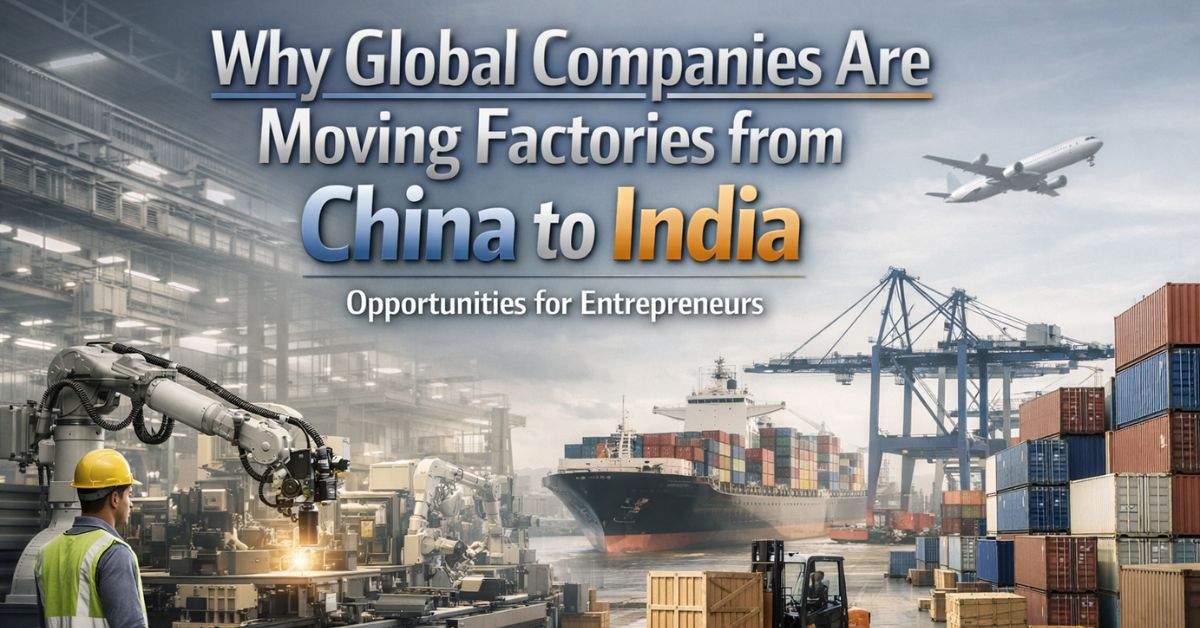
China has been known as the place where many factories are located. This is because China has labor costs, big supply chains, good ports and helpful government policies. However in years many companies around the world are looking for other options. India is becoming an attractive option. This trend is called the strategy. It is changing how global manufacturing works. Creating many opportunities for Indian entrepreneurs.
Understanding the Strategy
The China+1 strategy was first a backup plan. Companies wanted to spread out their manufacturing operations so they wouldn’t rely on one country. Over time it became an approach. Labor costs in China went up there were trade issues between the US and China and supply chains were disrupted during the COVID-19 pandemic. This showed how risky it is to rely on China.
The present situation brings India long-term advantages for its future development:
- Lower labor costs: Factory wages in India are between $150-250 per month compared to $500-700 per month in China.
- industrial land: Special industrial zones provide cheap land for big manufacturing.
- Government incentives: Programs like the Production Linked Incentive (PLI) scheme offer support for investment.
- workforce: India has a young technically skilled workforce ready to support global supply chains.
- Geopolitical risks: India provides a stable and predictable environment for foreign investment.
The combination of these elements creates an appealing business environment which benefits international companies when they seek to establish new operations in India.
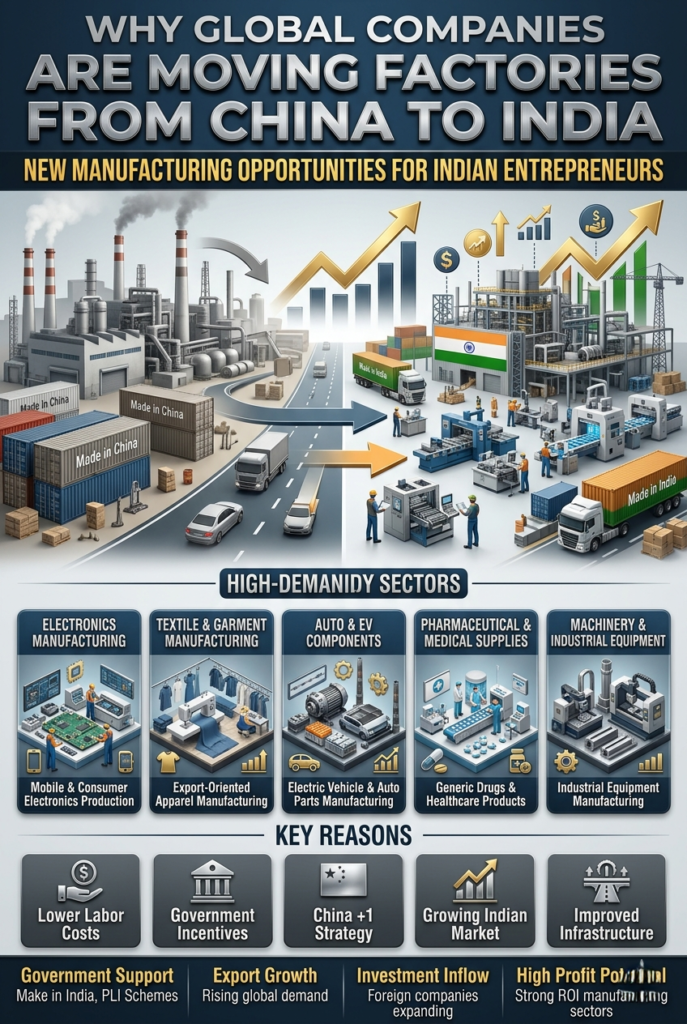
Sectors Benefiting from the Shift
The supply chain diversification efforts by businesses from China markets have resulted in rapid growth for certain sectors.(China+1 strategy India manufacturing)
Get Detailed Insights from This Book: Electronic Products Handbook With Circuit Diagrams
1. Electronics and Semiconductors
Indias electronics industry is booming. Apple has initiated iPhone production in India while entrepreneurs discover new business areas to explore:
- PCB fabrication
- Cable harness assembly
- Precision metal stamping
- Device casing production
2. Pharmaceuticals and Active Pharmaceutical Ingredients (APIs)
India provides 20 percent of the worlds supply of generic medications. The government launched Bulk Drug Parks and the PLI scheme for Pharmaceuticals. This enables medium enterprises to manufacture APIs and pharma intermediates domestically.
3. Textiles and Apparel
Indias rich cotton production and spinning and weaving clusters make it strong in textiles. Opportunities for entrepreneurs include:
- Technical textiles
- Medtech fabrics
- Protective workwear
4. Specialty Chemicals and Dyes
China dominates dye production but environmental restrictions have forced many plants to close. Indias industrial clusters in Gujarat are filling this gap. Small-scale chemical units can reach buyers.
5. Renewable Energy and Solar
India aims for 500 GW of capacity by 2030. This creates opportunities for entrepreneurs to manufacture cells, modules and associated components.(China+1 strategy India manufacturing)
Access Complete Business Plan: Solar Photovoltaics as a Renewable Energy Solution
India’s Cost Advantage for Global Manufacturing
The cost is a reason why companies are shifting from China to India. The comparison demonstrates that India maintains a competitive edge over its rivals:
Factor | India | China |
Monthly factory wages | $150–250 | $500–700 |
Industrial land costs | Moderate | High |
Corporate taxes | 15–22% (new companies) | 25% |
Government incentives | PLI, export support | Limited |
Geopolitical risk | Low | Higher |
India presents an attractive option for manufacturing projects because it offers businesses lower labor costs and affordable real estate and government funding programs.
Identify high-growth industries before others do
Lessons from Indian Industrial Leaders
Indian leaders teach entrepreneurs important business lessons through their leadership style:
- Dhirubhai Ambani (Reliance Industries): Invested of demand and built large-scale infrastructure.
- Kiran Mazumdar-Shaw (Biocon): Focused on specialization to create globally competitive exports.
- Narayana Murthy (Infosys): Demonstrated that scalable quality and compliance are critical for markets.
The study shows that success depends on three main components which include foresight and technical expertise and emphasis on quality.
Opportunities for New Entrepreneurs
First-generation entrepreneurs can enter the market through the China + 1 trend which activates new business opportunities. The process of secondary and sub-component production requires financial backing for establishment but it can grow swiftly. The industry offers various examples of this phenomenon:
- Cable harness units supplying electronics OEMs
- PCB fabrication for consumer electronics and EVs
- Precision tooling and packaging for pharma or chemicals
- scale API or specialty chemical manufacturing
Startups receive financial assistance and infrastructure resources through government programs.
How NIIR Project Consultancy Services (NPCS) Can Help
NIIR Project Consultancy services help entrepreneurs assess their manufacturing project needs through their evaluation and planning services:
- Market research and demand analysis
- Detailed Techno-Economic Feasibility Reports (DPRs)
- Process flow diagrams and product mix planning
- Machinery, raw material, and cost planning
- Financial modeling and profitability analysis
Entrepreneurs who work with NPCS can lower their investment risks while obtaining information about their project financial outcomes.
Related Article: 10 Best Business Books for Entrepreneurs in India (Startup Guide)
Conclusion
The China+1 manufacturing trend is real and accelerating. India emerges as a leading business location because it provides cost savings along with government support and skilled workers and bettering infrastructure. The market offers numerous business prospects which span across pharmaceutical and electronic and textile and chemical and renewable energy sectors.
First-generation entrepreneurs who use government schemes and professional advice from NPCS can establish export-capable businesses that will succeed in the current industrial transformation. The time to act is now because India will become the next global manufacturing powerhouse while entrepreneurs who take initiative will benefit from this opportunity.
Frequently Asked Questions (FAQs)
Is India ready to replace China as a manufacturing hub?
India may not replace China entirely, but it is capturing a growing share of global supply chains. Apple’s iPhone production in India, the growth of the semiconductor sector, and investments in Active Pharmaceutical Ingredients (APIs) are all examples of this.
Which states are best for specific manufacturing sectors?
Tamil Nadu is good at electronics, Gujarat is good at chemicals and pharmaceuticals, Maharashtra is known for auto parts, and Rajasthan is good at textiles.
Do I need large capital to participate?
Not necessarily. Many China+1 opportunities involve ancillary production, with investments ranging from ₹50 lakh to ₹3 crore.
Which government schemes are most useful?
he PLI scheme and the Semicon India program are both important for electronics. PLI Pharma and Bulk Drug Parks are good for the pharmaceutical and chemical industries. MUDRA loans, CGTMSE, and Udyam Registration all help MSMEs.
How can I assess financial viability?
A Detailed Project Report (DPR) models costs, revenue, working capital, and payback period. It is the most reliable tool to assess feasibility before investing.