India’s chemical and PCPIR petrochemical clusters industry has gradually developed into one of the most important strategic sectors of the manufacturing economy. Rather than operating only as a supplier to end-user industries (agriculture, pharmaceuticals, automobiles, textiles, and packaging), the sector is the industrial backbone of large-scale production and economic resiliency.
According to the Ministry of Chemicals & Fertilizers, the chemical industry is a major contributor to the manufacturing of Gross Value Added (GVA) and employs over 11 lakh persons in organized medium and large-scale industries. This scale of activity generates an active downstream ecosystem in which the MSMEs can thrive in the form of suppliers, converters and specialty manufacturers.
A major cause of this opportunity is the creation of Petroleum, Chemical and Petrochemical Investment Regions (PCPIRs).
Read More: The Complete Book on Distillation and Refining of Petroleum Products (Lubricants, Waxes and Petrochemicals)
What is a PCPIR and Why It Is Important for MSMEs
A PCPIR is a large, integrated industrial manufacturing zone that is specifically designed for chemical and petrochemical industries. Unlike the traditional industrial estates, PCPIRs are planned based on the anchor petrochemical projects and are supported by the common infrastructure.
Each PCPIR usually includes about 250 square kilometres of land with nearly 40% of land used for processing industries. For MSMEs to set up manufacturing facilities, this structure thus reduces to a great extent the capital burden on the entrepreneur.
The significant operational PCPIRs in India are Dahej PCPIR, Visakhapatnam-Kakinada PCPIR and Pradeep PCPIR.
Together, these clusters provide MSMEs a number of inbuilt advantages:
- Shared utilities – including power, steam, water and effluent treatment
- Port, rail and highway connectivity
- Less environmental compliance complexity
- Accelerated project commissioning schedules
Because of the existing infrastructure (core infrastructure), MSMEs can capitalise on production, quality and market development rather than backend systems.(PCPIR petrochemical clusters)
Why Manufacturing Based on PCPIR Is a Good Option for MSME
Import Substitution using Specialty Chemicals
India still relies on imports for some specialty and performance chemicals, particularly in pharmaceuticals, dyes and advanced materials. The benefit of PCPIRs is they can enable MSMEs to produce these products near large downstream consumers, leading to more reliable supply and margins.
High-demand segments are:
- Dye and pigment intermediates
- Pharmaceutical Chemical Intermediate
- Polymer additives / stabilizers
- Industrial and specialty solvents
The growth journey of Zydus Lifesciences on the leadership of Pankaj Patel illustrates how enterprises can scale by working from the bottom-up, with intermediates, and gradually progressing up the value chain. MSMEs can apply the same logic on a smaller, more concentrated scale.
Read More: Modern Technology of Industrial Chemicals
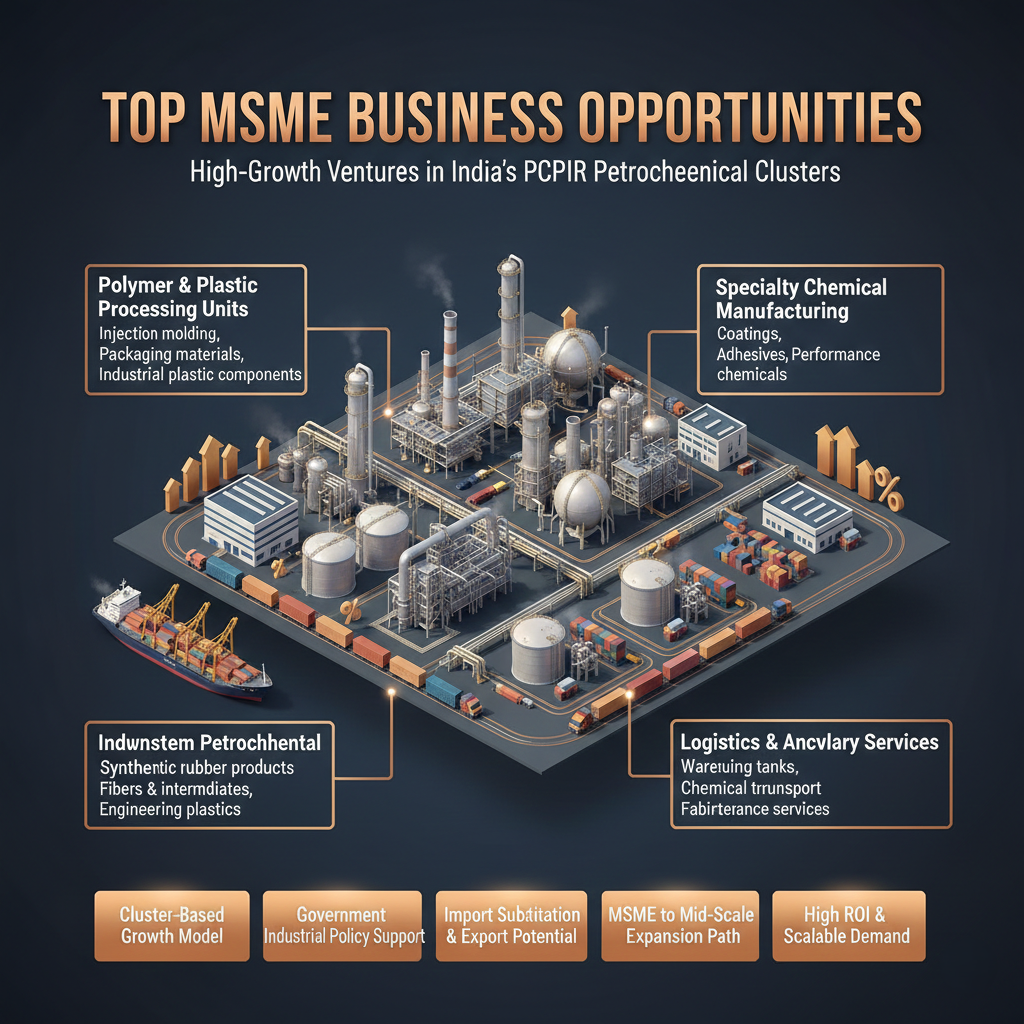
Plastic Processing Units and Polymer Conversion Units
India’s consumption of plastics continues to rise in the infrastructure, automotive, FMCG and packaging sectors. MSMEs working in the framework of PCPIRs are given the benefit of direct access to polymer feedstock for improved cost efficiency and stability of production.
Some of the polymer based MSME projects suitable for PCPIR locations include:
- Injection moulded automotive components
- HDPE and PVC pipe fittings
- PET bottles and containers
- Industrial plastics films and sheets
Government support under schemes like Plastic Parks further nails the feasibility of these projects. The success story of Unflex Ltd., founded by Ashok Chaturvedi, is interesting, as it illustrates how polymer conversion businesses can grow into global manufacturing enterprises.(PCPIR petrochemical clusters)
Export Potential Agrochemical Formulations
Agrochemicals are one of the most steady segments of demand-driven chemical industry because of the large agricultural base in India. PCPIR based MSMEs can produce formulations targeting both the domestic consumption market and the international market.
Some common formulations that are produced are:
- Emulsifiable concentrates
- Wettable powders
- Suspension concentrates
These products have predictable demand cycles and are therefore easier to finance and scale. Additionally, the proximity to ports enables MSMEs to easily fit in global agrochemical supply chains.
Read More: Project Reports & Profiles
Synthetic Rubber and Performance Plastics
Performance plastics and synthetic rubber are finding a growing role in automotive systems, electrical components, medical devices and industrial equipment. Although this segment is technologically advanced, the MSMEs can focus on niche, application-specific products.
Typical MSME opportunities include:
- Engineering thermoplastics
- Elastomeric seals and gaskets
- Composite polymer sheets
Industrial groups such as Welspun Group, under the leadership of Balkrishna Goenka, show the way in which polymer-based manufacture can be developed into companies competitive on a world stage.
Textile Chemicals Processing Synthetic Fibre Processing
Synthetic yarns and textile auxiliaries represent almost 9% of petrochemical production. MSMEs in the manufacturing of finishing agents for textiles, dyeing auxiliaries and fibre processing chemicals get continuous demand from India’s textile industry.
This segment is attractive because:
- Consumption is recurring instead of cyclical
- Domestic demand is strong
- Export markets are well built up
Read More: Profitable Petrochemical Business Ideas in India for MSMEs: Textile, Agriculture & Auto Applications
Importance of Feasibility Analysis Before Investment
Even with shared infrastructure, chemical manufacturing carries great capital and regulation responsibility. Therefore, MSMEs need to depend on structured techno-economic feasibility analysis before allocating funds.
A detailed feasibility study will normally assess:
- Source of raw material and price fluctuations
- Capacity utilization scenarios remotely governed by the meta-map 01/05/2010.
- Utility requirements and operating costs
- Environmental compliance requirements
- Financial indicators, such as IRR and break-even period
Organizations like Niir Project Consultancy Services (NPCS) help the entrepreneurs in preparing detailed project report (DPR) which improves the bankability and lessen the risk of execution.
Export Oriented Growth from PCPIR Locations
India’s chemical and petrochemical industry has consistently had capacity utilisation over 80%, indicating high downstream demand and export preparedness. Through the integrated system of transport services, the logistics system and port connections for MSME in the PCPIR areas support an optimal entry into international markets.
Read More: Top High-Growth Chemical Manufacturing Businesses New Entrepreneurs Can Start
Final Perspective
For MSME and first generation entrepreneurs, PCPIR based petrochemical clusters provide one of the most stable and scalable entry points into India’s industrial economy. Integrated infrastructure, good domestic demand, export connectivity and policy support form a strong platform for sustainable manufacturing growth.(PCPIR petrochemical clusters)
Entrepreneurs who marry feasibility-oriented planning efforts, prudent product choices, and value chain integration have the best chance of succeeding in this new industrial landscape.
Frequently Asked Questions (FAQs)
Are the projects of PCPIR good for first-time entrepreneurs?
Yes. The shared infrastructure and utilities system provides multiple benefits which reduce entrance costs for new businesses.
What is the average investment size of MSMEs in PCPIRs?
Most of the projects are in the range of Rs 1 Crore to 15 Crore depending on the type of the product and the scale of the project.
Does PCPIR support export oriented manufacturing?
Yes. Proximity to ports and integrated logistics makes exports very efficient.
What are the risks that MSMEs need to assess?
The main risks facing the business arise from three factors which include raw material price changes and regulatory requirements and market demand fluctuations.
Can MSMEs grow operations inside PCPIRs?
Yes. The cluster model can expand without any significant reinvestment in infrastructure.