

High profit manufacturing business in India is gaining strong momentum as the country’s manufacturing sector enters a phase of rapid transformation driven by policy incentives, supply chain shifts, sustainability goals, and industrial growth. Entrepreneurs and MSMEs are increasingly moving beyond traditional manufacturing and focusing on technically advanced products with high domestic demand and export potential.
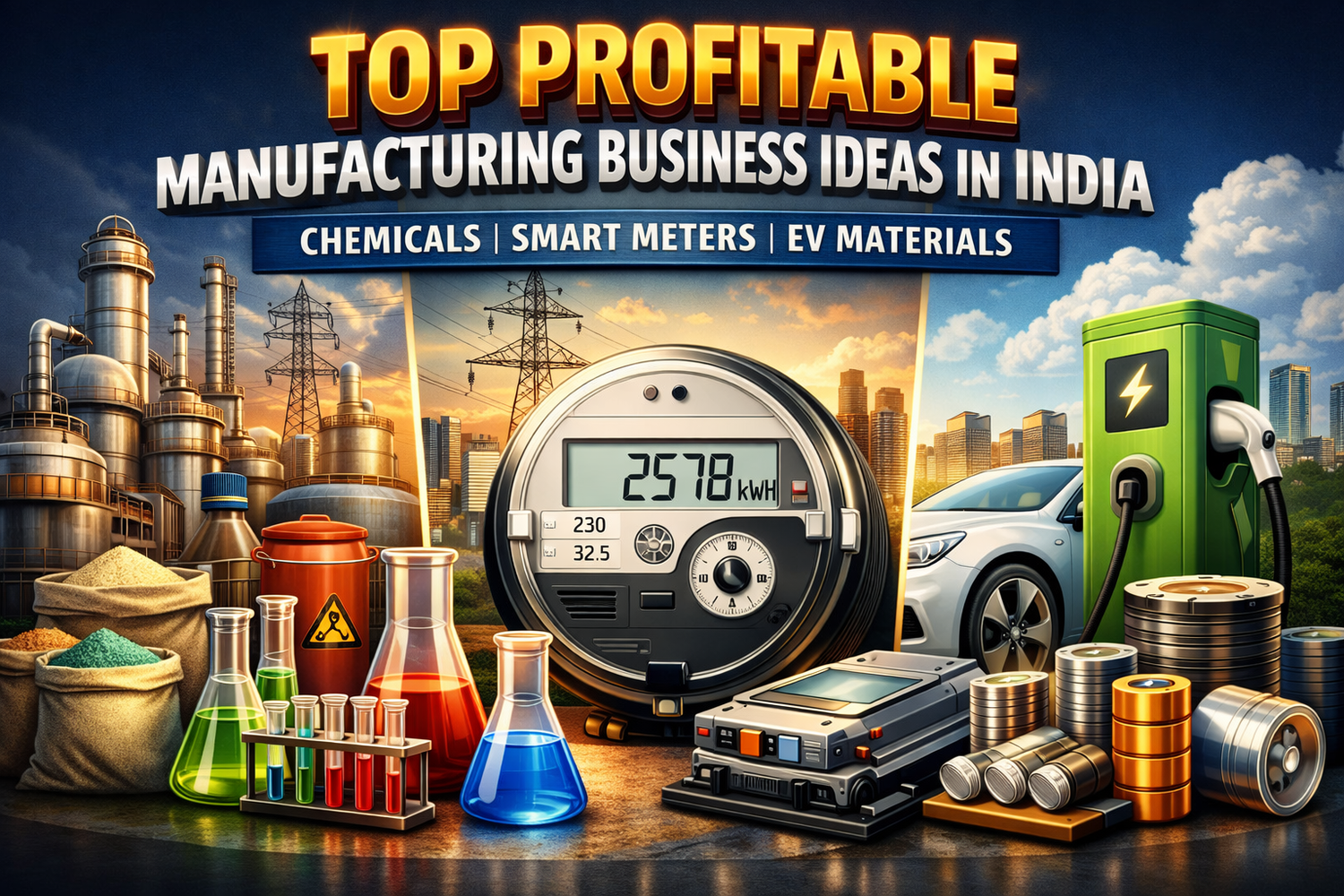
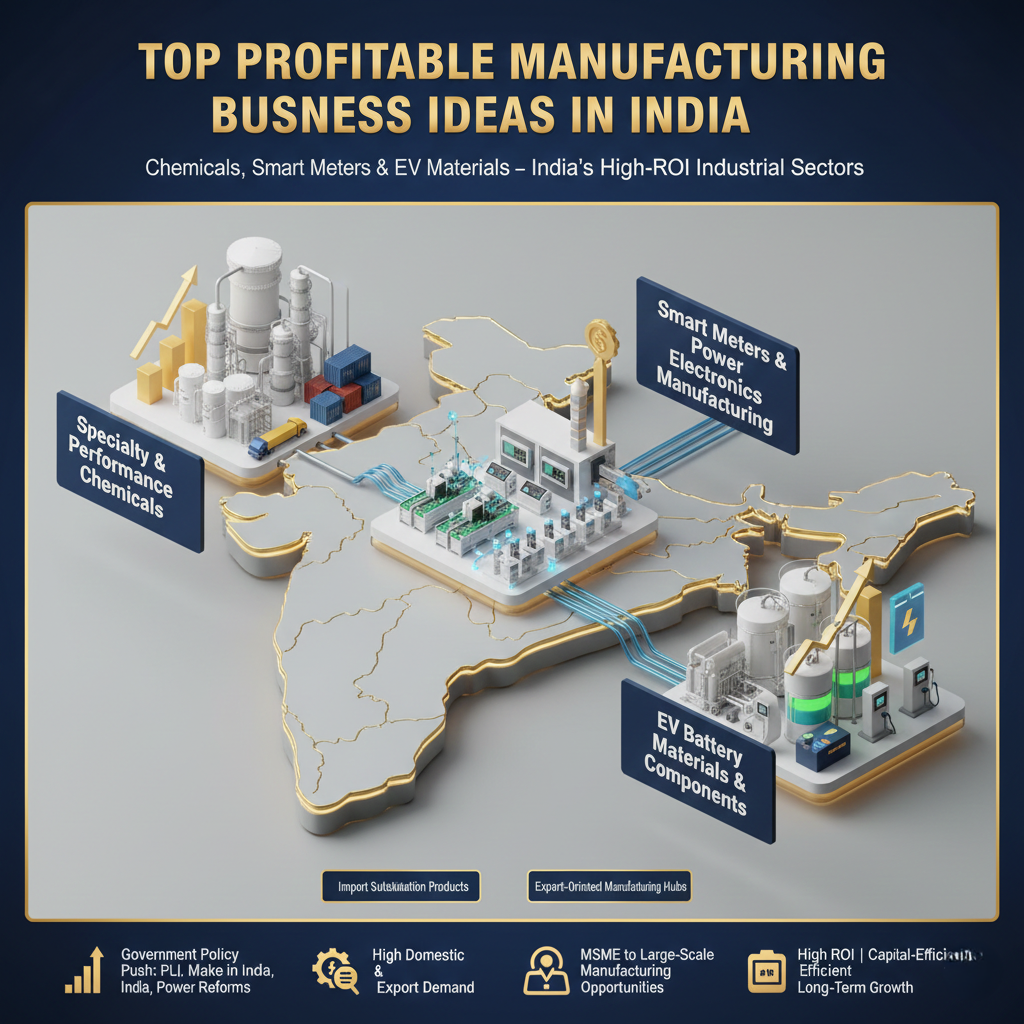
Rather than trying to target markets saturated with too many manufacturers, savvy manufacturers are targeting specialized products that offer steady demand, moderate competition, and long-term scalability. Three promising industrial segments stand out today: FMCG chemicals such as Texapon SLES N70, smart digital electric meters, and high-value EV battery materials such as Lithium Hexafluorophosphate.
This article delves into these opportunities, their insights from manufacturing, market demand and profitability outlook and strategic considerations for entrepreneurs coming in India’s modern industrial ecosystem.
Read More: Handbook On Chemical Industries (Alcohol Based)
1. Texapon SLES N70: FMCG and Hygiene Products High Demand Chemical
Industry Overview
Texapon SLES N70 (Sodium Lauryl Ether Sulphate) serves as the most widely utilized surfactant which functions in personal care products and cleaning solutions. The product functions as an essential element which shampoo products and liquid soap products and dishwashing liquid products and detergent products and institutional cleaning product formulations.
SLES has become a high-demand industrial chemical used in various industries because people in India now recognize the importance of hygiene and urban areas expand and people buy more fast-moving consumer goods. Manufacturers are favored by uniform market requirements in both urban and rural sectors.
Manufacturing Insights
Production includes chemical processes, such as ethoxylation, sulfonation and neutralization. While technically established, quality consistency and environmental compliance management is a critical success factor.
Typical MSME-scale plants are operated from 1000 to 15000 MT per annum. Investments have to incorporate effluent treatment plants (ETP) and stringent environmental management systems to comply with regulatory standards.
Raw Materials
- Fatty alcohol (C12–C14)
- Ethylene oxide
- Sulfur trioxide or chlorosulfonic acid
- Sodium hydroxide
Procurement strategies are very important because the prices of petrochemicals have a direct effect on profit margins.
Read More: Lithium Ion Battery (Battery Assembly)
Demand and Profitability
The Indian SLES market is continuing to grow along with the growth of FMCG and the demand for institutional hygiene. Export markets in Southeast Asia and Africa also help to stabilize volume.
EBITDA margins for efficient manufacturers are usually in the range 12-18% with further margin potential through backward integration or captive product formulation.
2. Digital Electric Meters: Backbone of Smart Grid Revolution in India
Industry Overview
Digital and smart electric meters have become key ingredients in India’s modernization of the power infrastructure. Modern metering systems enable remote system monitoring, which includes data analysis features and real-time usage monitoring, which differentiates them from standard metering systems.
Government-led smart meter programs, as well as industrial automation and smart housing projects, are driving massive deployments across the country.
Manufacturing Insights
Digital meter production is electronics manufacturing process that involves PCB assembly, firmware program, calibration and testing. Quality control and certification standards are a determining factor in accepting products in utility tenders.
Manufacturers need to allocate their resources for developing automated production facilities and testing centers and building systems which comply with both BIS requirements and utility standards.
Read More: Project Reports & Profiles
Raw Materials and Material Components
- Microcontrollers, semiconductor chips
- RF, GPRS, IoT – Communication modules
- Current sensors and current displays
- Plastic enclosures
- Passive electronic components
Supply chain resiliency is essential because semiconductor markets experience worldwide volatility.
Demand and Profitability
India has plans to install hundreds of millions of smart meters which provides strong demand for the long term. While margins per unit may be modest (around 8 – 12%), high volume contracts are assured sources of revenue and they can scale.
Industrial monitoring systems and EV charging infrastructure are emerging secondary markets.
3. Lithium Hexafluorophosphate as Critical Material for EV Batteries
Industry Overview
Lithium Hexafluorophosphate (LiPF6) is a high purity electrolyte salt for lithium-ion batteries for electric cars, energy storage systems and consumer electronics. Although it is a small percentage of the weight of the battery, it plays a critical role in safety and performance.(High Profit Manufacturing Business in India)
The chemical gives advanced manufacturers a strategic benefit because India is rapidly adopting electric vehicles and building its domestic battery production capabilities.
Manufacturing Insights
LiPF6 production demands special reactors, moisture-free conditions, and sophisticated quality control systems. The process is complicated with fluorination reactions, and crystal formation under inert atmospheres.
Due to the high technical barriers, this segment is more suited for experienced chemical manufacturers or consortium-based ventures.
Read More: Build a Profitable EV Station Franchise: A Strategic Guide for New-Age Entrepreneurs
Raw Materials
- Lithium fluoride
- Phosphorus pentachloride
- Fluorinating agents
Strict waste management and protocols for handling hazardous chemicals are mandatory.
Demand and Profitability
Domestic demand is soaring as EV adoption takes off. There are good localities for Indian manufacturers in import dependency. Profit margins are higher than 25% for technically-aware producers in scale production.
Strategic Lessons of Effective Industrial Leaders
Successful industrial entrepreneurs look to the long-term visibility of demand, and not short-term trends. Manufacturing bosses in India have shown that access to technically complex sectors with effective policy support produces sustainable competitive advantages.(High Profit Manufacturing Business in India)
Key lessons include:
- Invest in technology and compliance early.
- Match manufacture capacity to government policy direction.
- Build backward integration in order to protect the margins.
- Focus on product niches where technical barriers reduce competition.
Feasibility Studies Role in Manufacturing Success
Many industrial projects are not successful due to poor planning and unrealistic financial assumptions, rather than demand. Detailed techno-economic feasibility studies are useful in helping entrepreneurs assess the availability of raw materials, system complexity, capital investment, and operational risks.
A well structured feasibility report generally includes:
- Market demand analysis
- Manufacturing process design
- Layout and equipment planning of plants
- Financial projections and ROI estimates
- Environmental & regulatory requirements
Organized planning enables organizations to decrease their risk levels while making superior investment choices.
Read More: How to Start an EV Station Franchise: A Complete Guide for Entrepreneurs
Government Policy and Institutional Support
India’s manufacturing growth is supported by policy frameworks which promote domestic production of electronic products and EV-related chemical substances. The incentives for localization, smart infrastructure development, and clean energy transition maintenance create industrial opportunities which will last into the future.
Entrepreneurs entering advanced manufacturing should be watching:
- Production linked incentive schemes
- EV ecosystem policies
- Incentives for Electronics Manufacturing
- Environmental regulations and industrial regulations|
The analysis of policy direction helps investors develop investment strategies which will match upcoming market needs.
How to Select the Right Manufacturing Opportunity
Before choosing a product, entrepreneurs must consider:
- Technical capability and expertise
- Capital investment and compliance requirements
- Market accessibility and channels of distribution
- Long-term demand visibility
- Raw material availability and price volatility
Texapon SLES N70 has somewhat stable demand and accelerated break-even, digital electric meters have scale because of government projects, Lithium Hexafluorophosphate has high risk but high returns in the EV ecosystem.
Conclusion
India’s manufacturing future is evolving toward technologically advanced, policy-aligned, and sustainability-driven industries. Companies that develop products which have high market demand and present simple technical challenges will achieve growth through building sustainable operations.
Texapon SLES N70 provides reliable chemical production through its volume-based manufacturing system, digital electric meters enable infrastructure-based growth measurement, and Lithium Hexafluorophosphate serves as a vital business prospect during the development of India’s electric vehicle market. The process of selecting the appropriate opportunity involves evaluating three factors which include technical skills and financial management ability and future market expansion plans.(High Profit Manufacturing Business in India)
Frequently Asked Questions (FAQ)
- Which manufacturing segment is best for first-time entrepreneurs?
Texapon SLES N70 or similar FMCG chemicals are generally more suitable due to stable demand and lower technical complexity compared to advanced battery chemicals. - Are smart electric meters dependent only on government tenders?
Government contracts dominate, but industrial energy monitoring and private infrastructure projects are growing secondary markets. - Is Lithium Hexafluorophosphate manufacturing suitable for MSMEs?
It is better suited for technically experienced promoters or joint ventures due to high capital and technical requirements. - What is the most important factor in manufacturing profitability?
Efficient procurement, process optimization, compliance management, and stable demand alignment are key drivers of long-term profitability. - How long does it take for a manufacturing plant to break even?
It varies by sector, but FMCG chemicals often reach break-even faster than advanced electronics or EV material manufacturing. - Do government policies really influence manufacturing success?
Yes. Policy incentives, localization mandates, and infrastructure development significantly impact demand visibility and investment feasibility.