Fertilizer business opportunities in India are growing rapidly, as India is one of the largest agricultural economies in the world and agriculture contributes nearly 18% to the country’s GDP while employing more than 42% of the population. Because of this, the demand for fertilizers in India is always high and continues to grow every year.
With strong government support, subsidies worth more than ₹1.45 lakh crore, and the rapid adoption of new technologies like nano fertilizers and organic inputs, the fertilizer sector has become one of the most profitable and stable business opportunities in India.
If you are planning to start a manufacturing or trading business in the agri-input sector, this guide will explain fertilizer business opportunities in India, investment, profit margin, and how to start.
Read More: Startup Opportunities i Fertilizer Raw Material Processing
What is Driving Opportunities in the Fertilizer Market for Startups?
There are some good promoting factors that make the market for fertilizer startups successful. The government has subsidies that help to cut costs, especially in the production of organic fertilizer, which encourages the production of it. New technologies for fertilizer in the forms of Nano Urea, Nano DAP, and Urea Gold are being produced and are more efficient in the use of fertilizer.
India is also forming long term agreements with supplies in Bhutan, Nepal, and Sri Lanka, which creates more opportunities for India to export more fertilizer. In India, more than 2.14 lakh storefronts have been upgraded to PMKSK, which allows Friedberg’s Distribution Network to be used without a lot of investment to Tap into.
High-Potential Startup Opportunities In India’s Fertilizer Sector
Organic Fertilizer Manufacturing Under the MDA and GOBARdhan
Among the business opportunities available in the current ecosystem, the manufacturing of organic fertilizers is the strongest. For organic fertilizers produced at CBG and biogas plants, the government offers Market Development Assistance.
This makes the business financially feasible and promotes circular economy models. In agricultural regions where the supply of raw materials is abundant, startups can install units manufacturing FOM, Liquid FOM, and PROM.
The waste of municipal systems and farms provide a steady supply of a feedstock, enabling the formation of scalable waste-to-wealth models. Fast market penetration and strong brand visibility can result from partnerships with PMKSKs.
Nano and Bio-Fertilizer Manufacturing
Nano fertilizers now play a key role in India’s fertiliser strategy. More than 1,015 thousand bottles of Nano Urea have been produced, and demand is still increasing. Currently, six Nano Urea plants are operational and more are expected in the near future, along with Nano DAP plants.(Fertilizer Business Opportunities in India)
Startups can invest in contract rural manufacturing for nano nutrient blends with public sector fertilizer companies and do R&D. Regulatory proceeding is faster due to government-notified specifications and nano products have lower logistics costs due to more compact and lighter packages. A positive attitude from farmers results in a positive outlook on nano fertilizers for potential market entrants the farmers create.
Import Substitution in Potash and Phosphate Fertilizers
India is heavily reliant on imports for MOP and the raw materials for rock phosphate and phosphoric acid. This is a big opportunity for Startups to create potash-rich organic fertilizers or soil conditioners that decrease import dependence.
They can also set up processing units for imported intermediates to add domestic value. Increased global demand for potash and phosphate makes domestic alternatives more attractive, and consistent domestic demand ensures a reliable market.
Fertilizer Exports to South Asian Markets
The expansion of Indo-Nepal border trade regulation opens new doors for startups focusing on the export of organic or blended fertilizers, as fertilizers can now be exported as per soil conditions. Partnerships with Indian PSUs can lead to marketing risk mitigation through off-take agreements.(Fertilizer Business Opportunities in India)
Given the government-to-government MOUs, the export market will provide nascent fertilizer entrepreneurs with predictable growth.
Building Fertilizer Logistics and Digital Distribution Platforms
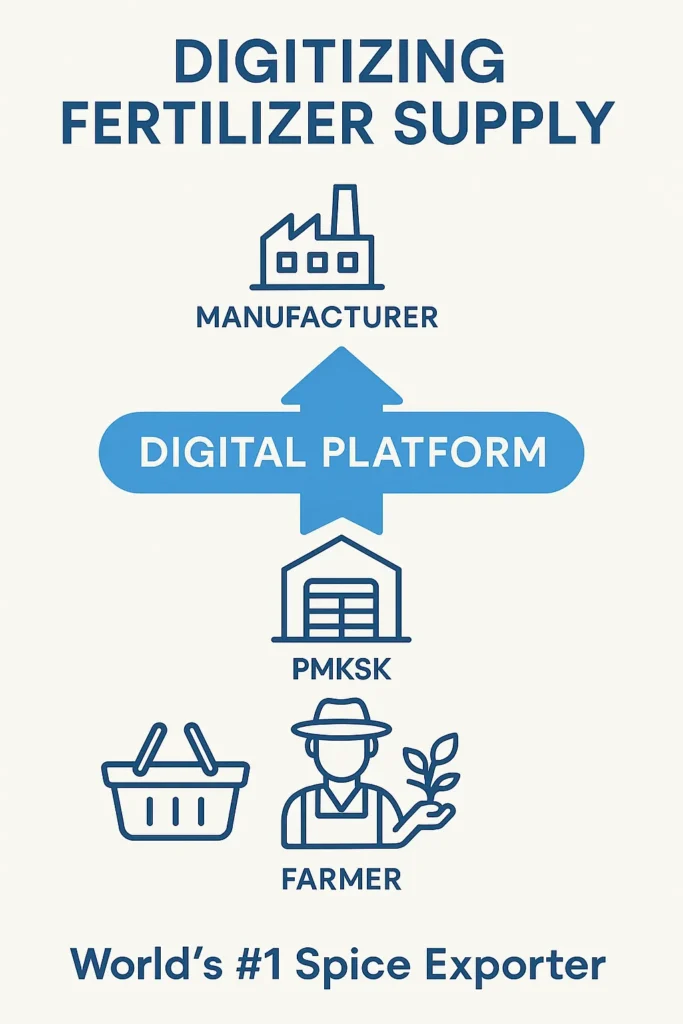
Digital transformation in distribution of fertilizers is still in its infancy, allowing for new opportunities for tech startups. Digital platforms to link fertilizer manufacturers, PMKSKs and farmers can streamline the ordering, storage and delivery process, and ease the distribution of value added agro-services such as drone spraying, soil testing and inventory management.
Integration with government iFMS and e-Urvarak dashboards can enhance efficiency and transparency. Such platforms can offer subscription-based services to end-users, providing sustained income.
Integrated Waste-to-Weath Plants Combining CBG and Orgnaic Fertilizers
The concurrent production of CBG and enteric waste-derived organic fertilizers enables vertical diversification and therefore allows an integrated CBG and organic fertilizer plant to offer multiple lines of revenue.
Such start-ups are able to procure animal enteric waste, crop by-residual, and even municipal waste, to produce CBG and organic fertilizers at the same location.
Given the SATAT scheme, CBG has an ensured off-take demand, while organic fertilizer sales are aided by the MDA. This endeavor fuels India’s renewable energy and waste management systems activites while mitigating entrepreneurship risk through frontier sector income diversification.
Insights From Import-Export Data
The latest data demonstrate urea’s importation by India has abated as domestic production has risen, however MOP importation has increased, suggesting production gaps and dependency.
Read More: Liquid Biofertilizer Manufacturing Industry
As to India’s exportation to Nepal and Bhutan, as and whereby exportation fears are alleviated, enhanced production opportunities emerge for India.
Start-ups can leverage these insights to focus on four areas, notably: potash and phosphate substitution, organic fertilizer exportation, and nano/bio-fertilizer innovations. Such areas are characterized by demand stability, supportive of policies, high revenue.
Learning from India’s Major Players in the Fertilizer Sector
IFFCO’s success with Nano Urea demonstrates the importance of innovation and farmer education in shaping the agricultural economy. RCF has demonstrated the importance of product differentiation and the premium pricing that can be attained even in regulated markets, such as with Urea Gold.
FAGMIL’s entry into SL shows the benefits of overseas market diversification. These are lessons for Startups in efficiencies, product niches, and public sector partnerships.
NPCS Assistance to Mss in Establishing Fertilizer Enterprises
NPCS (Niir Project Consultancy Services) aids in entrepreneurial support through comprehensive project design and feasibility study pertaining to fertilizer enterprises. Fertilizer sector potential needs the study of production flow, government schemes, raw materials, and economics of the sector.
NPCS provides a system to prepare detailed Techno Economic Feasibility Reports that incorporate market study, demand analysis, flow charts, equipment, and precise costing.
This stream of inputs aids the entrepreneur to know the capital need, gain profit, and fund the project within the government frameworks. NPCS provides comprehensive services that empower the entrepreneur to confidently establish and grow the fertilizer business.
Read Our Book: Click Here
Government Portals for Entrepreneurs
Entrepreneurs can access the official websites to obtain the latest policies, tenders, and programs.
Relevant sites include the Department of Fertilizers for policies, the GOBARdhan portal for opportunities in the diversion of organic waste, resources on retail expansion available in PMKSK, and the SATAT portal for registration and procurement of CBG.
These sites also assist new ventures in claiming available benefits and complying with regulations.
Business Models That Support Fast Growth
Startups may choose from multiple business models depending on their core competencies. Fertilizer retail franchises based on PMKSK models are effective and efficient in penetrating the rural market. In cluster-based manufacturing, MSMEs can collaborate on shared logistics to cut costs.
Digital models in logistics provide better and faster movement of fertilizer. In countries nearby, export-oriented joint ventures are lucrative. All these models are not only scalable but also profitable for many years.
Read Our Project Report: Click Here
Action Plan for Fertilizer Startup Founders
Starting with a niche (organic, blended, or nano), entrepreneurs should also apply for subsidized financing and register on iFMS for government assistance. Having partnerships with CBG plants and a waste collection network ensures enough raw material. Customers and distributors can be easily accessed with PMKSK and other digital tools.
Export opportunities should also be investigated. NPCS can prepare a DPR to provide reasonable expectations on investment, plant size, and profitability. Finally, including drones, digital, or soil analytics in service offerings can bolster customer loyalty and provide additional value.
Find the Best Idea for Yourself With our Startup Selector Tool
Conclusion
The fertilizer business in India is a high-potential, policy-supported and future-proof industry. With rising demand for organic, nano, and balanced fertilizers, and with government subsidies of over ₹1.45 lakh crore, this sector offers massive opportunities for new entrepreneurs.
Whether you want to start:
- An organic fertilizer plant
- A nano fertilizer unit
- A bio-fertilizer factory
- Or an integrated waste-to-wealth project
This is the right time to enter the fertilizer manufacturing business in India.
FAQs
1. Is fertilizer business profitable in India?
Yes, due to constant demand and government subsidies, the fertilizer business is highly profitable.
2. Which fertilizer business is best for startups?
Organic, bio, nano, and blended fertilizers are best for new entrepreneurs.
3. How much does a fertilizer plant cost?
Small plants start from ₹20–50 lakh, medium plants from ₹2–10 crore, and large plants can cost ₹10 crore+.
4. Can Indian companies export fertilizers?
Yes, India exports fertilizers to Nepal, Bhutan, Sri Lanka, and other countries.
5. Is government support available?
Yes, the government provides subsidies, incentives, and schemes to support fertilizer businesses.