
 Tata Steel
 JSW Steel
 ITC (Agri Business Division)
 Godrej & Boyce
 Aditya Birla Management Corporation
 Grasim Industries (Century Rayon)
 Thermax (Chemical Division)
 UPL
Hospitals, clinics and state medical corporations buy IV fluids in large volumes, which is why entrepreneurs and pharma groups set up plastic-bottle plants for dextrose, saline and Ringer's lactate. An IV fluids plant consultant helps you decide the line type, clean-room scale and approval route before money is committed. NPCS prepares the project report, advises on machinery and Schedule M requirements, and supports you through planning and commissioning.
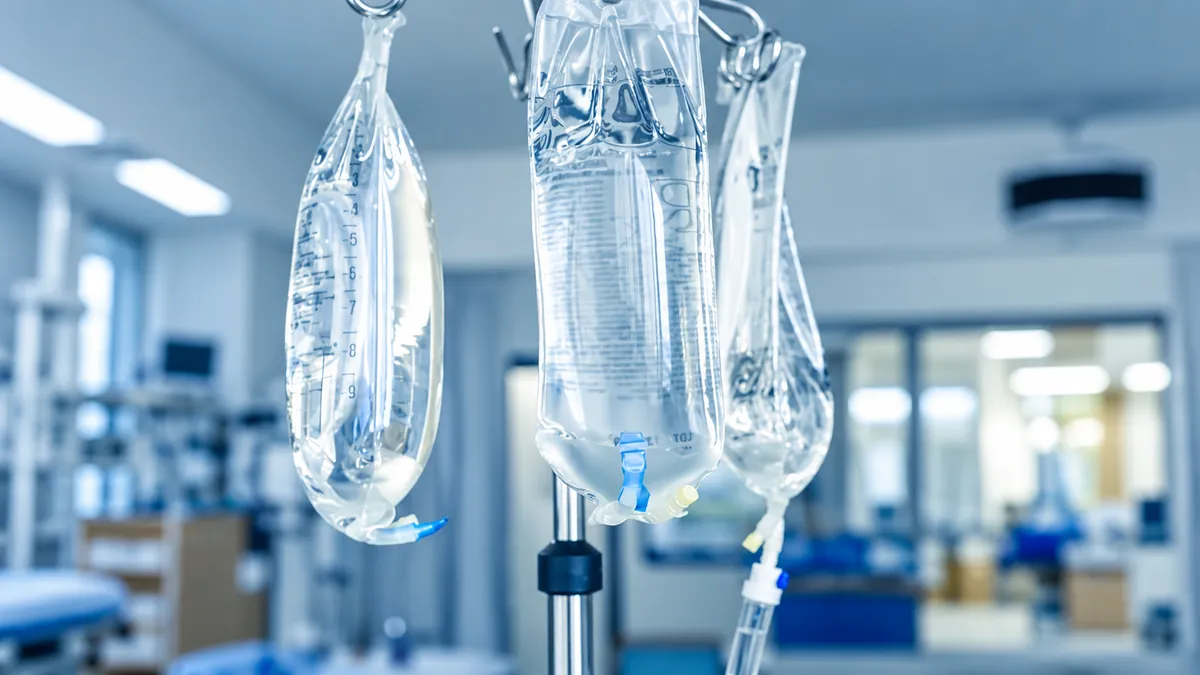
IV Fluids Plant at a Glance
| Typical capacity | ~1–6 crore bottles/year |
|---|---|
| Land | ~3–8 acres |
| Power load | ~1–3 MW |
| Water | High (WFI) |
| Manpower | ~80–250 |
| Indicative investment | ~₹40–150 crore |
Investment basis: Schedule M clean-room facility; excludes land.
Figures are indicative ranges. Your project report works them out for your capacity and location.
Market Demand for IV Fluids Plants in India
Demand for IV fluids in India is driven by hospital expansion, government procurement and the shift from glass to plastic bottles. Monsoon disease season raises consumption, so production planning should allow for that peak.
Gujarat, Himachal Pradesh (Baddi), Telangana, Maharashtra and Uttarakhand are the main clusters. Export potential is medium, so most new units focus on domestic buyers.
- Hospitals and clinics
- Government health programmes
- State medical corporations buying through tenders
- Distributors and exporters
IV Fluid Products You Can Make
Most new plants start with high-volume products such as normal saline and dextrose, which hospitals and tenders request most often. Specialised formulations like mannitol and metronidazole can be added later once the line and quality system are stable.
- Normal saline, dextrose (5%, 10%, 25%), Ringer's lactate, DNS, mannitol, metronidazole and other LVP formulations
IV Fluids Plant Process and Technology
The IV fluids plant process runs from water for injection (WFI) generation to compounding, filtration, bottle forming and filling, and terminal sterilisation in an autoclave. Quality is controlled at every stage rather than only at the end.
Your main technology decision is BFS (blow-fill-seal) versus FFS lines, and aseptic versus terminally sterilised products. Testing covers sterility, endotoxin (BET), particulate matter, assay and container integrity, following IP monographs and revised Schedule M.
- Water purification and WFI generation
- Solution compounding
- Filtration
- Blow-fill-seal or FFS bottle forming and filling
- Terminal sterilisation (autoclave)
- Leak and visual inspection
- Labelling and packing
Raw Materials and Machinery for an IV Fluids Plant
Inputs are water for injection, pharma-grade salts and dextrose, LDPE or PP granules for bottles, and closures. Pharma ingredients and polymer are both sourced domestically. The WFI system, BFS or FFS machine, autoclaves and clean-room HVAC are the most critical and costly items, so specify them carefully.
- RO-EDI and multi-column WFI still
- Pure steam generator
- Compounding vessels
- BFS/FFS machine
- Autoclaves
- Inspection machines
- HVAC with clean rooms
- QC lab
IV Fluids Plant Licence and Approvals
Approvals follow a set order: company registration, then pollution consent before construction, then the drug licence, then consent to operate. The pharmaceutical formulation category is Orange, and no QCO applies, but revised Schedule M GMP does.
- Drug manufacturing licence for large volume parenterals from the State Licensing Authority
- CDSCO joint inspection
- WHO-GMP if you plan to export
| Pollution category | Pharmaceutical formulation: Orange (CPCB S.No. 123.3) |
|---|---|
| HSN code | 3004 (medicaments in measured doses) |
| GST | 5% under GST 2.0 for most medicines; a few specified products differ |
| BIS / quality control order | No QCO; revised Schedule M GMP applies |
| Other licences | Drug manufacturing licence (large volume parenterals) from the State Licensing Authority with CDSCO joint inspection; WHO-GMP for exports |
Choosing the Right IV Fluids Technology
BFS and FFS lines both produce plastic-bottle IV fluids, but they differ in how the container is formed and filled. The choice also depends on whether your products are aseptically filled or terminally sterilised. Your capacity, product list and budget decide which route fits, and the project report compares them for your case.
Selling IV Fluids to Government and Institutional Buyers
State medical corporations buy through tenders, so tender eligibility shapes your plan from the start. GMP compliance and the right drug licence are the entry points. Tender pricing is also tight, so costs must be understood before you bid. Hospitals and distributors offer steadier alternate channels.
Government Schemes and Project Finance for IV Fluids Plants
MSME units may look at the revamped Pharmaceutical Technology Upgradation Assistance Scheme and state pharma policies. NPCS reports are used for bank loans and government programmes such as PMEGP, MSME schemes, Mudra and NABARD-linked projects, subject to each lender's requirements. A bankable report gives lenders the numbers they ask for.
What Decides Success in an IV Fluids Plant
Successful operators get GMP compliance, tender eligibility and bulky-product logistics right. The main risks are price control, tender pricing and freight. Rejected bottles can go to plastic recycling.
- Build GMP compliance into the design
- Plan tender eligibility early
- Cost freight into every price
How NPCS Helps You Set Up an IV Fluids Plant
NPCS supports the decisions that matter most: capacity, BFS or FFS technology, machinery selection and specifications, vendor selection and plant layout. Our team also guides production process planning and approvals, and assists with installation and commissioning. Reports are tailored to your capacity, budget and location.
NPCS's published client list records 22 assignments on iv fluids projects between 2012 and 2026 for clients in 9 states and 9 countries, including detailed project reports, bankable project reports and techno-economic feasibility studies.
What Your IV Fluids Plant Project Report Covers
- Project introduction and BIS specifications
- Manufacturing process with flow sheet
- Market survey (demand, imports/exports, existing units)
- Personnel
- Plant and machinery with suppliers
- Land and building with layout
- Raw materials with sources and rates
- Financials (project cost, working capital, cost of production, profitability, break-even, 5–10 year cash flow, projected balance sheet, IRR/NPV/payback)
IV Fluids Plant: Frequently Asked Questions
How much investment is needed for an IV fluids plant?
An indicative range is ~₹40–150 crore for a Schedule M clean-room facility, excluding land. The figure depends on capacity, technology and building scale. Your project report works out the cost for your planned capacity and location.
Which licences are needed for an IV fluids plant?
You need a drug manufacturing licence for large volume parenterals from the State Licensing Authority, with CDSCO joint inspection. Pharmaceutical formulation is Orange category for pollution. WHO-GMP is needed if you plan to export.
How much land and power does an IV fluids plant need?
A plant typically needs ~3–8 acres and a power load of ~1–3 MW, depending on capacity. Water demand is high because of WFI generation. Confirm both with your location and line size.
How to start an IV fluids plant business?
Begin with a feasibility study and project report covering capacity, technology and finance. Then choose a site, obtain pollution consent and the drug licence, order machinery and build the Schedule M facility. Commissioning and inspection follow.
How can NPCS help with an IV fluids plant project report?
NPCS prepares detailed and bankable project reports, feasibility studies and market research for IV fluids projects. Our team also advises on machinery, technology, layout and approvals. Share your capacity and location to get started.