
 Tata Steel
 JSW Steel
 ITC (Agri Business Division)
 Godrej & Boyce
 Aditya Birla Management Corporation
 Grasim Industries (Century Rayon)
 Thermax (Chemical Division)
 UPL
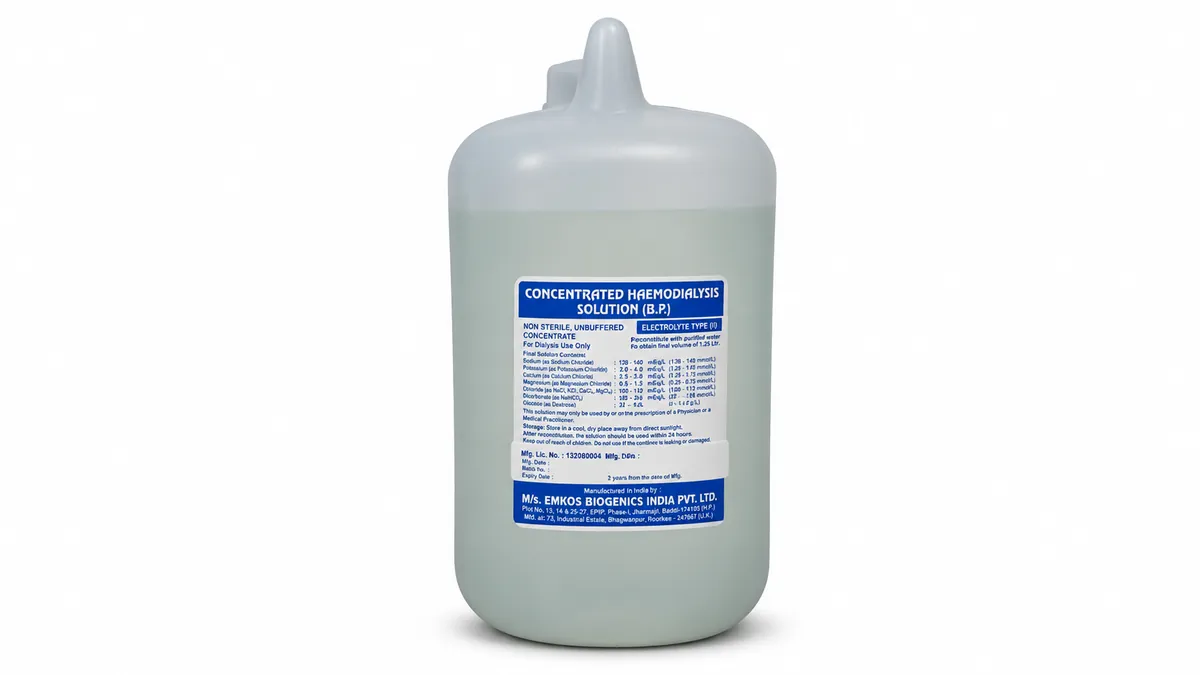
Dialysis centres, hospitals and state tenders buy acid and bicarbonate concentrates in large volumes, and that steady demand draws pharma entrepreneurs into this segment. A dialysis fluid plant consultant helps you decide the product range, the plant scale and the compliance route before money is committed. NPCS has worked on dialysis fluid projects, including techno-economic feasibility studies, and prepares reports that suit lenders and regulators alike.
Dialysis Fluid Plant at a Glance
| Typical capacity | ~5–50 lakh cans per year |
|---|---|
| Land | ~1–3 acres |
| Power load | ~200–800 kW |
| Water | High (purified) |
| Manpower | ~30–100 |
| Indicative investment | ~₹5–40 crore |
Investment basis: PD plants cost more; excludes land.
Figures are indicative ranges. Your project report works them out for your capacity and location.
Market Demand for Dialysis Fluid Plants in India
Demand for dialysis fluids in India follows kidney disease cases and the spread of dialysis centres. Buyers are mostly organised and recurring, which suits a manufacturer planning steady output.
- Dialysis chains that buy concentrates in regular volumes
- Hospitals with in-house dialysis units
- State tenders linked to the Pradhan Mantri National Dialysis Programme
- Existing clusters in Gujarat, Maharashtra, Telangana and Tamil Nadu
Dialysis Fluid Products You Can Make
Most new units start with acid concentrate and bicarbonate concentrate, since they need a simpler plant. Peritoneal dialysis solutions suit a later, higher-spec plant, and bicarbonate cartridges can follow once your customer base is stable.
- Acid concentrate (liquid), bicarbonate concentrate and cartridges, peritoneal dialysis solutions (higher-spec plant)
Dialysis Fluid Plant Process
The dialysis fluid plant process starts with purified water, because water quality decides everything downstream. Salts are weighed and dissolved, the solution is filtered, and it is filled into cans or bags. Bicarbonate lines add a powder blending stage.
Quality is controlled at several points rather than only at release. Testing covers ionic composition, endotoxins and microbial limits, and standards such as the ISO 23500 series and IP monographs guide the specifications. Concentrate-only plants are simpler, while peritoneal dialysis solution plants need sterile, BFS-type technology.
- Purified water generation
- Weighing and dissolution
- Filtration
- Filling in cans or bags
- (powder blending for bicarbonate)
- Testing and release
Raw Materials and Machinery for a Dialysis Fluid Plant
Inputs are pharma-grade salts such as NaCl, KCl, CaCl2 and MgCl2, plus sodium bicarbonate, dextrose, acetic or citric acid and cans. These chemicals are sourced domestically. The machine that matters most is the RO-EDI water system, followed by mixing tanks, filtration and can filling and capping.
- RO-EDI water system
- Mixing tanks
- Filtration
- Can filling and capping
- Powder blenders
- Lab
Dialysis Fluid Plant Licence and Approvals
A drug manufacturing licence is the central approval, and your plant must meet revised Schedule M GMP. Pharmaceutical formulation units fall under the Orange category (CPCB S.No. 123.3), so plan for consent to establish before construction and consent to operate before production. No BIS QCO applies.
- Register the unit and finalise the site
- Obtain consent to establish from the State Pollution Control Board
- Apply for the drug manufacturing licence
- Obtain consent to operate
| Pollution category | Pharmaceutical formulation: Orange (CPCB S.No. 123.3) |
|---|---|
| HSN code | 3004 or 3824 (by product classification) |
| GST | Classification-dependent; applied in the project financials |
| BIS / quality control order | No QCO |
| Other licences | Drug manufacturing licence; revised Schedule M GMP |
Choosing the Right Dialysis Fluid Technology
A concentrate-only plant is the usual entry point. It needs a strong water system and GMP discipline, and its investment sits at the lower end of the range. A peritoneal dialysis solution plant uses sterile, BFS-type technology, costs more and suits promoters with pharma experience and funding depth. Many operators start with concentrates, build tender credentials, and plan the PD line as a second phase.
Selling Dialysis Fluids to Hospitals and Tenders
Your main customers are dialysis chains, hospitals and state tenders. Tender eligibility generally rests on a valid drug manufacturing licence and demonstrated GMP compliance, so these should be in place before you bid. Demand linked to the Pradhan Mantri National Dialysis Programme makes tender readiness a commercial priority, not an afterthought.
Government Schemes and Project Finance for a Dialysis Fluid Plant
Demand from the Pradhan Mantri National Dialysis Programme supports the market case for your plant. A dialysis fluid plant project report helps here, because lenders look at costs, margins and compliance together. NPCS reports are used for bank loans and programmes such as PMEGP, MSME schemes, Mudra and NABARD-linked projects, subject to each lender's requirements.
What Decides Success in a Dialysis Fluid Plant
Good operators treat GMP compliance as a daily routine and plan for tender wins early. The main risk is logistics, since the product is bulky and freight can erode margins.
- Consistent GMP compliance
- Tender wins with hospitals and chains
- Location close to buyers to control freight
- Minimal waste, so little by-product income
How NPCS Helps You Set Up a Dialysis Fluid Plant
NPCS works through the decisions that shape your plant: capacity, concentrate or PD technology, machinery selection and vendor choice. Our team also supports plant layout, approvals planning and the finance case. Each report is tailored to your capacity, budget and market area, with guidance through installation and commissioning.
NPCS's published client list records 4 assignments on dialysis fluid projects between 2015 and 2022 for clients in 4 states, including techno-economic feasibility studies.
What Your Dialysis Fluid Plant Project Report Covers
- Project introduction and BIS specifications
- Manufacturing process with flow sheet
- Market survey (demand, imports/exports, existing units)
- Personnel
- Plant and machinery with suppliers
- Land and building with layout
- Raw materials with sources and rates
- Financials (project cost, working capital, cost of production, profitability, break-even, 5–10 year cash flow, projected balance sheet, IRR/NPV/payback)
Dialysis Fluid Plant: Frequently Asked Questions
How much does it cost to set up a dialysis fluid plant in India?
Indicative investment is about ₹5–40 crore, excluding land. Peritoneal dialysis plants cost more than concentrate-only plants. Your project report works out the exact figure for your capacity, technology and location.
Which licences are needed for a dialysis fluid plant?
You need a drug manufacturing licence and compliance with revised Schedule M GMP. Pharmaceutical formulation units fall under the Orange pollution category, so consent to establish and consent to operate are also required.
How much land and power does a dialysis fluid plant need?
Typically about 1–3 acres of land and a power load of roughly 200–800 kW, depending on capacity. Water demand is high because purified water is the main input, so plan the RO-EDI system early.
How to start a dialysis fluid plant business?
Begin with a feasibility study to choose between concentrate-only and PD solution plants. Then fix capacity and location, select machinery, secure consents and the drug licence, and line up hospital and tender buyers before commissioning.
How can NPCS help with a dialysis fluid plant project?
NPCS prepares the detailed project report, guides technology and machinery selection, and supports vendor selection and approvals planning. Our team tailors the report to your capacity and budget so it works for lenders as well.