
 Tata Steel
 JSW Steel
 ITC (Agri Business Division)
 Godrej & Boyce
 Aditya Birla Management Corporation
 Grasim Industries (Century Rayon)
 Thermax (Chemical Division)
 UPL
A condom manufacturing plant makes male latex condoms by dipping, electronic testing and foil packing. Entrepreneurs set one up to supply government family planning programmes, retail brands, social marketing agencies and export buyers. A condom manufacturing plant consultant helps you size the plant, choose the dipping line and plan the approvals. NPCS supports you with a detailed project report and technical guidance, so your capacity, investment and buyer strategy match from the start.
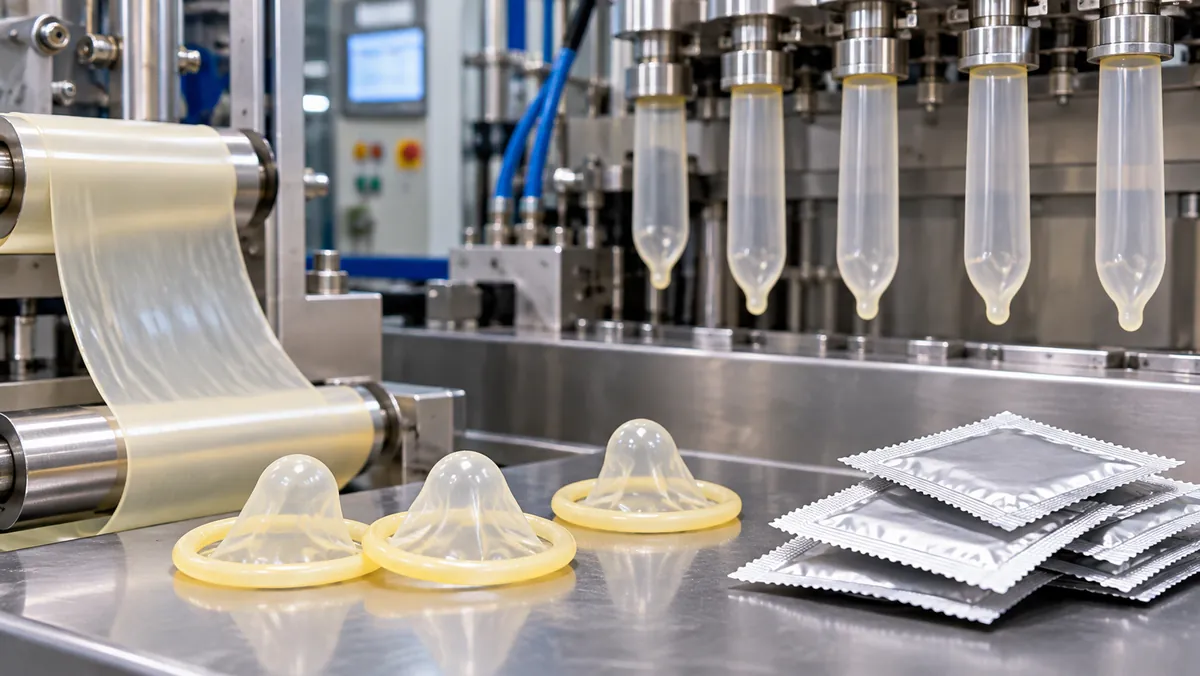
Condom Manufacturing Plant at a Glance
| Typical capacity | ~10–100 crore pieces per year |
|---|---|
| Land | ~3–8 acres |
| Power load | ~1–3 MW |
| Water | Moderate |
| Manpower | ~100–400 |
| Indicative investment | ~₹40–150 crore |
Investment basis: excludes land.
Figures are indicative ranges. Your project report works them out for your capacity and location.
Market Demand for Condom Manufacturing in India
Demand for condoms in India rests mainly on family planning and HIV prevention programmes. Government procurement is the anchor buyer, and brands, NGOs and exporters add further volume. Latex supply is concentrated in Kerala, and Kerala and Karnataka are the main clusters for the industry. Demand is steady through the year, so seasonality is low.
- Government procurement under family planning programmes
- Retail and social marketing brands
- NGOs running prevention programmes
- Exporters supplying overseas buyers
Condom Products You Can Make
Plain condoms suit bulk programme supply, while dotted, ribbed, flavoured and extra-thin types usually serve brands and retail. Lubricated variants cover both. Many new units start with a plain, lubricated range and add premium types once their brand channel develops.
- Plain, dotted, ribbed, flavoured and extra-thin condoms
- Lubricated variants
Condom Manufacturing Process
The condom manufacturing process turns compounded latex into tested, foil-sealed units on an automatic dipping line. Glass formers are dipped in compounded latex, then vulcanised so the film cures. After stripping, washing and drying, every piece goes through 100% electronic pinhole testing. Quality control matters most at this stage and during burst volume and pressure checks. Products are expected to meet ISO 4074 and IS 6730, and freedom from holes is the basic test. Lubricating, foil sealing and packing complete the flow.
- Latex compounding
- Dipping on glass formers
- Vulcanising
- Stripping
- Washing and drying
- 100% electronic pinhole testing
- Lubricating and foil sealing
- Packing
Raw Materials and Machinery for a Condom Plant
The main input is centrifuged natural rubber latex, sourced from Kerala. You also need compounding chemicals, lubricants and foil. Compounding tanks, dipping machines and ovens form the core of the line. Electronic testing machines and foiling machines decide your quality record and output, so select them with care.
- Compounding tanks
- Dipping machines
- Ovens
- Electronic testing machines
- Foiling machines
Condom Manufacturing Plant Licence and Approvals
Start with business registration and the State Pollution Control Board consent to establish before construction. Rubber dipping is generally Orange, though the final category depends on your process. You then need a licence under the Drugs and Cosmetics Act and Medical Devices Rules, and a consent to operate before production.
- Product compliance with IS 6730 and ISO 4074
- WHO/UNFPA prequalification for tenders
- Drugs and Cosmetics Act and Medical Devices Rules licence
| Pollution category | Rubber dipping is generally Orange |
|---|---|
| HSN code | 4014 10 (sheath contraceptives) |
| GST | Nil (contraceptives) |
| BIS / quality control order | IS 6730 and ISO 4074 compliance |
| Other licences | Licence under the Drugs and Cosmetics Act and Medical Devices Rules; WHO/UNFPA prequalification for tenders |
Choosing the Right Condom Dipping Technology
The facts point to automatic dipping lines as the working route for a condom plant. Line capacity should match your buyer mix, because a programme supplier needs far larger volumes than a small brand. Plan for the electronic testing and foiling machines to match dipping output, so no stage becomes a bottleneck. Your project report compares line options for your chosen capacity.
Export Opportunity for Condom Manufacturers
Export potential for condoms is high, and exporters are a recognised customer segment. International buyers and tenders usually expect WHO/UNFPA prequalification, along with ISO 4074 compliance. Plan these certifications early, because they shape your quality system and plant design. Many manufacturers combine export orders with domestic programme supply to keep the line well used.
Government Programmes and Project Finance
Demand from the National Health Mission and social marketing programmes supports condom manufacturing. Plants of this size need substantial funding, and lenders look closely at the project report. NPCS reports are used for bank loans and government programmes such as PMEGP, MSME schemes, Mudra and NABARD-linked projects, subject to each lender's requirements.
What Decides Success in a Condom Manufacturing Plant
Successful operators secure prequalification early and run strong quality systems. The main risk is tender price pressure, which squeezes margins on programme supply. Latex sludge is the waste to manage, so plan its handling within your pollution consent.
- Prequalification before bidding
- Documented quality systems
- Cost control against tender prices
- Proper handling of latex sludge
How NPCS Helps You Set Up a Condom Manufacturing Plant
NPCS supports the decisions that matter most in this project: capacity, dipping technology, machinery and approvals. Our team assists with machinery selection, vendor selection, plant layout and production process guidance. We also prepare the financial sections lenders review, and support installation and commissioning.
NPCS's published client list records 4 assignments on condom manufacturing projects between 2014 and 2019 for clients in 3 states, including detailed project reports, bankable project reports and techno-economic feasibility studies.
What Your Condom Manufacturing Plant Project Report Covers
- Project introduction and BIS specifications
- Manufacturing process with flow sheet
- Market survey (demand, imports/exports, existing units)
- Personnel
- Plant and machinery with suppliers
- Land and building with layout
- Raw materials with sources and rates
- Financials (project cost, working capital, cost of production, profitability, break-even, 5–10 year cash flow, projected balance sheet, IRR/NPV/payback)
Condom Manufacturing Plant: Frequently Asked Questions
How much investment is needed to start a condom manufacturing plant?
An indicative investment is ~₹40–150 crore, excluding land, depending on capacity and technology. Your condom manufacturing plant project report works out the cost for your planned output and location.
Which licences are needed for a condom manufacturing plant?
You need a licence under the Drugs and Cosmetics Act and Medical Devices Rules, plus pollution board consents. Rubber dipping is generally Orange. Product compliance with IS 6730 and ISO 4074 applies, and WHO/UNFPA prequalification is needed for tenders.
How much land and power does a condom plant need?
A condom plant typically needs about 3–8 acres and a power load of about 1–3 MW. Water use is moderate. Exact needs depend on your capacity, so confirm them in your project report.
How to start a condom manufacturing plant business?
Begin with a project report covering capacity, technology and buyers. Then register the business, obtain pollution board consent to establish and the Drugs and Cosmetics licence, order machinery, and plan prequalification for tenders alongside construction.
How does NPCS help with a condom manufacturing plant?
NPCS prepares detailed project reports, bankable reports and feasibility studies for condom plants. Our team also guides machinery and vendor selection, plant layout and commissioning. Share your planned capacity and location to begin.