
 Bajaj Steel Industries
 Tata Steel
 JSW Steel
 ITC (Agri Business Division)
 Godrej & Boyce
 Aditya Birla Management Corporation
 Grasim Industries (Century Rayon)
 Thermax (Chemical Division)
Renewable developers, DISCOMs and commercial users now buy storage as complete systems, and that has created room for Indian assemblers. A battery energy storage system assembly consultant helps you decide what to build in-house, which cells to source and which approvals to line up first. NPCS has worked on industrial projects since 1994 and prepares project reports that cover technology, machinery, approvals and finance for your capacity and location.
Battery Energy Storage System Assembly at a Glance
| Typical capacity | ~100 MWh–2 GWh per year |
|---|---|
| Land | ~2–10 acres |
| Power load | ~500 kW–3 MW |
| Water | Low |
| Manpower | ~30–200 |
| Indicative investment | ~₹20–300 crore |
Investment basis: excludes land.
Figures are indicative ranges. Your project report works them out for your capacity and location.
Market Demand for Battery Energy Storage System Assembly in India
Demand comes mainly from projects that need to store power and release it when it is worth more. Renewable integration, storage tenders and ToD tariffs are the main drivers. Gujarat, Karnataka, Tamil Nadu, Maharashtra and Delhi-NCR are the clusters to watch. Export potential is low, so plan around domestic buyers. Orders are project-driven rather than seasonal.
- Renewable developers firming solar and wind output
- DISCOMs and grid operators buying grid services
- C&I users needing backup and peak shaving
- EPC contractors bundling storage into larger contracts
Battery Energy Storage System Products You Can Assemble
Most new assemblers start with the variant that matches their first buyer. C&I cabinets suit factories and commercial sites, while containerised MWh-scale systems suit developers and utilities. Systems with PCS and EMS carry more integration value, so they need stronger engineering skills.
- Containerised BESS (MWh scale), C&I cabinets (100–500 kWh), residential storage, BESS with PCS and EMS
Battery Energy Storage System Assembly Process
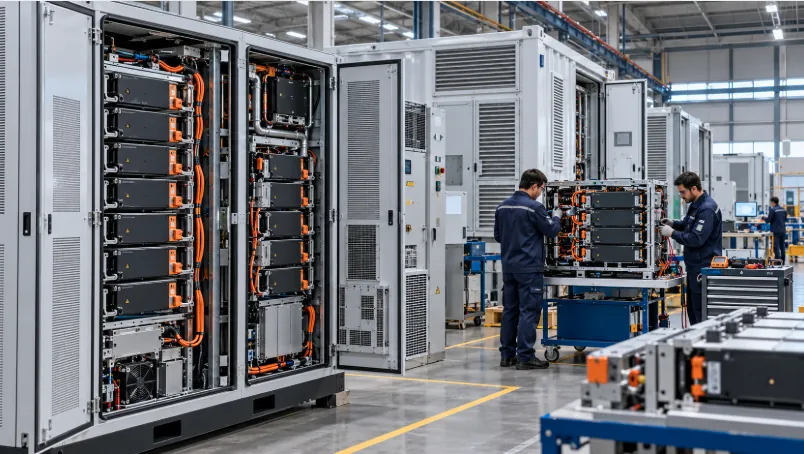
The process moves from tested cells to a commissioned system, and quality is checked at every handover. Cells are tested and grouped into modules, then built into racks and fitted into a container with HVAC and fire suppression. After PCS and EMS integration, the system undergoes factory acceptance testing before it ships. Teams check capacity, round-trip efficiency, thermal management and fire safety, using standards such as IEC 62619 and UL 9540A-type tests. A key early choice is module-level assembly versus integrating bought racks, along with liquid or air cooling.
- Cell testing and module assembly
- Rack integration
- Container fit-out (HVAC, fire suppression)
- PCS and EMS integration
- Factory acceptance testing
- Site installation and commissioning
Raw Materials and Machinery for Battery Storage Assembly
Your main inputs are LFP cells or modules, BMS, PCS, containers, HVAC and fire suppression. Cells are imported or come from emerging Indian cell plants, while PCS is sourced both domestically and from abroad. The test bay with load banks and the cell testers matter most, because they protect quality before a system leaves the plant.
- Cell testers
- Module assembly line
- Laser welders
- Rack assembly
- Test bay with load banks
- Container fit-out area
Battery Energy Storage System Assembly Licence and Approvals
Start with business registration and a factory licence, then secure consent to establish before building. Battery assembly without cell making is generally Green under CPCB S.No. 9.3. Cells need BIS registration under IS 16046, and CEA safety norms apply at site. Plan the fire NOC and EPR registration under the Battery Waste Management Rules before you begin commercial operation.
| Pollution category | Battery assembly without cell making is generally Green (CPCB S.No. 9.3) |
|---|---|
| HSN code | 8507 60 (lithium-ion accumulators) |
| GST | 18% on lithium-ion batteries; system supplies may follow other entries |
| BIS / quality control order | Cells need BIS registration (IS 16046); CEA safety norms apply at site |
| Other licences | EPR registration under the Battery Waste Management Rules; fire NOC; factory licence |
Choosing the Right Battery Storage Assembly Technology
Your technology choice shapes investment, skills and margins. Module-level assembly gives control over quality and cost, but it needs laser welders, cell testers and trained staff. Integrating bought racks is faster to start and suits teams strong in system design and project delivery.
Cooling is the second decision. Air cooling is simpler, while liquid cooling suits denser containerised systems. Your project report compares these routes for your target buyers and capacity.
Choosing the Right Battery Storage Plant Size
Plant size changes everything from land to team strength. Capacity ranges from roughly 100 MWh to 2 GWh per year, and indicative investment runs from about ₹20–300 crore, excluding land. A smaller plant can focus on C&I cabinets and one or two project types, while a larger one needs more land, power and orders. Many promoters begin small and add lines once references build up.
Government Schemes and Project Finance for Battery Storage Assembly
Viability Gap Funding for BESS supports storage projects, which can lift demand for assembled systems. PLI for advanced chemistry cells applies to cell makers rather than assemblers. NPCS reports are used for bank loans and government programmes, subject to each lender's requirements. A bankable report sets out costs, cash flow and payback clearly.
What Decides Success in a Battery Storage Assembly Plant
Good operators secure cell supply early, hold the right safety certifications and build project references. The main risks are dependence on imported cells and safety incidents. Rejected cells can go to recyclers, so plan a handling route for them.
- Reliable cell sourcing
- Safety certifications before bidding
- Documented project references
How NPCS Helps You Set Up a Battery Storage Assembly Plant
Our team works through the decisions that matter: capacity, technology, machinery and approvals. We help with machinery selection and specifications, vendor selection, plant layout, production process guidance, and installation and commissioning assistance. We also prepare bankable project reports that support your finance application.
NPCS's published client list records 50 assignments across electrical and electronics projects between 2013 and 2026, for clients in 14 states and 7 countries.
What Your Battery Energy Storage System Assembly Project Report Covers
- Project introduction and BIS specifications
- Manufacturing process with flow sheet
- Market survey (demand, imports/exports, existing units)
- Personnel
- Plant and machinery with suppliers
- Land and building with layout
- Raw materials with sources and rates
- Financials (project cost, working capital, cost of production, profitability, break-even, 5–10 year cash flow, projected balance sheet, IRR/NPV/payback)
Battery Energy Storage System Assembly: Frequently Asked Questions
How much does battery energy storage system assembly setup cost in India?
Indicative investment runs from about ₹20–300 crore, excluding land. The figure depends on capacity, technology and whether you assemble modules in-house. A project report works out the cost for your plan.
Which licences are needed for a battery storage assembly plant?
You need a factory licence, fire NOC and EPR registration under the Battery Waste Management Rules. Cells need BIS registration under IS 16046. Assembly without cell making is generally Green under CPCB S.No. 9.3.
How much land and power does a BESS assembly plant need?
A plant typically needs about 2–10 acres and a power load of about 500 kW–3 MW, depending on capacity. Water requirement is low. Your layout and equipment list will refine these figures.
How to start a battery energy storage system assembly business?
Begin by choosing your first buyers and variant, then fix technology and cell sourcing. Next, prepare a project report, secure consent to establish and line up finance. Our team can guide each step.
How can NPCS help with a battery storage assembly project report?
NPCS prepares a detailed project report covering process, machinery, approvals and financials for your capacity and location. Our team also supports machinery and vendor selection, plant layout and commissioning.