
 Sarda Metals & Alloys
 Tata Steel
 JSW Steel
 ITC (Agri Business Division)
 Godrej & Boyce
 Aditya Birla Management Corporation
 Grasim Industries (Century Rayon)
 Thermax (Chemical Division)
Drilling contractors, foundries, pellet plants and cat litter exporters all buy processed bentonite, and that demand is why entrepreneurs set up grinding and activation units. A bentonite processing plant consultant helps you pick grades, size the plant and line up approvals before money is committed. NPCS has advised industrial projects since 1994, and our team prepares project reports and feasibility studies that suit this kind of mineral processing unit.
Bentonite Processing Plant at a Glance
| Typical capacity | ~50–500 TPD |
|---|---|
| Land | ~2–6 acres |
| Power load | ~300 kW–1.5 MW |
| Water | Low |
| Manpower | ~20–80 |
| Indicative investment | ~₹2–20 crore |
Investment basis: excludes land.
Figures are indicative ranges. Your project report works them out for your capacity and location.
Market Demand for Bentonite Processing Plants in India
Demand for processed bentonite comes from industries that need a binder, a suspending agent or an absorbent. Iron-ore pelletising and cat litter exports are the main demand drivers named for this project. Production clusters sit near the clay deposits in Kutch (Bhuj) and Barmer, and export potential is high. Seasonality is low, so orders tend to be steady through the year.
- Drilling contractors for oil and borewell work
- Foundries needing sand binders
- Pellet plants making iron-ore pellets
- Pet-product exporters buying cat litter granules
Bentonite Products You Can Make
Each grade serves a different buyer, so your first choice shapes machinery and testing. Drilling and pelletising grades suit contract buyers who order in volume, while cat-litter granules need a granulator and suit exporters. Many new units start with one or two grades and add others later.
- Drilling grade, foundry grade, pelletising grade, cat-litter granules, civil (piling) grade, activated sodium bentonite
Bentonite Processing Plant Process
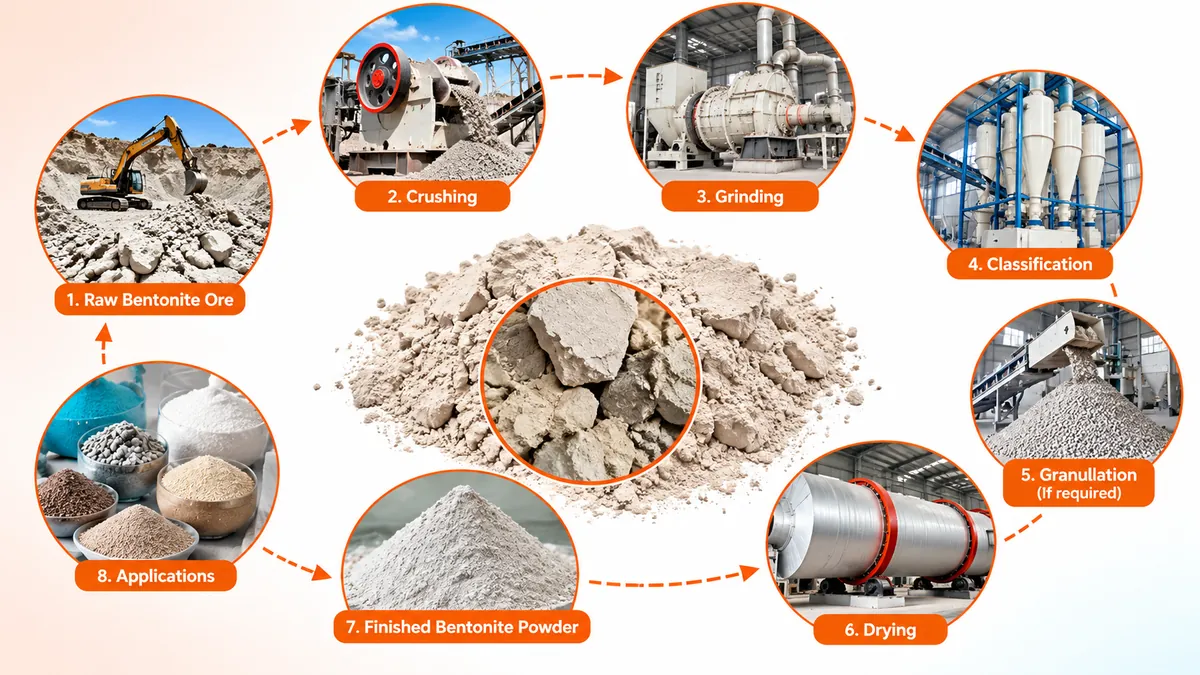
The bentonite processing plant process turns raw clay into a consistent powder or granule. Clay is crushed, mixed with soda ash to activate it, aged, dried, ground and classified by particle size. Litter grades go through granulation before bagging.
Quality control matters at every stage. Buyers test swelling index, viscosity, filtrate loss and moisture, and grades are measured against API 13A or IS 6186 depending on use. Rotary dryers and Raymond mills are the usual choice, with extruders as an option for activation.
- Crushing
- Soda ash activation
- Ageing
- Drying
- Grinding
- Classification
- Granulation (litter)
- Bagging
Raw Materials and Machinery for a Bentonite Plant
Your two main inputs are raw bentonite clay and soda ash for activation. Clay is typically sourced from Kutch in Gujarat and from Barmer in Rajasthan. The machines that most affect output and quality are the activation mixer or extruder, the rotary dryer and the Raymond mill.
- Crusher
- Activation mixer or extruder
- Rotary dryer
- Raymond mill
- Classifier
- Granulator
- Bagging
Bentonite Processing Plant Licence and Approvals
Approvals follow a set order. Register the unit first, then obtain consent to establish from the State Pollution Control Board before construction, and consent to operate before production. Grinding and processing of minerals falls in the Orange category (CPCB S.No. 88.5/90). You'll also need a mining lease or mineral dealer licence and transit passes for moving clay.
- Unit registration before any construction begins
- Consent to establish ahead of civil work
- Mining lease or mineral dealer licence with transit passes
- Consent to operate before commercial production
| Pollution category | Grinding and processing of minerals: Orange (CPCB S.No. 88.5/90) |
|---|---|
| HSN code | 2508 10 (bentonite) |
| GST | 5% on bentonite (Chapter 25) |
| BIS / quality control order | API and IS grade specifications used by buyers |
| Other licences | Mining lease or mineral dealer licence and transit passes |
Choosing the Right Bentonite Plant Size
Plant size decides both cost and market reach. Capacity typically runs from about 50 to 500 TPD, with investment of ~₹2–20 crore, indicative and excluding land. A smaller unit can focus on one grade, such as drilling or foundry. A larger one needs more land, power and working capital, but can serve pellet plants and exporters together.
Export Opportunity for Bentonite Products
Export potential for this project is high, and cat litter is the clearest example. Pet-product exporters buy granules in bulk, so a granulator line can open overseas orders. Buyers usually check swelling and moisture, so consistent testing and clean bagging help you hold those accounts over time.
Government Schemes and Project Finance
State incentives are the scheme route named for this project, and terms differ from state to state. Check the current policy where you plan to locate. NPCS reports are used for bank loans and government programmes such as PMEGP, MSME schemes, Mudra and NABARD-linked projects, subject to each lender's requirements.
What Decides Success in a Bentonite Processing Plant
Good operators secure consistent ore and master activation. The main risks are dust and freight, and fines from grinding are a by-product to plan for.
- Ore quality that stays consistent between lots
- Activation know-how with soda ash
- Dust control in crushing and grinding
- Freight cost from mine to plant
How NPCS Helps You Set Up a Bentonite Processing Plant
Our team works through the decisions that matter here: grades, capacity, dryer and mill selection, and the approvals sequence. We support machinery selection, vendor selection, plant layout, installation and commissioning. The result is a bentonite processing plant project report built around your capacity, location and budget.
NPCS's published client list records 4 assignments on bentonite processing projects between 2018 and 2024 for clients in 2 states and 1 country, including bankable project reports and techno-economic feasibility studies.
What Your Bentonite Processing Plant Project Report Covers
- Project introduction and BIS specifications
- Manufacturing process with flow sheet
- Market survey (demand, imports/exports, existing units)
- Personnel
- Plant and machinery with suppliers
- Land and building with layout
- Raw materials with sources and rates
- Financials (project cost, working capital, cost of production, profitability, break-even, 5–10 year cash flow, projected balance sheet, IRR/NPV/payback)
Bentonite Processing Plant: Frequently Asked Questions
How much does a bentonite processing plant cost in India?
Investment typically ranges from about ₹2–20 crore, depending on capacity, and this excludes land. Capacity usually runs from about 50 to 500 TPD. Your project report works out exact figures for your chosen grades and location.
Which pollution category applies to a bentonite processing plant?
Grinding and processing of minerals falls in the Orange category under CPCB S.No. 88.5/90. You'll need consent to establish before construction and consent to operate before production from the State Pollution Control Board.
How much land and power does a bentonite plant need?
A plant typically needs about 2–6 acres and a power load of about 300 kW–1.5 MW, depending on capacity. Water requirement is low. These are indicative ranges, and your layout and machinery choice will refine them.
How to start a bentonite processing plant business?
Start by choosing target grades and buyers, then secure clay supply from sources such as Kutch or Barmer. Next, prepare a project report, finalise machinery, and obtain registration and pollution board consents before building.
How can NPCS help with my bentonite plant?
NPCS prepares bankable project reports and feasibility studies, and supports machinery selection, vendor selection, layout and commissioning. Share your planned capacity and location, and our team will outline costs and approvals.