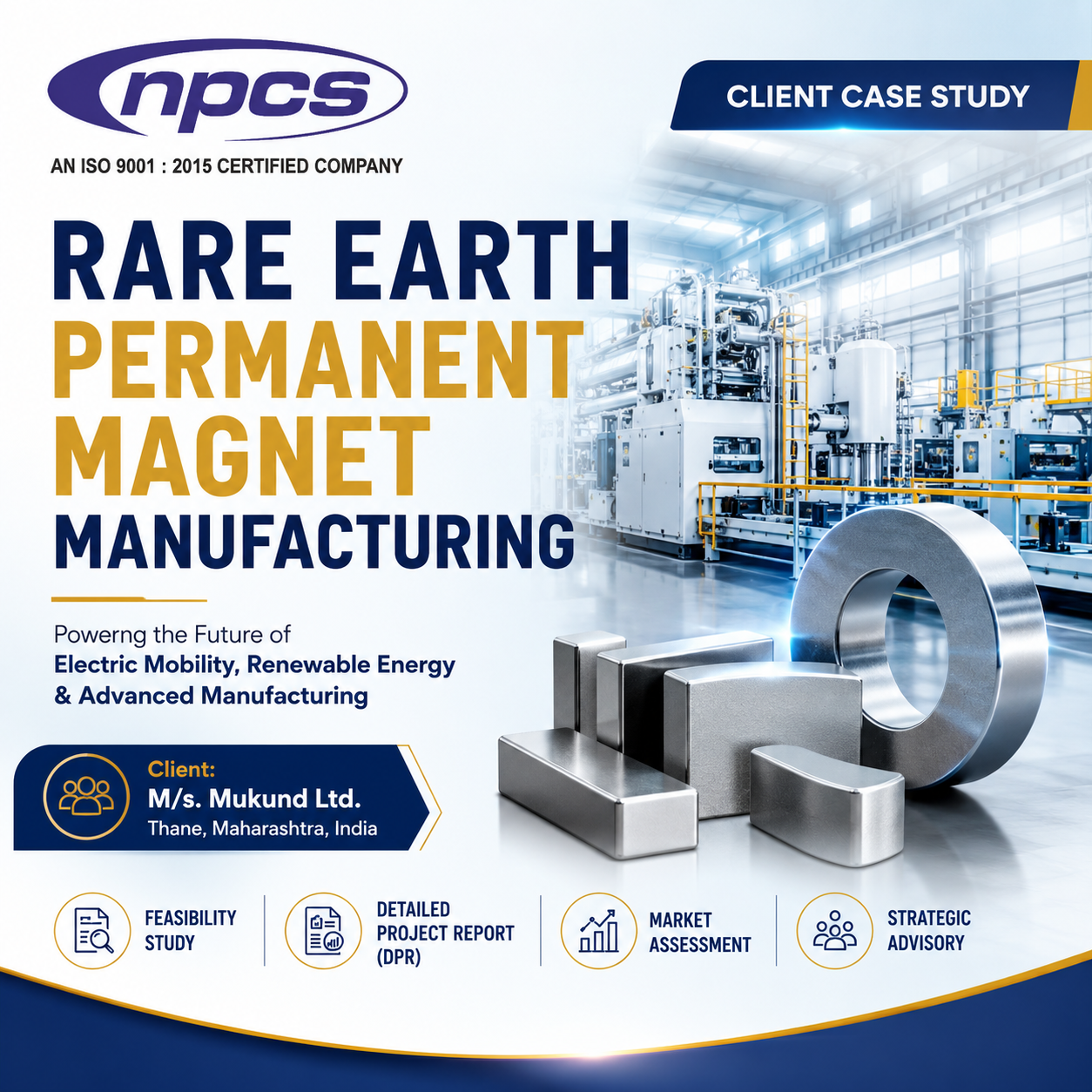

Why Mukund Ltd. Chose Rare Earth Magnet Manufacturing — and How NPCS Built the Case for It
Why Mukund Ltd. Chose Rare Earth Magnet Manufacturing — and How NPCS Built the Case for It
A Thane-based industrial company was looking for its next major investment. The answer turned out to be one of the most strategically significant manufacturing opportunities in India right now.
Mukund Ltd. had the appetite for a serious manufacturing investment. What they needed was a sector that made sense — not just on paper, but in terms of real market demand, operational feasibility, and a capital structure they could justify to stakeholders. They came to NPCS with that brief, and the engagement led them to rare earth permanent magnet manufacturing.
It's a sector that doesn't come up in most investment conversations, but it probably should. India currently imports over 90% of its rare earth permanent magnet requirements, predominantly from China. At the same time, domestic demand is accelerating rapidly — driven by EV manufacturing under the FAME II and PLI schemes, wind energy capacity targets of 140 GW by 2030, defence modernisation programs, and the broader expansion of industrial automation and robotics. The supply gap is real, and the window to enter as a domestic manufacturer is open right now.
NPCS worked through a twelve-week engagement to take Mukund Ltd. from initial opportunity screening to a fully developed Detailed Project Report. The process started with a structured evaluation of the client's objectives, capital position, and regional industrial relationships in Thane — and then moved into a thorough analysis of the rare earth magnet market before any technical work began.
The manufacturing process for sintered NdFeB magnets is genuinely complex, and that complexity was a key part of the challenge NPCS was brought in to address. The production flow runs from raw material procurement — neodymium, praseodymium, dysprosium, iron, and boron in controlled purity grades — through vacuum induction melting, strip casting, hydrogen decrepitation, and jet milling down to particle sizes of 3–5 microns under inert gas conditions, followed by magnetic alignment and compaction, vacuum sintering at temperatures between 1,050 and 1,100°C, precision surface treatment and coating, and final magnetization with full BH curve quality testing. Getting that process right requires specific equipment — vacuum induction melting furnaces, strip casting machines, hydrogen decrepitation reactors, isostatic presses, vacuum sintering furnaces, CNC cutting and grinding equipment, and impulse magnetizers — and NPCS identified and specified the full machinery list as part of the technical feasibility work.
On the financial side, the DPR covers the complete investment picture: capital costs across plant and machinery, infrastructure and utilities, and working capital requirements. The financial projections — IRR, payback period, EBITDA margin, and break-even timeline — were modeled under both conservative and optimistic demand scenarios. The project also qualifies for PLI scheme benefits and priority sector lending, which improves the overall economics meaningfully. The specific figures are held within the confidential DPR, but the headline outcome was clear: the project cleared NPCS's viability benchmarks on every key financial metric.
Mukund Ltd. reviewed the full feasibility study and DPR and confirmed they are proceeding with the next phase of implementation planning. For a company entering a technically demanding, capital-intensive manufacturing category, having that level of preparation behind the decision makes a considerable difference.