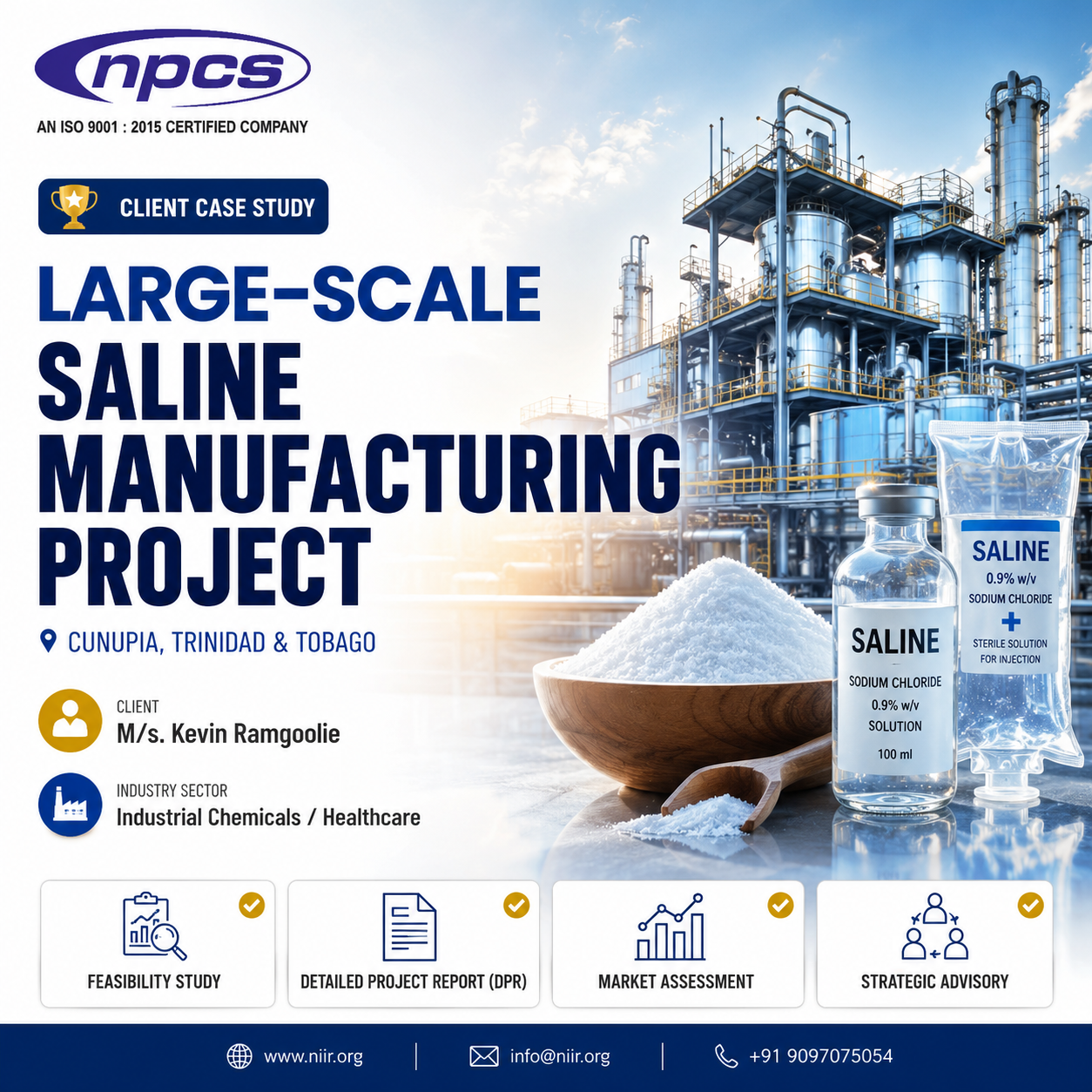

Trinidad Imports Most of Its Saline. Kevin Ramgoolie Wants to Be the One Who Changes That.
Trinidad Imports Most of Its Saline. Kevin Ramgoolie Wants to Be the One Who Changes That.
A Feasibility Study for a Large-Scale Saline Plant in Cunupia — Built Around Caribbean Market Reality, Not Assumptions
Saline solution is one of those products that never stops being needed. Hospitals go through it constantly — for IV therapy, wound irrigation, surgical procedures, and a dozen other clinical applications. The Caribbean healthcare system is no exception, and for years the region has met that demand almost entirely through imports. For an entrepreneurial investor paying attention to where the gaps are, that's a significant signal.
M/s. Kevin Ramgoolie, based in Cunupia, Trinidad and Tobago, was paying attention. The idea of building a local saline manufacturing plant made intuitive sense — but intuition doesn't satisfy lenders, doesn't answer technical questions about pharmaceutical-grade production requirements, and doesn't tell you whether the numbers actually work at the scale you're imagining. That's where NPCS came in.
The engagement started with something NPCS treats as non-negotiable: confirming the right opportunity before doing anything else. Several manufacturing categories relevant to the Caribbean's industrial profile were screened and assessed. Saline came through that process as the strongest candidate — not because it was the most glamorous option, but because the fundamentals were unusually solid. Demand is consistent and largely non-cyclical. The core raw materials — pharmaceutical-grade sodium chloride and purified water — are accessible and not subject to the kind of supply chain volatility that can undermine a new manufacturing operation. And the import substitution angle is genuine: Trinidad and Tobago, along with much of the Caribbean, currently brings in saline from outside the region, which creates both a market opening and a pricing advantage for a domestic producer.
The technical side of saline manufacturing is more demanding than the product's simplicity might suggest. Producing pharmaceutical-grade saline for healthcare use means working to exacting standards at every stage. Water purification alone involves reverse osmosis, deionization, and UV sterilization to reach Water for Injection quality. Sodium chloride is dissolved under controlled conditions to hit precise concentration targets — 0.9% w/v for normal saline. The solution then goes through multi-stage filtration, in-process quality testing covering pH, osmolarity, conductivity, and endotoxin levels, aseptic filling into pre-sterilized containers under Grade A clean room conditions, and terminal sterilization by autoclave before final QC release and dispatch. Every step has a regulatory requirement attached to it, and the facility design has to account for all of them.
NPCS mapped this process in full, specified the machinery required at each stage — water purification systems, stainless steel mixing tanks, sterile filtration assemblies, automated filling lines, autoclaves, and clean room infrastructure — and reviewed the applicable compliance frameworks. Getting pharmaceutical registration right from the start is not something you want to retrofit into a plant that's already been designed and built around different assumptions.
The financial model was built to be used in real conversations, not just filed away. Capital requirements, operating cost structure, revenue projections based on institutional healthcare contracts and distribution networks, IRR, payback period, and break-even analysis were all modeled under multiple scenarios. The output was structured specifically to hold up in discussions with lenders and investors. Beyond Trinidad and Tobago's domestic healthcare system, the analysis also identified export potential across Caribbean island nations — a meaningful upside that extends the addressable market well beyond a single-country footprint.
Kevin Ramgoolie reviewed the complete Detailed Project Report and the phase-wise implementation roadmap, and approved the project concept to proceed toward implementation planning.