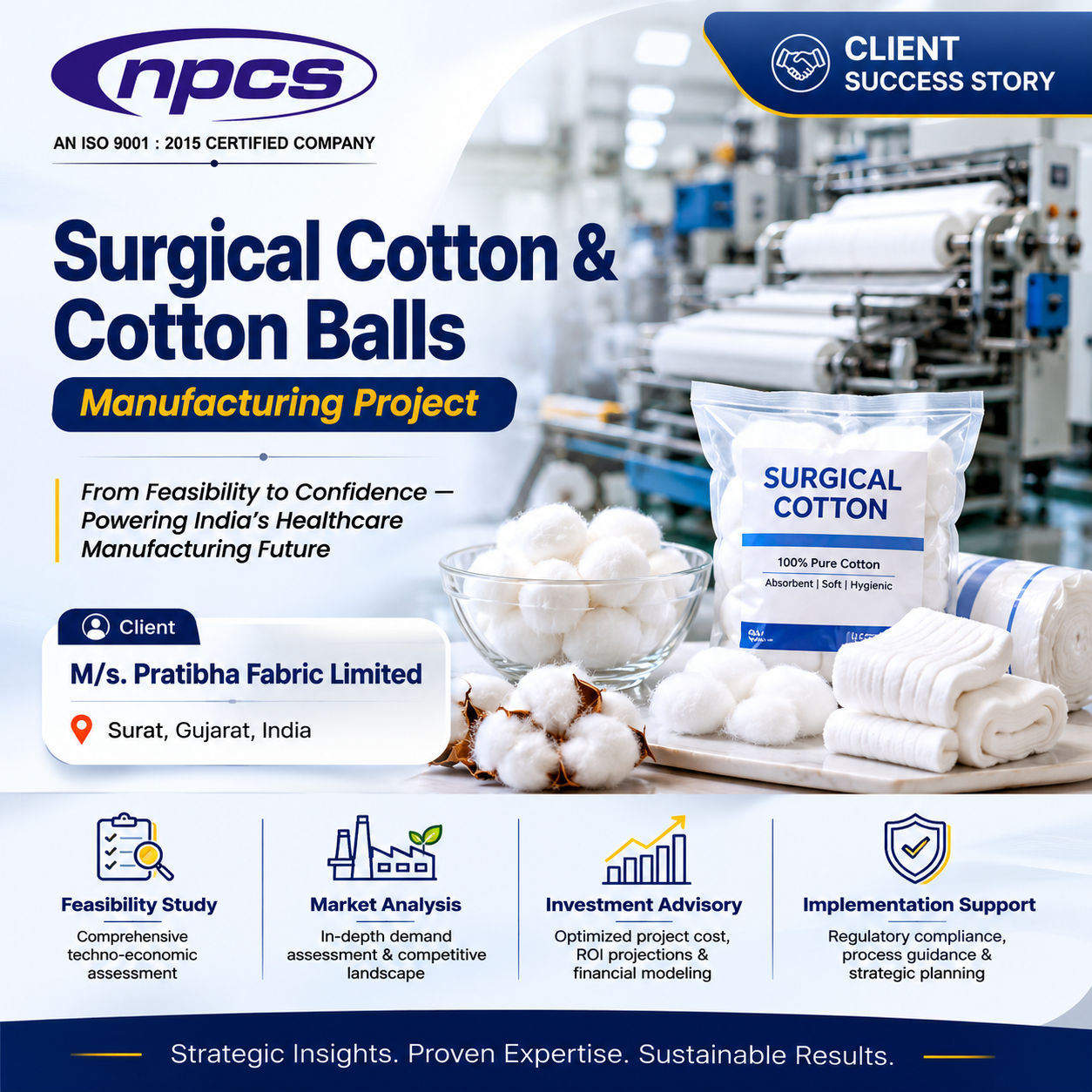

From Textile Roots to Healthcare Manufacturing — Pratibha Fabric Limited's Strategic Leap with NPCS
From Textile Roots to Healthcare Manufacturing — Pratibha Fabric Limited's Strategic Leap with NPCS
A Surat-based fabric company wanted to diversify into medical consumables. We helped them figure out exactly where to go — and whether it was worth it.
Pratibha Fabric Limited has been a known name in Gujarat's textile industry. But the leadership team had been thinking bigger for a while. They could see the limitations of staying in a single sector, and they had their eyes on healthcare consumables — a space that felt adjacent to what they already knew, yet promised steadier demand and better long-term margins.
The question wasn't whether to diversify. It was where, exactly, and whether the numbers actually worked.
That's the conversation they brought to NPCS.
After reviewing the client's capabilities, regional advantages, and investment priorities, our recommendation was surgical cotton and cotton balls manufacturing. It sounds straightforward, but the reasoning behind it was anything but arbitrary.
Gujarat is India's largest cotton-producing state. Surat has logistics infrastructure, export connectivity, and an established industrial ecosystem. Pratibha's existing knowledge of textile fiber processing was directly transferable to absorbent cotton manufacturing. And the end market — hospitals, clinics, pharmacies, pharmaceutical companies, and retail consumers — buys this product consistently, recession or not.
India's medical cotton market is growing at somewhere between 8% and 12% annually. A significant portion of what the country consumes is still imported. For a domestic manufacturer meeting BIS standards, that's not just a market opportunity — it's a structural opening.
We worked through the project across five phases. First, we screened more than a dozen manufacturing options against the client's specific criteria before landing on surgical cotton as the strongest fit. From there, we went deep on market analysis — demand volumes, buyer segments, competitive pricing, five-year forecasts. We mapped the raw material supply chain across Gujarat, assessed seasonal pricing dynamics, and identified supplier risk factors.
On the technical side, we laid out the full manufacturing process: raw cotton procurement and grading, mechanical cleaning and opening, carding and lapping, bleaching with hydrogen peroxide or sodium hypochlorite, washing, drying, and optional ETO sterilization for surgical-grade product. We specified the machinery required at each stage, from carding machines and bleaching tanks to ball-forming equipment, hydro extractors, and automated packaging lines.
The financial modeling covered the full picture — capital expenditure across land, civil construction, plant and machinery, utilities, lab setup, pre-operative costs, and working capital. Our projections showed an ROI in the range of 25% to 35% annually, an IRR between 20% and 28%, and a payback period of roughly 3.5 to 5 years. Break-even was achievable at around 55% to 65% capacity utilization — a realistic target for Year 2 of operations.
We also walked the client through the regulatory landscape: BIS IS:1440 standards for absorbent cotton, CDSCO licensing requirements, and GMP compliance for medical-grade production. These aren't afterthoughts in this industry — getting the compliance picture wrong early can cost months of delays and real money.
By the end of the engagement, Pratibha's leadership had a clear, grounded view of what this project would cost, what it would return, what risks existed, and how to sequence the execution. They decided to proceed with full implementation.