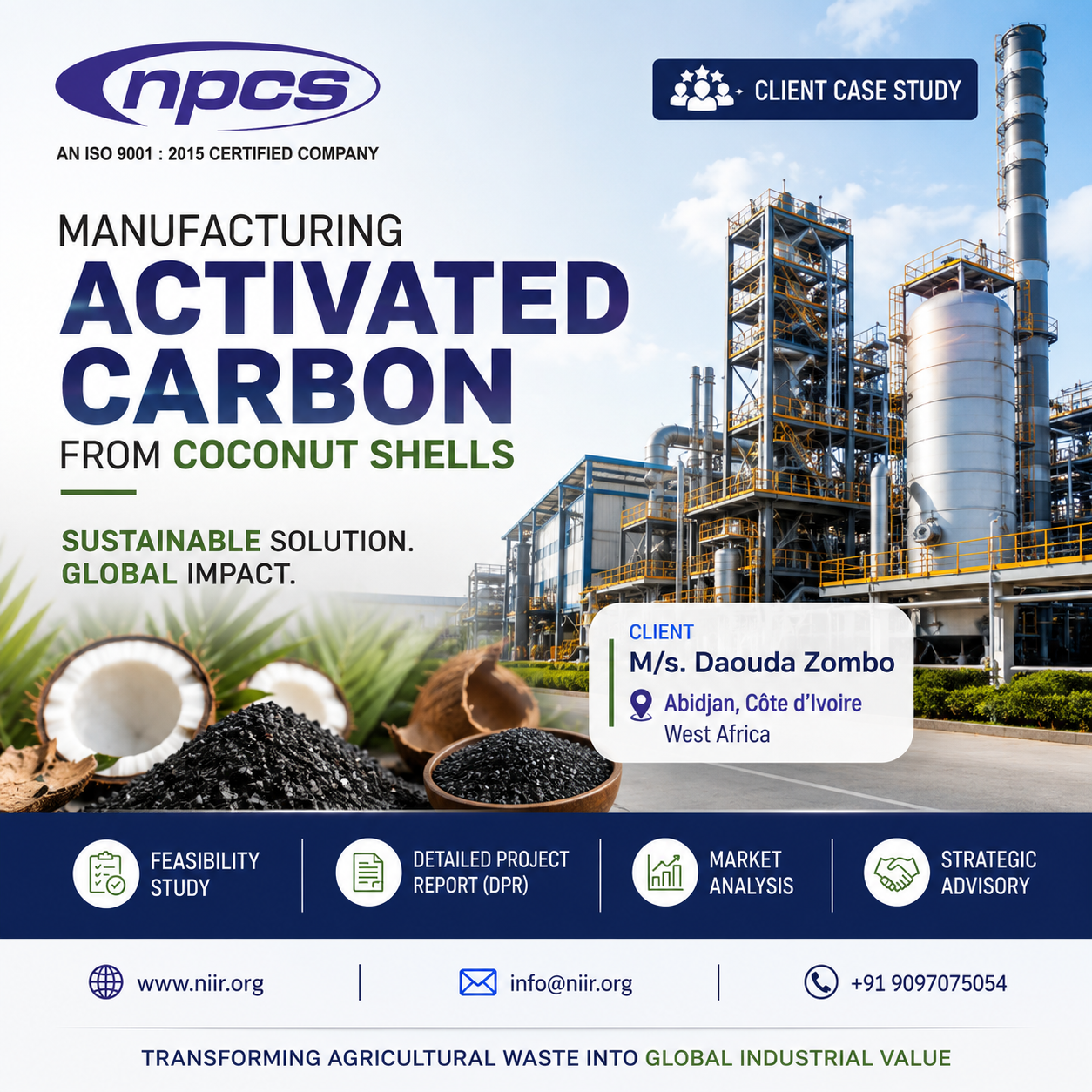

From Agricultural Waste to Industrial Gold — Activated Carbon Manufacturing in Côte d'Ivoire
From Agricultural Waste to Industrial Gold — Activated Carbon Manufacturing in Côte d'Ivoire
How a West African entrepreneur turned coconut shells into a bankable industrial venture with NPCS
When Daouda Zombo came to us, he had a clear goal but a complex problem. Based in Abidjan, he wanted to build something real — a manufacturing business grounded in local resources, with genuine export potential and a financial return worth the risk. He wasn't looking for a generic report. He needed a partner who could tell him honestly whether the opportunity was viable.
We recommended activated carbon manufacturing from coconut shells. Not because it was fashionable, but because the numbers made sense and the conditions in Côte d'Ivoire made it genuinely compelling.
Coconut shells are one of the best raw materials for activated carbon production. They produce carbon with a high micropore density, low ash content, and excellent hardness — qualities that water treatment plants, pharmaceutical manufacturers, and gold refineries actively seek out. And Côte d'Ivoire, with its growing coconut sector and strong government support following the 2024 Abidjan summit with the International Coconut Community, offered a real feedstock advantage that few other locations could match.
We worked through the project in nine weeks, covering everything from raw material sourcing and process selection to financial modelling and export market mapping. On the technical side, we recommended steam activation over chemical methods — cleaner output, lower regulatory burden, and a product that meets international standards without the complications of chemical handling.
The financial picture held up under scrutiny. Manufacturing costs came in around USD 1.82 per kg, with a total product cost near USD 2.15 per kg — against a U.S. import benchmark of roughly USD 2.09 per kg at the time of analysis. With gross margins in the 35–45% range and a projected IRR above 21%, the payback period came in under five years. We stress-tested the model and it stayed positive.
Beyond the numbers, what mattered most was positioning. Daouda is entering this market early. There's no established coconut-shell activated carbon manufacturer in Côte d'Ivoire yet — which means he has a real first-mover advantage in both the domestic market and across West Africa, while also being well-placed to supply buyers in the U.S. and EU who are actively looking for reliable, sustainable sources.
The project has been approved. Site selection near Abidjan is underway, equipment procurement is in progress, and raw material agreements with local coconut processors are being negotiated. We're continuing to support the implementation phase.
This is exactly the kind of project we built our practice around — identifying the right opportunity, validating it rigorously, and giving an investor the confidence to move forward without second-guessing themselves at every turn.