
Introduction: TVS Motor case study
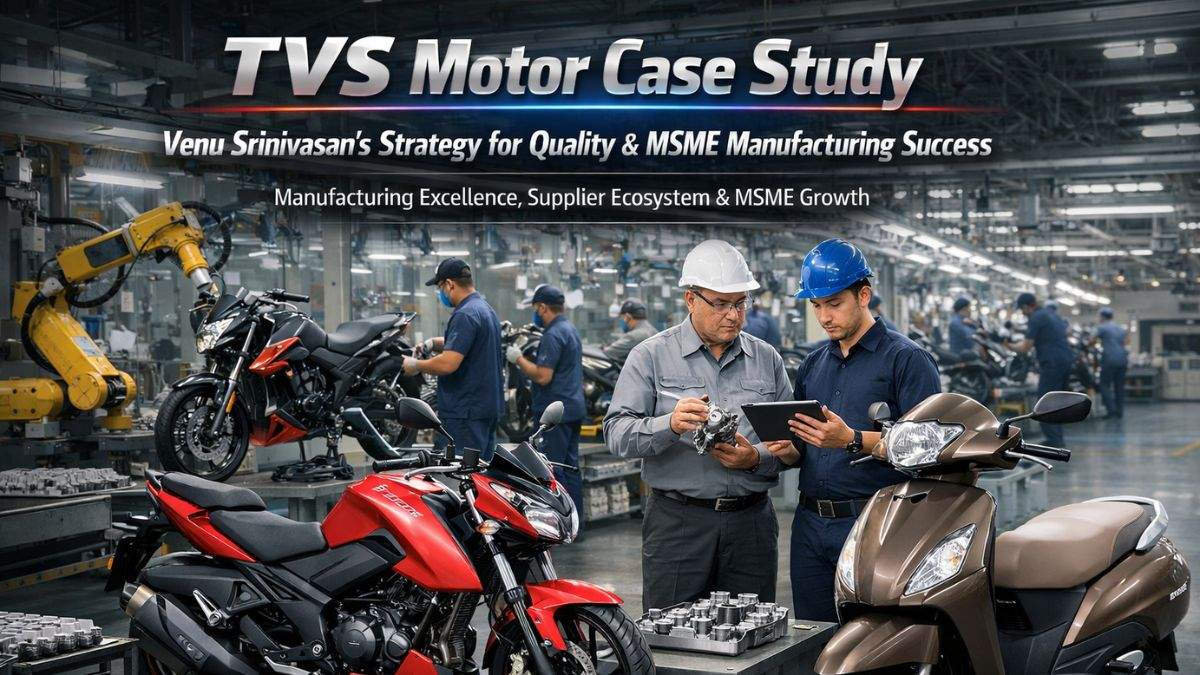
The tale of Venu Srinivasan and TVS Motor Company is not merely a corporate success story- it is a roadmap of how focused manufacturing, long term thinking, and quality-first approach can take an Indian firm to become a global player.
When most of the industries in India were concentrating on cost advantage, TVS took the other route; it was competing in terms of quality, systems and engineering excellence. This move did not only affect the company, but also impacted the automotive environment in India as a whole.
TVS Motor is one of the most reputed two-wheeler manufacturers in the world today and its history has offered some significant lessons to entrepreneurs in the auto component, EV manufacturing and MSME sector.
Get Detailed Insights from This Book: Our Books
The Vision of Venu Srinivasan: Building Through Discipline
At the time Venu Srinivasan became the head of the company, Indian manufacturing was at its early stages. The majority of businesses were oriented on mass production but not on quality of the processes. TVS, however, took a totally different path.
The company based its foundation on the notion that quality is not a department- but a culture.
One of the most significant changes was when TVS Motor was the first Indian company to be conferred the Deming Prize, which has been widely recognized as one of the most important awards in the world in terms of quality management. This was the testament to the fact that Indian manufacturing was capable of being of Japanese world standard.
Rapid expansion was not in the spotlight but rather:
- Developing effective internal mechanisms.
- Working out regular production cycles.
- Educating employees about quality discipline.
- Developing sustainable engineering.
This platform subsequently assisted TVS to expand internationally without fear.
TVS Motor Company: World Mobility Leader.
The TVS Motor Company is currently operating in Asia, Africa and Latin America. It is among the two biggest manufacturers of two-wheelers in the world, with millions of customers every year.
This industry is one of the most powerful industrial sectors in India as India is among the largest two-wheeler markets in the world with 16-18 million units sales each year.
TVS managed to achieve success since it had a basic knowledge: in the emerging markets, people need to be mobile and this aspect needs durability, affordability, and reliability rather than luxury engineering.(TVS Motor case study)
Key strengths of TVS Motor include:
- Powerful commuter-based product design.
- Intensive knowledge of the new market requirements.
- Moderate cost and quality system.
- Good export policy in the developing regions.
This mix enabled TVS to fight with Japanese and other international brands.
India’s Auto Component Industry: The Real Growth Engine
Although such automobile firms as TVS are very visible, the powerhouse of the industry is its auto component ecosystem. The industry is supported by thousands of MSMEs in India which are the suppliers of parts to OEMs.
These are engine components, braking components, electrical components and high precision machined assemblies. This ecosystem is among the most significant industrial industries in India due to its size and complexity.
Key segments in auto manufacturing include:
- Precision machined components
- Rubber and plastic moulded parts
- Electrical wiring harnesses.
- Engine and transmission parts.
- EV battery and controller systems.
This ecosystem enables even small-scale entrepreneur to venture into the industry without necessarily assembling full cars.
View Full Project Details: Electric Vehicle Business Setup Guide
EV Revolution: The Biggest Opportunity for MSMEs
The transformation in electric mobility is changing the whole automotive sector. Electronic and battery-based systems are substituting traditional mechanical systems.(TVS Motor case study)
This shift has opened up colossal prospects in:
- EV battery packs
- Motor controllers
- BMS (Battery Management Systems)
- Charging infrastructure components
- Lightweight structural parts
This shift is further being accelerated by government assistance in the form of FAME-II and PLI schemes.
Why EV manufacturing is attractive for entrepreneurs:
- Reduced mechanical complexity than ICE engines.
- High government incentives
- Rapidly growing demand
- Export opportunities in international EV markets.
Nonetheless, to succeed in this industry, one should have high level of technical skills and invest in quality systems at an early age.
Related Article: Build a Profitable EV Station Franchise: A Strategic Guide for New-Age Entrepreneurs
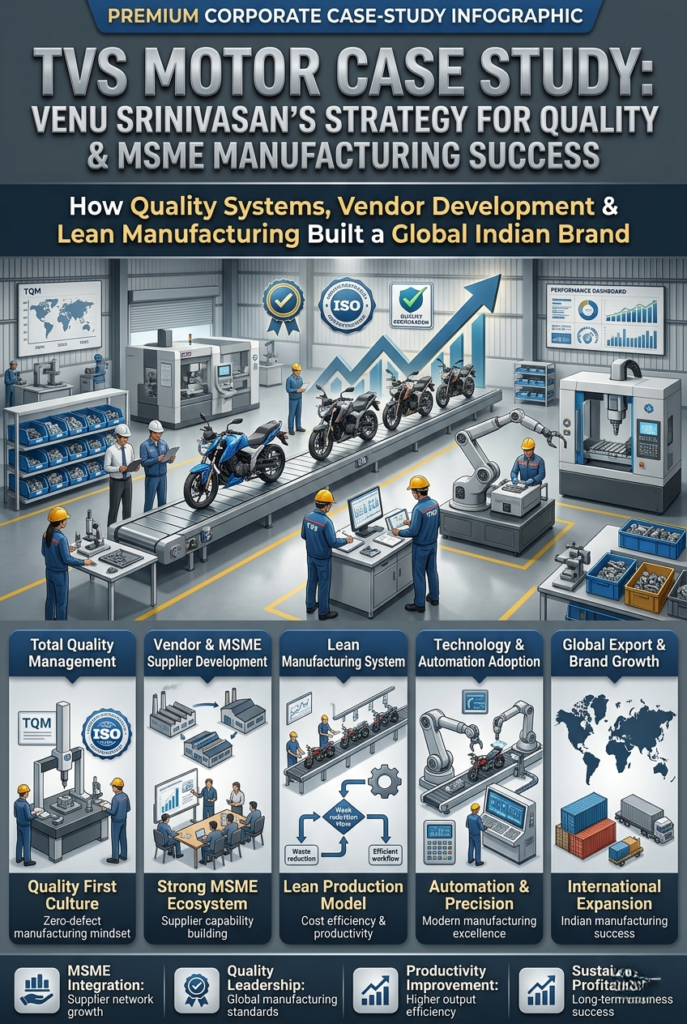
Manufacturing Discipline: The TVS Philosophy
Among the greatest lessons learnt at TVS is that the success in manufacturing relies on systems, rather than machines.
The company adheres to a philosophy in which each production process is geared towards minimizing variation and enhancing consistency. This is based on Japanese manufacturing ideals.
Core manufacturing principles followed by TVS:
- Not inspected later, quality built into the process.
- Continuous improvement on all levels.
- Strong supplier integration
- Very keen attention to reliability engineering.
This field has helped TVS gain long-term credibility of international partners and internationalize.
Export Growth: India is Developing a Global Presence.
TVS Motor has been able to venture into new market like Africa, Southeast Asia and Latin America. These areas like durable, cheap and low maintenance cars- areas that Indian manufacturers are good at.(TVS Motor case study)
The auto component sector in India is also increasing rapidly in exports because of the cost competitiveness and quality improvement.
The major export strengths of the Indian manufacturers:
- Lower production costs
- Skilled engineering workforce
- Improving global certifications
- Strong MSME ecosystem
With the globalization of supply chains, India has emerged as a destination of choice in manufacturing.
Government Support for Manufacturing Entrepreneurs
India has developed a robust policy environment to promote manufacturing. These programs are particularly significant to MSMEs and startups.
There are major schemes that are:
- Production Linked Incentive (PLI) Scheme.
- FAME-II: electric mobility.
- CGTMSE collateral-free loans
- PMEGP of small manufacturing industries.
- Udyam registration benefits
These schemes contribute to decreasing the financial hurdles and enhancing project viability, particularly in capital-intensive sectors.
Build a profitable business with the right idea
NPCS: Supporting Industrial Entrepreneurs in India
NPCS (Niir Project Consultancy Services) can be of great help in advising entrepreneurs within the manufacturing industry. It is also involved in the preparation of Detailed Project Reports (DPRs) that assist investors in knowing the technical and financial viability of industrial projects.
NPCS helps entrepreneurs by offering:
- Market research and demand analysis.
- Manufacturing process planning
- Guidance on machinery and plant set-up.
- Details of sourcing raw materials.
- Profitability studies and financial predictions.
This proves to be of great value to first-generation entrepreneurs as most manufacturing failures are as a result of poor planning as opposed to absence of demand. NPCS assists in minimizing this risk through structured and data-driven project insights.
Key Lessons from the TVS Growth Story
The experience of TVS Motor Company teaches the contemporary businessperson some valuable lessons:
- The quality systems should be constructed at the very beginning.
- Technology alliances have the capacity to expedite development.
- Specialization in one product area then diversify.
- Even MSMEs need to think on an international scale.
- Discipline, and not shortcuts, are the keys to manufacturing success.
These are very applicable principles today to anyone venturing in the auto or EV manufacturing industry.(TVS Motor case study)
Conclusion: The Future of Indian Manufacturing
The history of Venu Srinivasan and TVS Motor Company demonstrates that Indian manufacturing can be competitive in the world when it is founded on good systems and quality discipline.
India is currently going through a new industrial phase, prompted by EV adoption, incentives in the government, and global supply chain changes. This forms an enormous opportunity to MSMEs and startups.
The people who will emerge successful in this new era of growing manufacturing will be the entrepreneurs who are different in their approach to quality, innovation and their approach to planning.
Frequently Asked Questions (FAQ)
Q1. What is the secret of success of TVS Motor Company?
The success of TVS Motor is founded on the sound quality systems, disciplined manufacturing and long-term investment in engineering.
Q2. Are MSMEs good in the auto component industry?
It is, of course, one of the most promising sectors because of the high demand, growth of exports, and EV expansion.
Q3. What will become of EV production in India?
Government incentives and increase in global demand are likely to drive the EV sector at a high level.
Q4. What is NPCS?
NPCS (Niir Project Consultancy Services) offers Detailed Project Reports, Feasibility studies, and consultancy services to manufacturing companies.
Q5. The amount of investment required to initiate a manufacturing unit?
The minimum investment is 50 lakh per small unit and can go up to several crores depending on the nature of the project.