



Introduction: Startup India funding scheme
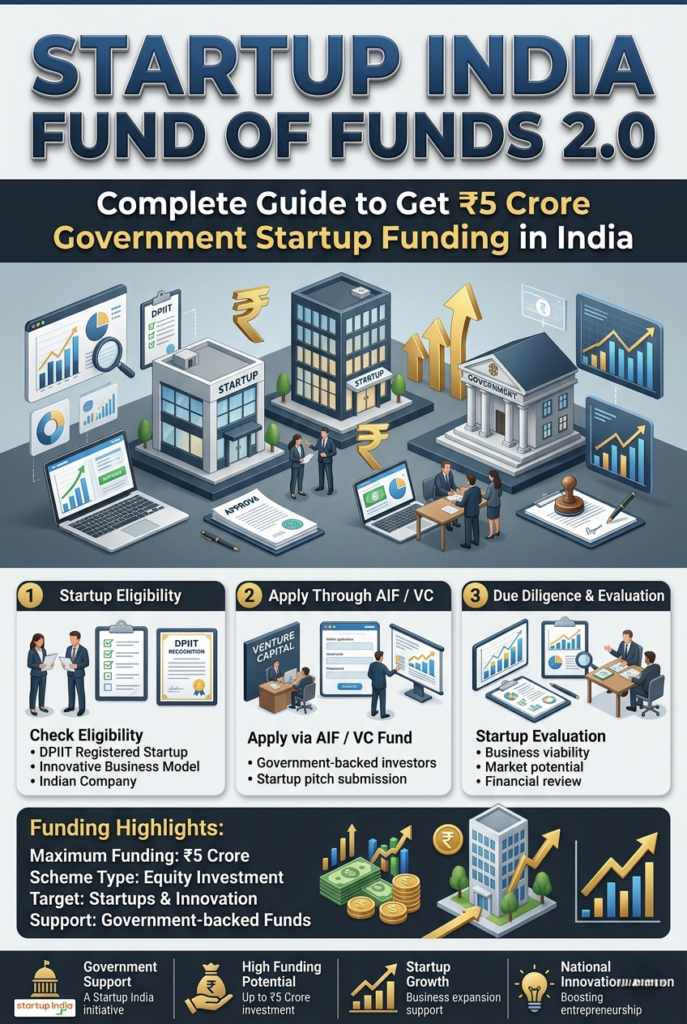
The Startup India Fund of Funds 2.0 (FoF 2.0) is the new phase in the development of the startup ecosystem in India. The scheme has a huge corpus of 10000 crore to fund innovative and scalable startups in the country.
This scheme does not provide funds directly to founders as opposed to direct government grants. Rather, investments are made by means of registered Alternative Investment Funds (AIFs), which invest in startups after assessing their potential.
This implies that founders have to concentrate on developing a robust business that will attract investors as opposed to submitting applications to a government portal in order to gain access to funds.
How Startup India Fund of Funds 2.0 Works
FoF 2.0 has a very basic structure that is, nevertheless, vital to get familiar with:
- Government gives funds to SIDBI.
- SIDBI is investing in registered AIFs.
- AIFs invest in startups.
Therefore, investors decide the actual funding and not the government.
In basic terms: Government finances the ecosystem, investors the startups.
Related Article: Startup India Fund of Funds 2.0: ₹10,000 Crore Government Scheme for Deep Tech & Manufacturing Startups
Who Can Get Funding Under This Scheme
This plan will be used in startups that are scalable and innovation driven. It mainly supports:
Deep tech, artificial intelligence, robotics, EV technology, clean energy, advanced manufacturing and industrial innovation.(Startup India funding scheme)
It also gives a boost to startups that are in their initial stages but have some form of market validation but require funding to grow a notch higher. Startups in Tier 2 and Tier 3 cities are another key area of concern under this scheme and are currently being actively encouraged.
Not every business is a good one though.
Not eligible:
- Traditional trading businesses
- Non-registered entities
- Businesses without innovation
- Old firms above the age of startups.
Step-by-Step Process to Get Funding
It is a process that is well-organized and time-consuming however when done properly it is simple to fund.
The initial one is obtaining DPIIT Startup Recognition via the Startup India portal. In its absence, there is no access to the ecosystem that is linked to FoF 2.0.
Then your company should be incorporated as either a Private Limited or LLP under MCA. This is necessary since AIFs only invest in formal corporate structures.
This is followed by documentation which is very crucial to success by investors.
Get Detailed Insights from This Book: Our Books
Important documents needed are:
- Investor pitch deck
- Business model explanation
- Financial projections
- Details of products or technology.
- Team background
In the case of manufacturing and deep tech startups, Detailed Project Report (DPR) is essential due to the desire of investors to have clear financial and technical disclosure.
Importance of Detailed Project Report (DPR)
One of the most significant documents involved in the funding approval is a DPR, particularly in manufacturing, chemicals, EV, food processing, and industries.
It assists the investors to comprehend:
- Project setup and cost requirements.
- Revenue and profit forecasts.
- Technical feasibility
- Market demand analysis
- Production capacity planning
A good DPR boosts investor confidence and decreases due diligence time.
Role of NPCS in Startup Funding
NPCS (NIIR Project Consultancy Services) is the one that assists startups with the preparation of professional DPRs and feasibility studies.
They offer research and systematized project reports endorsed by the industry and extensively used in the funding discourse.
Why NPCS is useful for startups:
- Prepares project reports in the details of various industries.
- Provides feasible cost and profit analysis.
- Assists in the planning of manufacturing and industrial projects.
- Improves credibility during investor meetings
This can particularly come in handy when a startup is seeking AIF investors or bank lenders as it helps to substitute assumptions with data-supported forecasts.
Website: https://niir.org
Get Detailed Project Report (DPR): Project Reports & Profiles
How Long Does the Funding Process Take?
The startup funding process is not immediate. It is based on preparation and interest of investors.(Startup India funding scheme)
On average:
- DPIIT registration: 7–10 days
- Investor outreach: 1–2 months
- Due diligence: 3–6 months
- Legal closing: 1–2 months
Time taken: 6-12 months in total.
Well-equipped startups with their pitch decks and DPRs typically receive quicker funds.
Common Mistakes Startups Make
Numerous startups cannot get funding because they have bad ideas but rather because they execute their ideas poorly.
Common mistakes include:
- Application without DPIIT recognition.
- Weak financial planning
- Lack of a definite business model.
- Targeting wrong investors
- Inadequate documentation.
These errors can be prevented, and it will be a great benefit to the success of funding.
Choose the right startup backed by real market demand
How to Increase Your Chances of Funding
To better its funding opportunities with FoF 2.0, startups ought to consider:
- Creation of a robust MVP or prototype.
- Early recognition by DPIIT.
- Preparation of professional DPR.
- Focusing on industry-oriented AIF investors.
- Becoming members of incubators or accelerators.
These measures will enable the creation of credibility and appeal to serious investors.
Conclusion
One of the largest opportunities to 2026 Indian entrepreneurs have is Startup India Fund of Funds 2.0. It is not however, a direct funding scheme. It is an investor-driven ecosystem where success is dependent on preparation, documentation, and targeting investors.
Strong business models and professional documentation such as DPRs and a well-defined growth strategy will increase the chances of a startup securing funds considerably.
This scheme can be used to scale Indian startups with the right strategy to take their notion to scalable and globally competitive companies.
Frequently Asked Questions (FAQ)
Q1. Can I directly apply for FoF 2.0 funding?
No, it is not funded by the government, but by AIF investors.
Q2. Is it required to be registered by DPIIT?
Yes, it is compulsory in order to be eligible in Startup India schemes.
Q3. Should startups have revenue in order to be funded?
Not always. Funding can be secured by early-stage and deep tech startups without revenue in case the potential is high.
Q4. What is the funding range?
Usually 50 lakh to 5 crore based on the level of start up and investor.
Q5. So, what does DPR mean?
It offers organized financial and technical transparency, boosting investor confidence.
Q6. What does NPCS do to assist startups?
NPCS offers professional DPRs and feasibility studies enhancing chances of success in funding.


