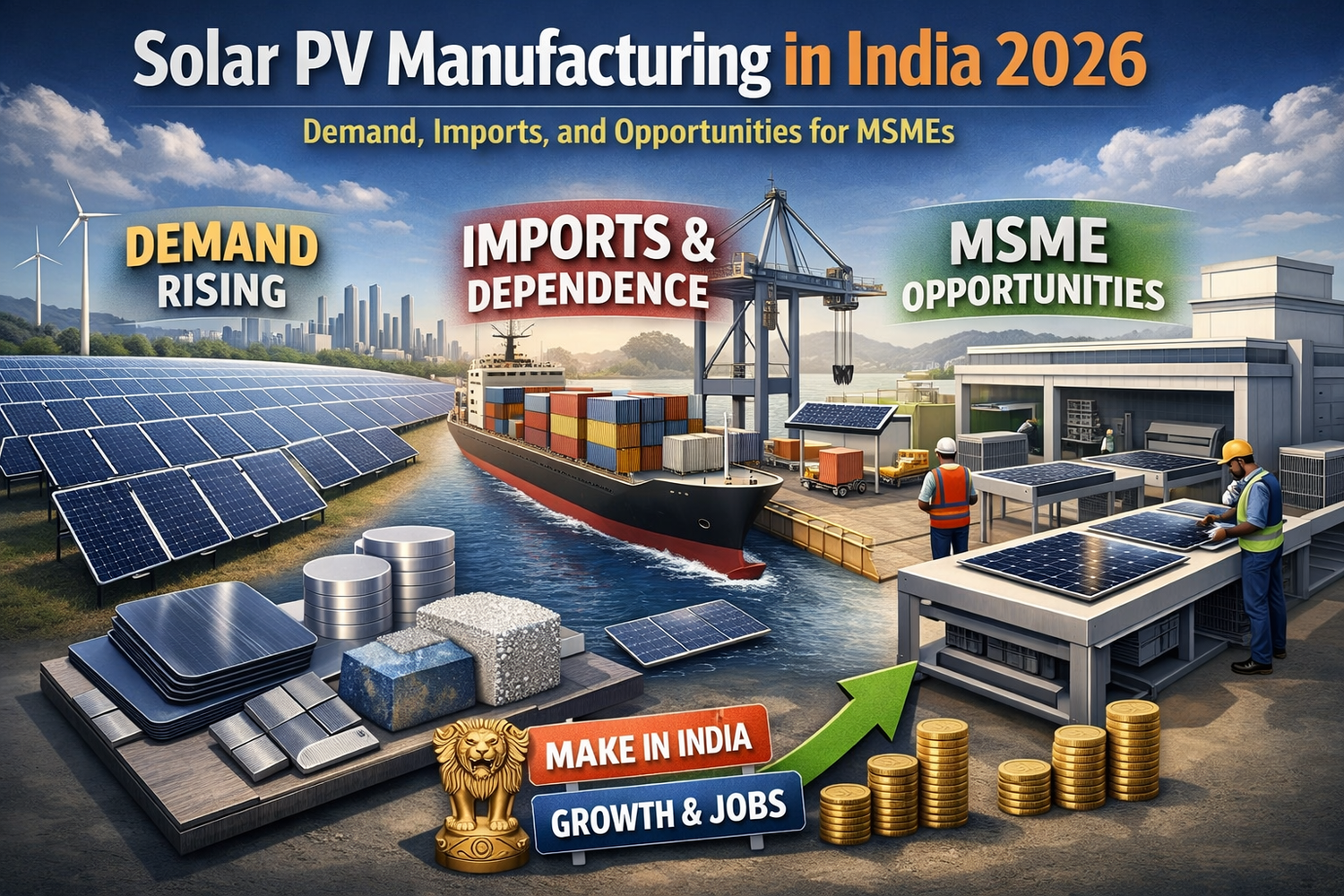

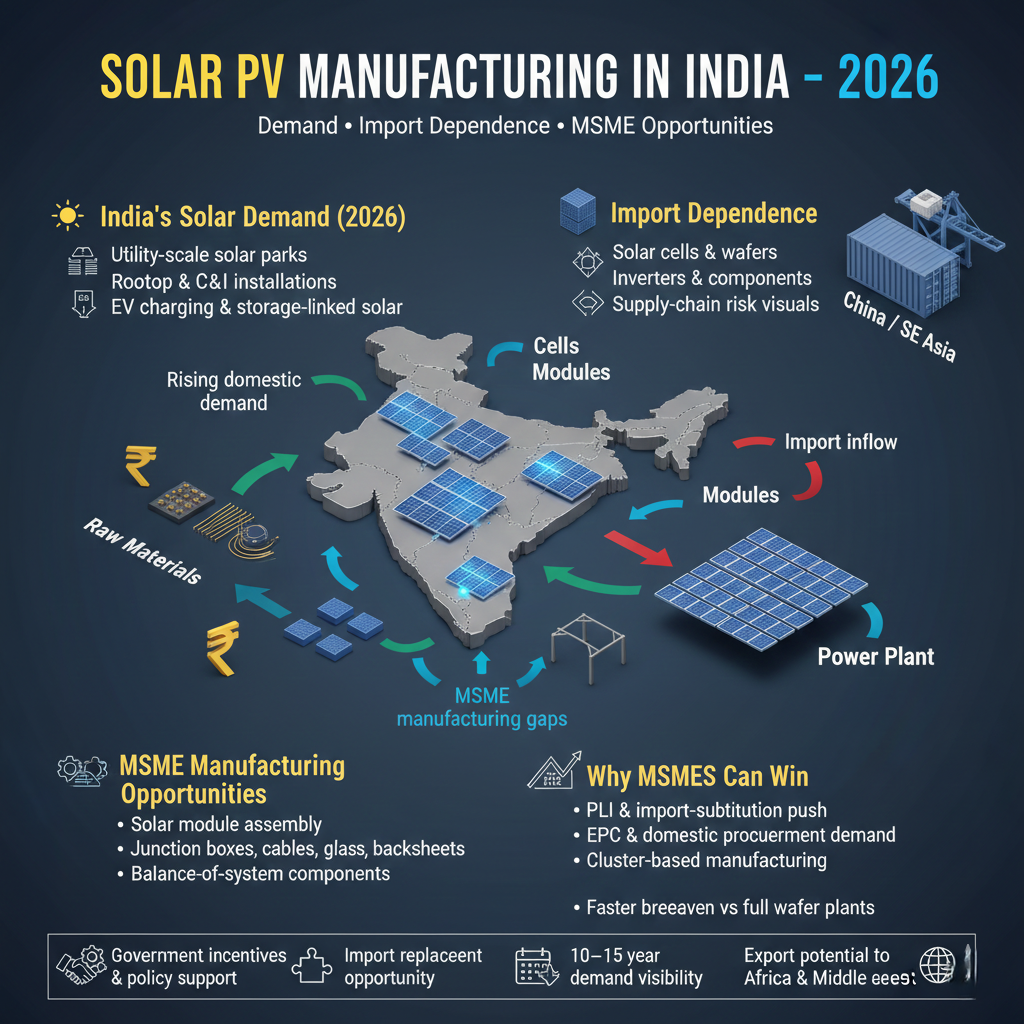
Solar Pv manufacturing India industry has reached a decisive stage. The opportunity is no longer driven by future policy promises or aspirational capacity announcements, but by hard market realities – installed capacity growth, tender pipelines, import dependence and the pace at which domestic manufacturing can realistically scale.
When these factors are viewed together one conclusion stands out clearly, that the demand for solar PV cells and modules in India continues to be larger than reliable supply from domestic sources, and imports are making up for this gap in a sustained and structured manner.
For entrepreneurs, MSMEs, this imbalance is not a threat to be avoided. It is a strategic window – if approached with discipline, realism and an alignment to market specifications.
Read More: Solar PV Power and Solar Products Handbook
Solar Demand in India Has become Continuous, Not Cyclical
Over the past five years, India’s solar industry has made a transition from a stage of intermittent tender business to a pipeline-enabled execution. Utility-scale solar parks, rooftops, government-supported procurement, open access, and state-level tenders are now in operation at the same time.(solar Pv manufacturing India)
This overlap has resulted in year-round demand for solar PV modules and cells.
Recent trends suggest that developers are no longer concerned about whether projects will be awarded or not. Their biggest issue today is the reliability of supply – whether the modules and cells will be delivered on time, up to the specifications tendered, and able to meet increasingly tight commissioning schedules.
In other words, demand risk is less and execution risk and supply risk are more.
Why Domestic Solar Manufacturing Has Not Fully Caught Up
India has brought major additions to the solar manufacturing arena but growth has been uneven across the value chain.
- Module manufacturing first grew because of less capital requirements and quicker setup timelines.
- Cell manufacturing followed more cautiously due to the higher technical complexity, yield sensitivity and capital intensity.
- Upstream segments such as ingots and wafers are still highly import-dependent.
This has led to a structural mismatch:
- For example: – Many module plants are running below optimal capacity because of lack of appropriate cells.
- Imported cells are often used to maintain assembly lines.
- Technology mismatch – this prevents the seamless integration between the available domestic cells and modern module designs.
Imports, therefore are not simply, price driven. They are making up for sequencing lag and technology lag in the domestic manufacturing ecosystem.
Imports Are Not Just Due to Cost, But Specification Gaps
A closer glance at the import patterns reveals that overseas suppliers typically fulfill certain procurement requirements that domestic manufacturers have difficulty delivering on a consistent basis.
These include:
- Increased wattage and efficiency bands required by recent tenders of MNRE and SECI
- Strict delivery schedules associated with liquidated damages and commissioning schedules
- Compatibility with newer system architectures, BOS configurations
Domestic capacity was added very quickly, but there was a lag in technology migration and upstream integration. Imports are consequently becoming a bridge between the current project requirements and the old factory configurations.
Read More: SOLAR PHOTOVOLTAIC POWER PLANT – Manufacturing Plant, Detailed Project Report, Profile, Business Plan, Industry Trends, Market Research, Survey, Manufacturing Process, Machinery, Raw Materials, Feasibility Study, Investment Opportunities, Cost and Revenue
Where Solar Manufacturing Entrepreneurs Can Still Make Winning Businesses
Despite growing competition and shrinking margins, there are several areas in solar manufacturing where entrepreneurs can make a living – if done with precision and realism.
1. PV Cell Manufacturing as per Tender Requirements
Solar cell production provides a good opportunity for technically disciplined entrepreneurs. While capital requirements are higher than module assembly, risk is reduced greatly if plants are designed to existing procurement specifications, not experimental or speculative technologies.
Key success factors include:
- Strict adherence to prevailing norms of MNRE and SECI tender
- Focus on yield stability and process control instead of peak efficiency claims
- Long-term supply contracts with domestic module manufacturers
Margins might be thinner, but stable volumes and predictable utilization go a long way toward making a company more bankable and lender friendly.
Read More: Solar Panel
2. Module Manufacturing using Sure Cell Supply
Module manufacturing is no longer in the realm of low entry, high margin business. However, it has the potential to be viable when treated like a logistics and reliability-driven operation, rather than a commodity play.
Successful entrants usually distinguish themselves on the basis of:
- + High automation levels which reduce labor variability
- Secured – domestic or contracted cell supply
- Strong control over quality, documentation and delivery schedules
In the today’s market, consistency and compliance are more important than scale.
3. Ingot and Wafer Manufacturing is a Strategic Opportunity
Upstream manufacturing can still be considered the weakest and most import-dependent part of Indian manufacturing. Limited availability of domestic wafer is a direct constraint for cell manufacturing expansion, which is the strategic opportunity for long-term investors.
This segment is best suited to entrepreneurs who:
- Have patient capital, access to tech partners
- Are comfortable with increased learning curves
- Focus on creating strategic supply chain assets instead of short-term gains
While payback periods are longer, downstream dependency generates durable value once operations have stabilized.
4. BOS-Integrated Manufacturing Clusters
Manufacturers that offer modules with balance-of-system (BOS) components, such as structures, junction boxes or cables, often find better positioning with EPC players.
Some of the benefits of this approach are:
- Stronger bargaining power with EPC contractors
- Reduced dependence on stand-alone margin for modules
- Benefits include: – More predictable cash flows from project to project
This model favors cluster-based manufacturing as opposed to isolated plants.
Read More: How to Start a Solar Panel Manufacturing Business
Lessons from India’s Large Industrial Players
The strategies adopted by large players like Adani Group and Reliance Industries present important lessons besides scale.
Carefully sequenced were their investments:
- Downstream manufacturing followed visible demand first
- Upstream integration didn’t happen until after utilization visibility and policy integration
The upshot for MSMEs is clear:
- Preventing too much entry integration at the entry stage
- Stabilize operations in demand secure segments
- Expand upstream only when utilization and cash flows have been proven
What Makes a Solar Manufacturing Project Financially Bankable
From the view of feasibility and lender, there are common features between successful solar manufacturing projects:
- Realistic capacity utilization assumptions
- Technology choices that allow incremental upgrades
- Predictable input sourcing arrangements
- Well-designed working capital cycles.
Many projects are killed not because of weak demand, but overestimated yields, aggressive ramp-up assumptions, and cash-flow mismatches.
Read More: Solar Panel Manufacturing: 10 reasons why it is a game-changer for startups
Why Timing is Still Important for New Entrants
Import dependence will decrease with the coming on line of large integrated capacities. However, large players are cautious in their approach, whereas MSMEs have the ability to react quicker to immediate gaps in the market.
Entrepreneurs that now enter with:
- Manufacturing lines that are aligned to specifications
- Conservative financial assumptions
- Assured offtake relationships
can achieve long-term relevance even as the market matures.
Closing Perspective
India’s solar PV manufacturing opportunity is no longer about following incentives or headlines. It is about determining where there is a growing demand consistently greater than reliable supply and developing manufacturing capacity to match that gap perfectly.(solar Pv manufacturing India)
There’s still plenty of room to win for entrepreneurs who have a combination of market insight, technical discipline and financial realism.
Frequently Asked Questions (FAQs)
Is solar PV manufacturing still viable for MSEs in India?
Yes. Projects with well-defined scope, firm offtake, and conservative technology choices are viable.
Should a new manufacturer begin with cells or modules?
Modules give a lower execution risk but cells have better strategic positioning, if technical capability is high.
How significant is government incentives to project viability?
Incentives are good for improving returns but should not be the fundamental business logic.
What is the most common risk underestimated?
Variability of yield and working capital requirements.
How long does it normally take to break even?
Three to five years for well structured projects.