


India’s rooftop and utility solar push has made solar panel manufacturing one of the most sought-after business ideas in engineering graduates’ minds, MSME owner’s radar, and first-time investor’s portfolio. The demand is no longer restricted to EPC contractors – housing societies, factories, and farmers have started asking for installations at an affordable price. Solar panel manufacturing as a business idea scores high on potential export orders if the promoter knows what to do with cell sourcing, quality testing, and channel sales apart from the production know-how.
Why Solar Panel Manufacturing Is a Smart Business Idea Right Now
Solar capacity additions are set to grow at a healthy rate this year as distribution companies push for rooftop solar, and large-scale developers look to meet their renewable energy targets. The demand for panels will only increase as solar remains one of the most cost-effective sources of electricity for both industrial and residential consumers. Apart from the obvious demand from EPC contractors, there is a growing need for modules from retail channel partners who can provide end-to-end solutions from sale to installation. With import duties on finished modules rising, the domestic value addition makes excellent economic sense, making this the perfect time for a new entrant to grab a leadership position and not leave it to competitors after three years.
Government Policies & Incentives
The Production Linked Incentive scheme for high-efficiency modules, administered by the Ministry of New and Renewable Energy, offers substantial benefits for solar cell and module manufacturers. The Make in India initiative promotes indigenous manufacturing through the Approved List of Models and Manufacturers (ALMM) and offers collateral-free loans to MSME units under the Credit Guarantee Trust for Micro and Small Enterprises (CGTMSE), administered by the Ministry of MSME. State governments also offer capital subsidies and stamp duty exemptions to solar panel manufacturing units. Some states also provide concessional power tariffs and exemptions from electricity duty for the first five to seven years, helping reduce the working capital requirements, particularly beneficial for a capital-intensive industry such as solar panel manufacturing.
Multiple Manufacturing Business Ideas for Startups
Monocrystalline Solar Module Assembly Line
A small-scale solar module manufacturing business that assembles monocrystalline PERC cells into modules can be an excellent entry-level business idea for a solar panel manufacturing unit. Monocrystalline solar cells offer the best energy output at an affordable price, and their assembly requires significantly lesser capital investment compared to vertical integration with cell manufacturing. However, it is crucial to note that most institutional buyers only purchase from manufacturers with Bureau of Indian Standards (BIS) and Ministry of New and Renewable Energy (MNRE) approved solar modules, necessitating the test equipment and quality control infrastructure to bid for government and distribution company tenders.
Rooftop Solar Kit Assembly & EPC Bundling
While assembling solar modules into kW-sized rooftops require additional equipment such as inverters, mounting structures, and wiring, it can be an excellent business idea to complement solar panel manufacturing. The rooftop solar kits can be sold at an attractive profit margin to residential and commercial consumers while also bundling EPC services for installation and offering maintenance and repair services on an annual subscription basis.
Solar Mounting Structure & BOS Component Fabrication
While most EPC contractors procure balance of system (BOS) components such as mounting structures, cable ladders, and junction boxes from a set of approved manufacturers on a project basis, a judiciously located value addition center can capture a significant regional market by fabricating these components on a large scale.

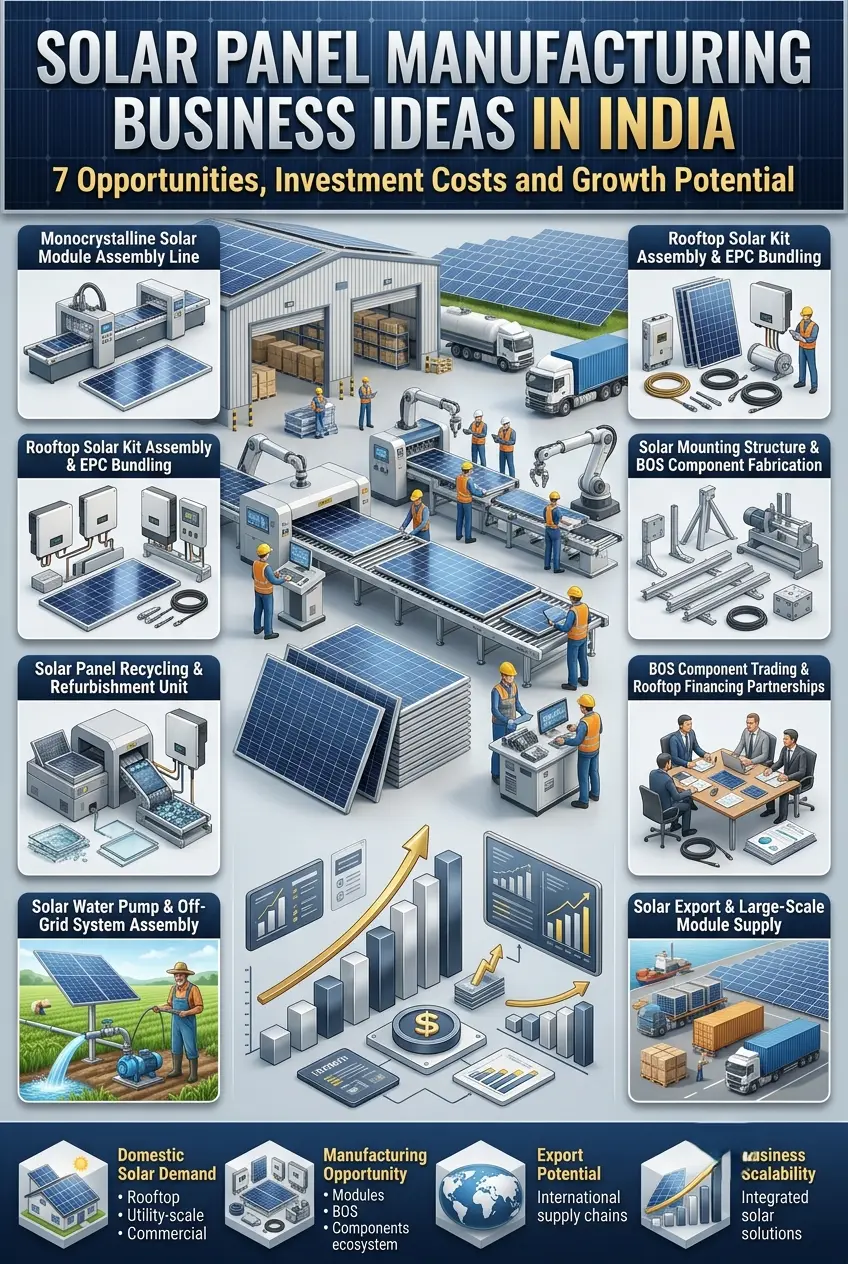
Solar Panel Recycling & Refurbishment Unit
As India’s rooftop solar market matures, solar panel refurbishment and recycling have emerged as a lucrative business opportunity. While the demand for solar modules is set to rise, the first round of installations will inevitably see a significant fraction of panels reaching the end of their lifecycle and due for refurbishment. Solar panel recycling and refurbishing fits in well as a business idea with a small capital investment while also positioning the promoter as a responsible, sustainable manufacturer adhering to the extended producer responsibility (EPR) guidelines, currently under consideration by the government.
BOS Component Trading & Rooftop Financing Partnerships
While many first-time promoters are quick to overlook the importance of solar financing in India, a strategic partnership with non-banking financial companies (NBFCs) and rooftop financing platforms can significantly enhance the bottom line of a solar panel manufacturing business idea by enabling the promoter to offer flexible EMI-based payment options to his buyers. A rooftop solar financing partnership can be particularly important when bundled with rooftop solar kits to clear a significant portion of the invoice value by the consumer as an advance payment.
Solar Water Pump & Off-Grid System Assembly
Solar water pumps have emerged as an alternate application area with farmers being the primary consumers. As many as 30% of the farmers in India are expected to transition to solar-powered water pumps, primarily in the arid belt of the country. A solar water pump manufacturing business can be an ideal business idea for a solar panel manufacturing startup looking to diversify its product offerings.
Import–Export Opportunity Analysis
India still imports a meaningful share of solar cells even as module assembly capacity grows domestically, which creates a genuine import-substitution opportunity for new manufacturers willing to integrate backward into cell production over time. On the export side, Indian modules increasingly compete for orders from Africa, the Middle East, and Southeast Asia, where buyers want an alternative to a single dominant Asian supplier base. A startup that secures BIS certification early can position itself for both ALMM-linked domestic tenders and outbound orders coordinated through export promotion councils under the Department for Promotion of Industry and Internal Trade.
Market Outlook & Scaling Roadmap
India’s solar module demand will grow exponentially in the coming years as the government pushes renewable energy and solar technology costs continue to fall. While current manufacturing capacity is adequate for the domestic demand, a solar panel manufacturing business has significant headroom to scale its installed capacity in line with the increasing demand. A new entrant with a 25 MW module manufacturing facility can scale to 100 MW and beyond within three to five years, depending on the initial working capital investment, ensuring a healthy ROI within five years of operations. It is crucial for the promoter to keep track of the ALMM and PLI guidelines and the corresponding bid announcements, as a timely working capital infusion can enable the new entrant to capture the most lucrative module tenders.
Skills, Manpower & Quality Control
Solar panel manufacturing differs significantly from conventional engineering manufacturing in terms of the skills required at the shop floor level. A competent solar panel manufacturing unit requires trained manpower at various levels such as assembly line workers, quality and testing supervisors, and production planning managers. While some of these skills can be acquired internally within the manufacturing unit, others, particularly the quality and testing expertise, may require outsourcing. A competent production manager is the linchpin of a solar panel manufacturing business, and you need to prioritize his hiring because he oversees the plant’s day-to-day operations, liaises with the quality control team, and ensures that the testing procedures align with the BIS and MNRE guidelines, enabling the manufacturer to secure government tenders that are significantly more lucrative than the private ones.
Indian MSME Success Stories
Vikram Solar — Gyanesh Chaudhary
Gyanesh Chaudhary’s Vikram Solar is an excellent example of a solar panel manufacturing business that began as a small-scale enterprise in Kolkata and grew to become one of India’s leading module manufacturers, with exports to several countries. Vikram Solar’s emphasis on testing laboratory investments, even when the demand from large-scale EPC contractors was minimal, is a valuable lesson for young entrepreneurs looking to enter the solar panel manufacturing space.
Waaree Energies — Hitesh Doshi
Hitesh Doshi’s Waaree Energies is another successful solar panel manufacturing business that began its journey as a solar panel trading company. Doshi’s decision to shift from solar panel trading to manufacturing enabled him to diversify his customer base, initially reliant solely on domestic demand, to international markets.
How NPCS Can Help Entrepreneurs Evaluate the Opportunity
We at Niir Project Consultancy Services (NPCS) offer expert consultation for preparing Market Survey cum Detailed Techno-Economic Feasibility Reports (DPR) for setting up new industrial or business units. Our reports provide extensive information on the project’s process, market, and financial viability, enabling an entrepreneur to make a well-informed decision before investing significantly in the project. Our DPRs offer end-to-end information on a wide range of topics, including the manufacturing process, market research and demand analysis, process flow diagrams, product mix and capacity, machinery and material requirements, and project financials and profitability. In short, a techno-economic report from NPCS will help an entrepreneur assess the investment, returns, and scalability of a solar panel manufacturing venture.
In the case of solar panel manufacturing, due diligence is particularly important for understanding the machinery and material requirements, and NPCS’s thorough research will help an entrepreneur minimize guesswork at this critical stage. Similarly, a project report will prove instrumental in securing the required funding from banks, NBFCs, and state-level MSME schemes. An expert assessment of the proposed project, as offered by NPCS, will significantly reduce the learning curve for a first-time promoter, enabling him to minimize risks and maximize ROI.
NPCS has published a comprehensive printed reference book on Solar Panel Manufacturing, covering technology, market analysis, investment parameters, and manufacturing processes in depth — the printed book: Solar PV Power and Solar Products Handbook.
For a detailed techno-economic Project Report on setting up a manufacturing business in this sector — including plant economics, machinery lists, financial projections, and applicable government incentives — the NPCS Project Report: Solar Panel – Manufacturing Plant, Detailed Project Report.
Common Pitfalls to Avoid
Most solar panel manufacturing promoters make the mistake of locking in their supply chain partnerships at the earliest, leaving them exposed to volatile silicon prices and import duty cuts. Another frequent error is to overlook the importance of BIS and ALMM certification. If an aspiring manufacturer does not factor in the costs and time for testing and certification, he may have to incur additional expenditures on test procedures and documentation if the test results do not meet the tender specifications. A competent promoter will keep in mind the time and costs of testing before selecting the test house and cell supplier, thus avoiding changes to his project financials due to inadequate documentation knowledge or poor cell economics.

Conclusion
Solar panel manufacturing is a rewarding business idea for the right promoter who prioritizes quality and certification. For an entrepreneur looking to capitalize on the solar energy boom while also considering government incentives and financing options, solar panel manufacturing can prove to be a rewarding business idea if he conducts due diligence, as outlined in this report, before making a sizeable investment and approaching the appropriate government agencies, such as Gujarat Industrial Development Corporation (GIDC).
Your Investment Deserves the Right Opportunity
Every serious investment begins with choosing the right sector and the right business model. With hundreds of industrial opportunities available across India’s manufacturing and clean-energy landscape, making the most informed choice is critical. NPCS Startup Selector tool helps entrepreneurs, MSMEs, and investors identify the most suitable business opportunities based on their investment capacity, location, and interests — so your capital is directed toward a venture with the strongest fit and potential.