

Solar Panel Manufacturing Business
India is experiencing an incredible energy revolution in its energy sector with solar power leading the pack. With a goal of 500 GW of non-fossil fuel capacity in the country by 2030, solar energy is projected to take over 50 percent of this figure. This development is leaving unprecedented opportunities to entrepreneurs, MSME founders, and investors in solar panel manufacturing. Solar manufacturing is today becoming one of the most profitable industries in India with favourable government policy, increased domestic demand, and increased export potential.
This guide offers a detailed discussion of solar manufacturing environment, market forces, cost, government incentives and the real steps to initiate a business with solar panels in India.
Read More: Solar PV Power and Solar Products Handbook
The Indian Solar Revolution: Why Manufacturing Counts.
In the past, India has been dependent on imported solar panels especially those of China. Nevertheless, the drive of the government of self-reliance and emergence of domestic demand are transforming the market. Key initiatives include:
- Production Linked Incentive (PLI) Scheme: provides financial support to high-efficiency solar module manufacturers which results in reduced capital expenses.
- Basic Customs Duty (BCD): 40 per cent on imported modules and 25 per cent on cells to safeguard local manufacturers.
- Quickened Market Development: Government projects must acquire ALMM listed (Approved List of Module Manufacturers) Indian solar panels.
To entrepreneurs, solar manufacturing is a special offer to take advantage of such incentives and serve a fast growing market.
The Solar Market Dynamics in India
The current installed solar capacity of India is greater than 85 GW and an average of 3040 GW per year will be needed to achieve this in 2030. The major demand factors are:
- Utility-scale Solar Parks – Solar fields that provide power to the grids.
- Residential & Commercial Rooftop Projects – Individual Residential, Office, and industrial rooftops.
- Agri-Solar and Solar Pumping Solutions- Sustainable energy to farmers.
- Floating & Hybrid Solar Installations- Unconventional designs in order to maximize space.
- Export Opportunities -Expanding demand in Southeast Asia, Africa, and the Middle East.
Although it is growing domestically, there is still a lack of high-efficiency solar cells, which is an opportunity that new players can enter the industry and make a profitable business.(Solar Panel Manufacturing Business)
Read More: Solar Panel
Solar Manufacturing is also attractive to entrepreneurs because of these reasons
The solar panel manufacturing is a good business idea due to several reasons:
- Government Incentives: PLI schemes save capital costs to approved manufacturers to a great extent.
- Import Protection: The tariffs on imported modules and cells are high BCD, which protects domestic manufacturers.
- Assured Market Access: ALMM listing will require government projects to include certified Indian panels.
- Profitable Economics: A 100 MW module assembly line can bring in 150-200 crore of revenue with the EBITDA margins of 8-14.
- Indian producers are becoming more competitive on the global market, particularly when it comes to consumers who are willing to find alternative suppliers other than China.
Solar manufacturing is a key business that is strategic and future-oriented due to the presence of a supportive policy, rising domestic demand, and international competitiveness.
Read More: 42 Most Profitable Manufacturing Business Ideas in India Under ₹10 Crore Investment Guide
Understanding the Solar Manufacturing Process
The investment in the solar manufacturing is a successful activity that needs a good understanding of the production process that determines the requirements of capital and profitability. The two major avenues are:
- Solar Cell Manufacturing
- Process: Photovoltaic cells are made by processing silicon wafers in cleanrooms on high-tech equipment.
- Scale & Cost: Minimum size is 500 MW with capital of 400600 crore.
- Profitability: High margins, but the costs are high and the technology is advanced.
- Solar Module Assembly
- Process: Ready-made cells are laminated between polymer backsheets and tempered glass, framed using aluminum, and equipped with junction boxes.
- Scale Cost: A 100 MW plant costs between 25 and 40 crore and needs between 80 and 120 workers.
- Profitability: Medium investment with quicker returns, best suited to first time entrepreneurs or MSMEs.
Read More: Project Reports & Profiles
The main Cost Elements of Module Assembly
Component | Cost Contribution (%) |
Solar Cells | 45–55 |
Tempered Glass | 10–15 |
EVA Encapsulant | 5–8 |
Backsheet | 5–7 |
Aluminum Frame | 8–12 |
Junction Box & Connectors | 4–6 |
Silver Paste | 6–9 |
This disaggregation assists entrepreneurs in planning the capital allocation and finding the supply chain opportunities.
Opportunities Throughout the Solar Value Chain
The solar manufacturing ecosystem has several entry points that can be explored by entrepreneurs:
- Module Assembly: This method requires less capital and has acceptable margins, making it ideal for MSMEs.
- Cell Manufacturing: The profit potential is high, but it needs a lot of technology and money.
- Solar Glass Production: This solves problems with not enough supply at home.
- EVA Encapsulant and Back sheets: This is an important input that is mostly brought in from other countries these days.
- EPC + Manufacturing Integration: Assures captive offtake and maximum margin capture.
Waaree Energies and Vikram Solar and Reliance New Energy demonstrate that leading companies achieve success through their combination of operational scale and product excellence and their ability to form strategic partnerships.
Read More: Startup Selector
Government Support and Compliance Requirements
The key to mitigating risk and fast tracking growth in solar manufacturing lies in government support:
- PLI Scheme: Provides financial incentives on the high-efficiency solar modules.
- ALMM Listing & BIS Certification: Government procurement projects are required to have this.
- MSME Support: The state level subsidies, preferential power tariffs and credit guarantees provided by SIDBI finance working capitals and start-ups.
These regulations are necessary to win government contracts and enjoy financial incentives.
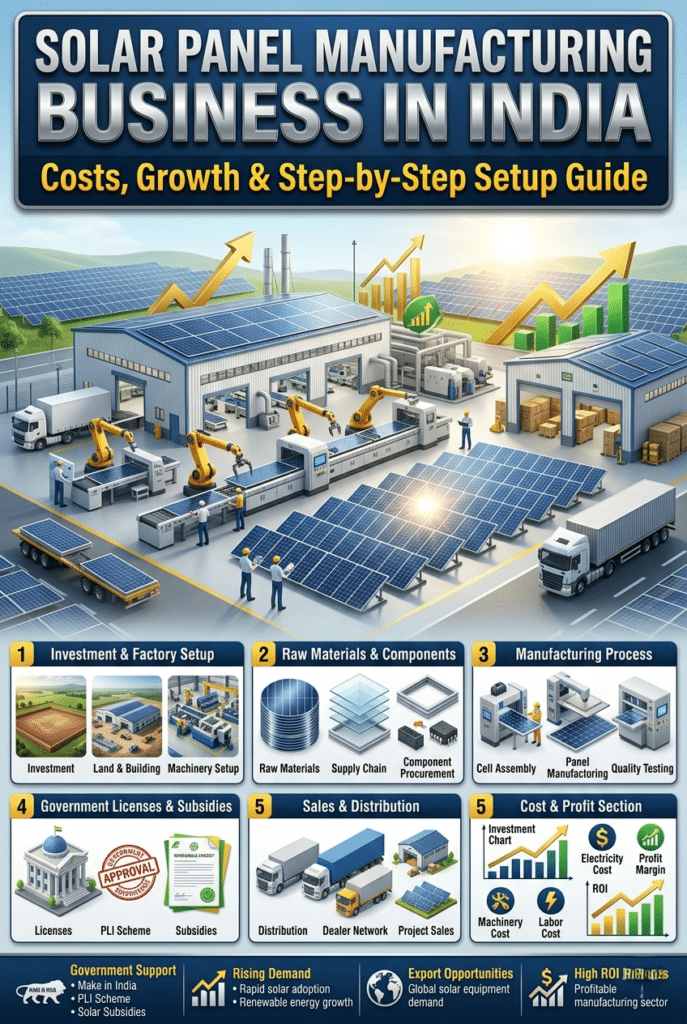
How to start a Solar panel business in India
- Feasibility Study and Market Research: find out about demand, competition, and financial projections.
- Select Type of Manufacturing: Select either a module assembly or a cell based on capital, skills, and scale.
- Install Plant and Machinery: Get certified tools and set up a production line.
- Secure Certifications: BIS, ALMM listing and other regulatory approvals.
- Hire Talented Workforce: Skilled workers such as engineers, technicians, and production employees are the keys to success in operation.
- Supply Chain/Procurement: Find stable suppliers of cells, glass, EVA and other raw materials.
- Marketing and Sales Strategy: Focus on government tenders, domestic buyers and export markets.
Read More: How to Start a Solar Panel Manufacturing Business
Export Potential and International Opportunities
The solar manufacturers in India are becoming more competitive in the global markets. Southeast Asia, Africa, the Middle East and Europe are the countries where they are choosing non-Chinese solar panels. With the emphasis on quality, certification, and scale, Indian companies will be able to secure a large portion of world demand, thus, solar manufacturing is not only a local prospect, but also an export-oriented project.
NPCS: Your Manufacturers of Solar
Niir Project Consultancy Services (NPCS) focuses on the market research, feasibility studies, and reports of solar ventures. IRR, NPV analysis, financial modeling, and process diagrams, capacity planning, and mitigating risks, NPCS assists the entrepreneur in making sound decisions. NPCS reports have become a reliable partner in the success of solar manufacturing by investors and lenders who use their reports in the appraisal of projects.
Conclusion: The Right Time to Enter Solar Market
The solar industry in India is developing at an alarming rate and it is backed by government incentives, increasing demand and competitiveness in the world. Those entrepreneurs who invest in module assembly or integrated solar manufacturing today are in a position to grab domestic as well as international opportunities.
The sector requires three essential elements for successful operation:
- Preparation: Feasibility studies and market research.
- Technical Expertise: Competent staff and efficient machinery.
- Discipline: Effective operations, compliance, and working capital management.
The solar panel manufacturing industry in India achieves success as a business through proper planning and its execution process. The company uses its generated profits to establish itself as a competitor in global markets.
Frequently Asked Questions of Solar Production
Q1. Minimum cost of a module assembly unit?
Around ₹20–40 crore for 50–100 MW capacity.
Q2. Is BIS certification and ALMM listing obligatory?
Yes, in particular to provide government projects.
Q3. Is there a possibility of beginners to get into solar module assembly?
Yes, and skilled teams and feasibility planning.
Q4. Major threats in solar production?
Dependence on imports, regulatory adjustments, technological obsolescence and delays in working capital.
Q5. Breakeven payback of a 100 MW plant?
Usually 4-6 years; may be shortened to 3-5 years using subsidies or long term supply contracts.