

Small town business ideas India
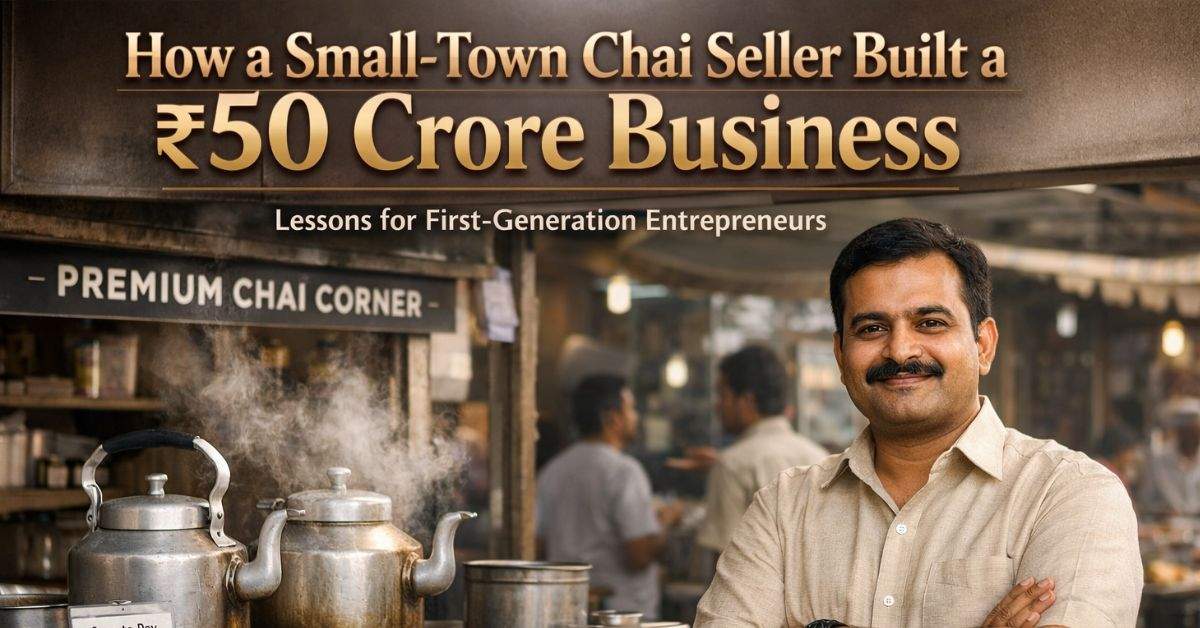
India’s entrepreneurial development now extends beyond its metropolitan areas. Companies which develop new products and services are starting to establish their operations in tier-2 and tier-3 towns because these areas provide business chances which larger FMCG companies and corporate organizations do not pursue. The inspiring journey of Ratan Kumar Sharma, a chai seller from Sitamarhi, Bihar, demonstrates how a first-generation entrepreneur can build a ₹50 crore business from scratch with determination, strategy, and local market understanding.
Read More: Our Books
From ₹800 and a Kettle to ₹50 Crores: Ratan’s Journey
Ratan started his initial business venture by investing ₹800 and using a borrowed kettle to sell tea in his local area. He maintained his dedication to local problems by developing packaging solutions which small retailers and tea vendors could use at budget-friendly prices because most people prefer to follow urban fashions.
Ratan used all his earnings to build his first industrial facility which he established close to Muzaffarpur after acquiring a basic form-fill-seal machine. His first products—spice mixes and namkeen in small, branded sachets—catered to a largely untapped market ignored by big FMCG brands.
Ratan Agro Industries established multiple production facilities which resulted in revenue growth that exceeded the expectations of typical urban startups. He achieved success through a combination of uncomplicated and effective methods which made his formula work:
- Understand the buyer
- Control costs meticulously
- Scale gradually
Read More: Business Plans / Project Profiles
Why Tier-2 and Tier-3 Towns Are Ideal for First-Generation Entrepreneurs
Small-town India offers several advantages for aspiring manufacturers:
1. Lower Setup Costs
Industrial land in tier-2 towns has a price range that starts at ₹800 per square meter and goes up to ₹2 500 per square meter. In metropolitan areas industrial land costs between ₹12 000 and ₹40 000 per square meter. This purchasing method requires businesses to spend less money during their initial phases because they need lower equipment costs.(Small town business ideas India)
2. Affordable Labor
Small towns pay unskilled workers between ₹250 and ₹380 for their daily work while urban areas charge between ₹550 and ₹750 which enables businesses to maintain their expenses while delivering products with high-quality standards.
Read More: Project Reports & Profiles
3. Faster Growth in Demand
The rural market experiences FMCG consumption growth between 12 and 16 percent every year which surpasses the growth rate of urban markets. The combination of affordable products with high quality creates a business opportunity which new companies can use to establish themselves in small towns.
4. Government Incentives
The CGTMSE loan program together with food processing PLI and backward area grants programs decreases entry obstacles while enabling first-time business owners to launch their enterprises without the need for substantial financial resources.
The combination of low-cost operations and growing business opportunities together with financial support from the government creates conditions which help businesses succeed in tier-two and tier-three towns.
Read More: Startup Selector

Profitable Business Ideas for Small-Town Entrepreneurs
Ratan’s story shows people can find opportunities in places where demand for products remains unfulfilled. The most reachable choices which people can consider include:
Packaged Food and Spice Processing
- Low-cost machinery
- Strong local raw material supply
- High demand for small branded packs
- Examples: namkeen, masala mixes, packaged snacks
Agro-Input Manufacturing
- Fertilizers, micronutrient blends, crop nutrition products
- Steady sales through agri-dealer networks
- Growing demand due to modern farming methods
Eco-Friendly Packaging
- Bagasse plates, kraft paper bags, compostable products
- Rising demand from institutional buyers and export markets
The government-backed small manufacturer incentives create new market possibilities for both specialty chemicals and construction materials.(Small town business ideas India)
Read More: 10 Best Business Books for Entrepreneurs in India (Startup Guide)
Key Lessons from Successful Entrepreneurs
Indian company heads prove through their achievements that having superior branding or huge investment sums in a firm is secondary to an understanding of the market and the customer:
- Mahesh Gupta (Kent RO Systems): Focused on semi-urban buyers and simple, reliable products.
- Rajendra Kumar Agarwal (Donear Industries): established his business by focusing on small-town retailers who existed before his competitors discovered that market opportunity.
- Arvind Mehta (Prataap Snacks): achieved business growth through affordable products which customers could easily find in retail stores instead of using extra funds for advertising to surpass his competitors.
Ratan Kumar Sharma built his business according to three principles which involve starting with a small operation followed by profit reinvestment and forward-looking investment decisions.(Small town business ideas India)
The Importance of Export Markets
Numerous small manufacturers fail to recognize export opportunities which serve as their primary pathway for business expansion:
- India’s trade agreements with ASEAN, SAARC, and UAE create preferential access for processed foods, specialty chemicals, and eco-packaging.
- Government programs such as EPCG and APEDA help first-time exporters reach international buyers while improving domestic competitiveness.
Small-town companies can enhance their financial results through international sales which allow them to extend their business operations beyond their domestic market.
Read More: Best Franchise Business in India Under 10 Lakh – Low Investment & High Profit
How NPCS Supports First-Generation Entrepreneurs
Niir Project Consultancy Services (NPCS) provides complete feasibility studies which include detailed techno-economic reports (DPRs) that entrepreneurs use to make investment decisions:
- Market research and demand analysis
- Process flow diagrams and capacity planning
- Machinery and raw material specifications
- Financial projections and profitability analysis
The services provide investment solutions which companies can use to establish operations that achieve both growth and profitability while avoiding early-stage business failure.
Conclusion
Ratan Kumar Sharma demonstrates that small-town business owners can create successful large enterprises through customer understanding and profit reinvestment and government program utilization. India now recognizes its tier-2 and tier-3 towns as emerging centers for manufacturing development.
First-generation entrepreneurs can achieve success in their business ventures through effective planning and organizational assistance from NPCS. The key to success requires businesses to initiate operations through small projects that expand their activities while maintaining market presence.
Frequently Asked Questions (FAQ)
Can I start a manufacturing business with less than ₹25 lakh?
Yes. MSME clusters allow packaged food, agro-input, specialty chemical, and eco-packaging units to start with ₹15–35 lakh. CGTMSE loans fund up to 85% without collateral.
How do I pick the right product for my region?
Evaluate local raw material availability, proximity to buyers, and state incentives. A techno-economic feasibility report (DPR) can help identify the best options.
Can small manufacturers realistically export?
Yes. Products like processed foods, fertilizers, eco-packaging, and specialty chemicals have buyers in Southeast Asia, the Middle East, and Africa. Quality and consistency are crucial.
Which government schemes are most useful?
CGTMSE, PMEGP, CLCSS, SFURTI, and sector-specific PLI programs are highly relevant for first-time entrepreneurs.
How long does it take to start production?
With prepared land and suppliers, production can begin in 9–18 months, including approvals, equipment setup, and trial runs.