SFURTI Scheme business India
The traditional industries in India like handloom, bamboo, honey, khadi, and coir still offer millions of people a living. Nevertheless, small-scale manufacturers are unable to expand due to the lack of modern equipment, packaging plants, as well as direct market accessibility. The Indian government established the SFURTI program to finance shared infrastructure developments and cluster manufacturing facilities.
The SFURTI scheme provides an efficient entry point to launch or grow a manufacturing enterprise with less financial risk to entrepreneurs, startups, NGOs, and owners of MSMEs. The scheme enables businesses to concentrate on production and sales because it delivers grant funding which does not create debt obligations. Through good planning, several clusters funded under this program have attained a yearly income of 1 crore or above.
What is the SFURTI Scheme and Why It Matters
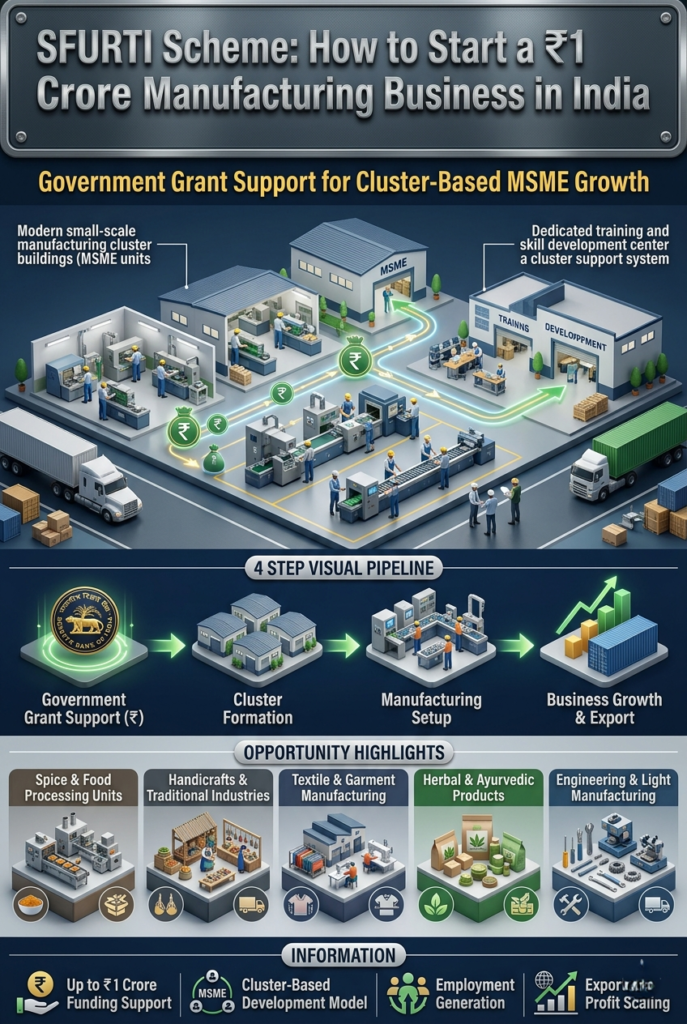
The SFURTI scheme, formally referred to as the Scheme of Fund of the regeneration of Traditional Industries, aims to enhance the traditional manufacturing industries by establishing Common facility centres (CFCs). These centres are communal production centres that are equipped with up to date machinery and processing facilities. The cluster has common infrastructure instead of each artisan investing separately in costly equipment to cut expenses and enhance productivity.(SFURTI Scheme business India)
This model has revolutionized most small-scale industries to enhance product quality and allow business to access bigger markets. It also promotes cooperation of artisans which enhances production capacity and bargaining power with buyers.
The amount of financial support is one of the most appealing aspects of the scheme.
Read the Complete Book Here: Our Books
Funding under the SFURTI scheme typically includes:
- Up to ₹25 lakh for small clusters
- Up to ₹1 crore for medium clusters
- Up to ₹2.5 crore for large clusters
- Skill development and training.
- Marketing and branding assistance
Since the financing is in the form of a grant, business people will not have to pay the money they used in developing infrastructures. This greatly reduces the chances of commencement of a manufacturing enterprise.
Why Traditional Manufacturing Businesses Are Growing
The evolving consumer preferences and favourable government policies are making traditional manufacturing to be increasingly more profitable. The customers are becoming increasingly interested in sustainable and handmade goods, especially natural materials. This trend has provided business opportunities in rural and semi-urban areas.
Access to markets and finance has also been enhanced by government efforts. The financial aid to small businesses through programs like PMEGP and MUDRA loans and digital platform enable manufacturers to sell their products to customers throughout India.
The rising demand of locally produced goods is another significant factor that is augmenting growth. A large number of consumers are willing to buy goods that contribute to the development of local societies and retain the old artisanship. Due to this, industries which were initially regarded as small scale are now making it into a competitive and profitable industry.
Industries Supported Under the SFURTI Scheme
The program has concentrated on the more traditional industries that have good employment opportunities and market stability. The prospects of these industries are very high to any entrepreneur keen on developing a sustainable business.(SFURTI Scheme business India)
The most popular industries are:
- Manufacturing of handlooms and textiles.
- Processing and packaging of honey.
- Bamboo furniture and products.
- Coir product manufacturing
- Village industries and Khadi.
Both of these industries have their own benefits. To illustrate, honey processing companies gain advantages as more and more people take organic food products, whereas bamboo production is increasing with the rise of the usage of environmentally-friendly materials. By adopting an industry according to the availability of resources in the surrounding environment and the demand in the market, entrepreneurs can experience a consistent growth.
Get Detailed Project Report (DPR): Project Reports & Profiles
Financial Potential of a SFURTI-Based Business
Among the best benefits of the SFURTI scheme is its high financial potential. The government bears most of the infrastructure expenses hence entrepreneurs can start businesses with comparatively minimal investments. This enables companies to achieve profitability sooner than in the conventional manufacturing arrangements.
As an example, once operations are stable a medium-sized manufacturing cluster can make a lot of revenue. Monthly income will be determined by capacity to produce, demand and quality of the products, but most businesses will realize a stable income during the first year.
Typical financial outcomes for successful clusters include:
- Monthly revenue ranging from ₹20 lakh to ₹80 lakh
- 1. 22-55 percent profit margins.
- Less than 12-month investment recovery.
- Increased income for workers and artisans
These findings indicate that cluster-based manufacturing has a high potential in terms of economics.
Step-by-Step Process to Start a SFURTI Cluster
To initiate a cluster, it takes proper planning and coordination of the stakeholders. It starts with the identification of a group of artisans or workers that work in a certain industry in a certain geographical region. This cluster is based on this group.(SFURTI Scheme business India)
Once the group is formed, an implementing agency has to be set up to oversee the project. It is the role of this organization to make the application and manage activities after the project approval. The project report, which presents the business plan and financial forecast is the most important part of the process.
The basic steps involved in starting a cluster are:
- Determine the industry and place.
- Form a group of artisans or workers
- Register an implementing agency e.g. trust or society.
- Develop a project report (DPR).
- Apply to government to be approved.
- Build the Common Facility Centre and start operations
The whole process is expected to last twelve to eighteen months.
Find high-return business ideas based on your budget & ROI
Importance of Professional Project Reports and Expert Guidance
To achieve the approval under SFURTI scheme, it is important to prepare a quality project report. The report should contain technical information, financial forecasts, market analysis and operational planning. Simple mistakes in documentation may slow down the approval or decrease funding eligibility.
That is why numerous entrepreneurs prefer to deal with professional consultants. Companies like the NIIR Project Consultancy Services (NPCS) specialize in preparing comprehensive project reports and feasibility study of manufacturing firms. Their experience assists entrepreneurs to develop effective production systems as well as fulfill the requirements of the government.
NPCS has over forty years of experience in industrial consultancy and has helped in several manufacturing projects in India. Their services include:
- Preparation of Detailed Project Report (DPR)
- Market and feasibility analysis.
- Selection and cost estimates of machinery.
- Plant layout design and production planning.
- Advice on government schemes and approvals.
The collaboration with seasoned consultants will enhance the chances of the project being approved and minimizes the risks involved in the operation.
Related Article: MSME Business Ideas by Government: Unlocking India’s Startup Revolution
Benefits of Starting a Business Under the SFURTI Scheme
The SFURTI scheme presents a few benefits that render it appealing to the entrepreneurs. Among the most significant advantages is less financial risk since infrastructure financing is government-supported. This enables the businesses to operate at lower investment and quicker profitability.
The other important advantage is enhanced quality of products. Availability of modern machinery and testing equipment assists businesses to comply with industry standards and compete both in the national and international markets. Marketing and branding are also assisted in the scheme leading to more visibility and customer confidence.
When businesses are located in a cluster, they generally grow more due to sharing of resources and knowledge. This teamwork strategy enhances productivity and opens new growth possibilities.
Frequently Asked Questions (FAQs)
How many people do we need to run the SFURTI scheme?
At least one hundred craftsmen will create a small group. The bigger group can demand half a thousand or more craftsmen.
Is the financing offered in the scheme recoverable?
No, it is funded as a government grant and is not to be repaid.
Is it possible to initiate a cluster by a private entrepreneur?
Yes, however, to apply to fund, the entrepreneur should have an eligible organization like a trust, society, or cooperative.
What is the duration of approval process?
The process of approval and setting up normally consumes a period of twelve to eighteen months.
Who will assist in making the project report?
Professionals such as NIIR Project Consultancy Services (NPCS) can offer professional assistance in preparing project reports and feasibility studies.