

Secondary Steel Industry in India sector is in structural change. While large integrated steel plants are still adding to their capacity, the thrust is now truly being built by secondary steel producers and manufacturing units driven by MSMEs. These businesses are unobtrusively driving the infrastructure boom in India, real estate boom, automobile boom, renewable energy installations and engineering industries.
As per Ministry of Steel Annual Report 2024-25, the consumption of finished steel in India from April to December 2024 reached 111.49 million tonnes, which increased by more than 11 per cent over the year. In contrast, the growth rate of finished steel production is much slower, and the import rate increased sharply. This imbalance underscores a very important fact in the Indian context: In order to meet the future demand, there should be a strong, decentralized secondary steel ecosystem in India.
Read More: SPONGE IRON – Manufacturing Plant, Detailed Project Report, Profile, Business Plan, Industry Trends, Market Research, Survey, Manufacturing Process, Machinery, Raw Materials, Feasibility Study, Investment Opportunities, Cost and Revenue, Plant Economics
Why Secondary Steel Is Becoming Most Powerful MSME Sector Of India
The infrastructure growth of India is broad-based and long-term. Mega projects under PM GatiShakti, Bharatmala, Metro rail networks, airport modernization, renewable energy parks, logistics hubs and industrial corridors are generating steady demand for steel across the different regions. This demand pattern is strongly in favor of secondary producers that are agile and region-focused.
Some of the most important factors that have contributed to this shift include:
- Fast growth in infrastructure and urban construction
- Increasing availability of steel scrap because of scattering of vehicles and because of urban redevelopment
- Lower capital requirements as compared to integrated steel plants
- Strong affinity to India’s green steel and decarbonisation goals
With induction furnace and electric arc furnace units already accounting for over 35 per cent of the crude steel production in India, secondary steel is no longer such a supporting segment but a core pillar of the industry.
Induction Furnace Steel: The backbone of Long products manufacturing
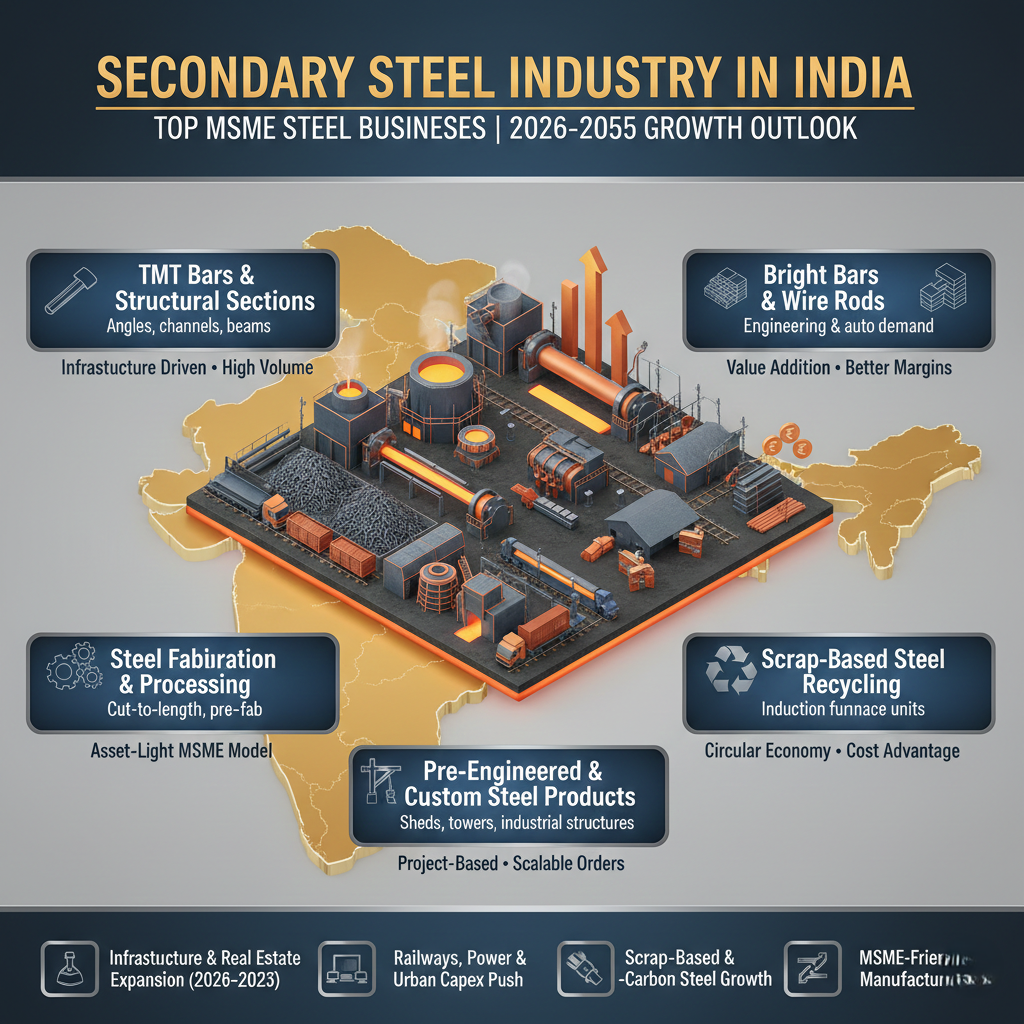
Induction furnace based billet and ingot manufacturing provides the base to the long value chain of Indian steel products. Billets and ingots are vital raw materials for rolling mills which make TMT bars, structural sections, pipes, flats and angles.
This segment is particularly attractive for MSMEs because of:
- Flexible raw material usage, such as scrap and sponge iron
- High local demand from local rolling mills
- Increased turnaround time and reduced logistics costs
A billet plant that is 50,000 to 200,000 tonnes per annum can provide consistent cash flow by supplying local construction and infrastructure markets.
Read More: The Complete Technology Book on Hot Rolling of Steel (2nd Edition)
TMT Bars and Structural Steel: A Motion of Ten Years
TMT bars are and continue to be the most consumed steel product in India. The demand is driven by residential housing, commercial complexes, bridges, metros, industrial buildings and rural infrastructure. As building standards get better, there is also a higher demand for higher grade and seismic resistant TMT steel.
Structural steel products like beams, channels, angles and joists are equally important. These products are widely used in:
- Warehouses and logistics parks
- Pre-engineered buildings
- Solar, renewable energy structures
- Factories and industrial sheds
Because of the fact that some specialized sizes and grades are still imported, MSME re-rolling mills clearly have an opportunity to substitute imports with domestic production.
Pipes, Tubes and Galvanized Steel: Towards Value Addition
Steel pipes and tubes have become high-value engineering products. Beyond traditional applications, they are now key to city gas distribution networks, solar mounting systems, automotive structures and electric vehicle platforms.
Precision ERW tubes as well as galvanized products are gaining importance because of their durability and corrosion resistance. Key demand sectors include:
- Renewable energy installations
- Infrastructure and water pipelines
- Automotive and Electric Vehicle Manufacturing
- Construction in rural and industrial areas
MSME scale tube mills and galvanizing lines can capture these markets based on quality, customization and faster delivery.
Read More: 10 High-Demand Downstream Steel Product Manufacturing Ideas in India
Scrap Processing and Green Steel: The Opportunity of the Future
Steel scrap processing and recycling has emerged as one of the most strategic segments in the Indian steel ecosystem. As the capacity of induction furnace and electric arc furnace grows, the demand for clean and processed scrap grows.
Scrap-based steel production has a number of benefits in the long run:
- Reduced carbon emissions, as compared to blast furnace routes
- Reduced reliance on imported raw materials
- Alignment with global green steel trends
Scrap shredding and processing units are not only supporting steel producers but are also an integral part of the circular economy in India.
Read More: Steel Rolling Technology Handbook (2nd Revised Edition)
Fabrication, PEB and Precision Engineering: Moving Up the Value Chain
As the steel consumption matures, value addition is moving towards fabrication and precision engineering. Infrastructure Steel bridge, metro station, airport, and railway provide project-based opportunities and good revenue visibility.(Secondary Steel Industry in India)
Pre-engineered building components are experiencing a significant growth in demand because of growth in warehousing, logistics, data centers, and cold storage. Precision machined steel components help to further unlock doorways to sectors such as defence, railways, oil and gas, and aerospace – many of which are still dependent on imports.
Why 2025 to 2035 is the Golden Decade for Secondary Steel MSMEs
India’s steel demand is likely to outstrip capacity additions by large producers. Secondary steel MSMEs, with their flexibility and regional focus, are in the best position to fill this gap.(Secondary Steel Industry in India)
Some of the key benefits to MSMEs are:
- Reduced barrier to entry and scalable investment
- Strong domestic demand aided by government spending
- Import substitution opportunities of value added steel products
- Long-term relevance with regard to sustainability / green steel policies
Read More: Top 20 Steel Products Manufacturing Business Ideas
Frequently Asked Questions (FAQ)
Is secondary steel manufacture profitable in India?
Yes. Rising demand, import substitution and reduced capital cost make secondary steel one of the most profitable MSME manufacturing sectors.
How much investment does it take to invest in a secondary steel business?
Most MSME-scale projects can be initiated with an investment of between Rs. 10 crore and Rs. 50 crore based on product and capacity.
Which secondary steel segment has faster returns?
TMT rolling mills, steel wire products, scrap processing units and steel service centers often have faster payback because of their high demand.
Is scrap-based steel environmentally sustainable?
Yes. Scrap-based steel has the added advantage of reducing carbon emissions, and is also in line with India’s long-term objectives on green manufacturing.
Are MSMEs able to compete with the big steel producers?
Absolutely. MSMEs have competed with their flexibility, customization, rapid delivery and good presence in the regional market.