


Rubber rarely makes headlines but is an essential element in any industry. The reason for this is that rubber parts are used practically everywhere — from transport to engineering, from everyday shoes to heavy machinery. This factor, combined with the consistently high demand for rubber products, creates excellent prerequisites for a profitable business. This article will explore the conditions for starting a rubber business, study the specifics of five promising directions, and take a closer look at the opportunities for exporting and successful local business examples.
Why Rubber Manufacturing Is a Dependable Choice
Demand Anchored in Real Industry
Rubber products are industrial goods with a consistently high demand. They are parts and components; hence, the demand for them depends on the needs of various industries. These sectors form the basis of the economy and never lose relevance. Therefore, a producer of rubber parts and components can be confident of steady income. In addition, India is a natural rubber producer, which means that there is a reliable source of raw material. In addition, local industries need rubber components, which is another reason to start a business in this direction.
A Value Chain With Room to Enter
The rubber sector is quite broad, offering ample opportunities to choose a niche for a startup. Thus, a prospective business owner should study the existing supply-demand gaps in the local market. The Rubber Board of India and the Ministry of Commerce and Industry can help in this, providing useful data on the current state of the rubber market. The main thing is to identify the unmet demand for specific rubber parts and components in the regional market.
Government Policies and Incentives
Support for rubber manufacturing comes through both sector bodies and broad industrial schemes. The Rubber Board promotes cultivation, processing, and product development, which strengthens the raw material base. Meanwhile, the Make in India push and MSME programmes back component manufacturing.
Founders should register on Udyam for collateral-free credit and priority lending. Cluster development support through the Ministry of MSME helps smaller units share infrastructure and cut costs. Rubber-growing states offer additional help; for instance, Kerala’s industrial promotion agency supports processing and value-addition projects.
5 Rubber Business Ideas for Startups
Idea 1 — Rubber Moulded Components
Moulded rubber components are used in a wide range of machines and mechanisms. Almost all sectors of the economy, from engineering to transportation, are in great demand for various bushes, seals, and gaskets. Therefore, a business that manufactures such details will find a market for its goods. It is necessary to start such a business by finding at least one buyer and offering a consistent product. Seals and gaskets are standard parts, which means their dimensions and shape are well-defined. In this regard, the main quality criterion for such products is geometry. A well-made product with high accuracy will find its market.
In addition, it is essential not to forget about the convenience and speed of delivery. Local production will be able to provide these advantages, which the entrepreneur should use. Thus, the demand for such details as bushes, seals, and gaskets is constant and allows the entrepreneur to create a stable source of income.
Idea 2 — Rubber Gaskets and Seals
Gaskets and seals are essential components that are in demand in all sectors of the economy. Everyone wants to get rid of problems caused by gas leaks, and therefore, people are willing to pay to ensure that their vehicles or equipment do not malfunction. A business producing such details will be able to find its market. In addition, this type of production is relatively simple, which makes it ideal for a beginner entrepreneur. It is advisable to start small with standard sizes, and then move on to more complex shapes and custom sizes. In addition, the market for spare parts is extensive and constantly growing. Therefore, the entrepreneur will be able to find repeat sales and buyers. A reliable product and a well-organized production process will ensure the company’s success.
Idea 3 — Reclaimed and Recycled Rubber
Recycled rubber is obtained from waste materials, which is why such products are in great demand among environmentally conscious consumers. With the growing popularity of sustainable products, this type of business is becoming increasingly relevant. The supply of raw materials is also available, as waste is found almost everywhere. At the same time, there is a need for this type of product, both among local entrepreneurs and in the global market. Moreover, the processing of waste into new products is a relatively simple process. Therefore, this idea seems promising and viable in both the local and international markets. A recycled rubber business will be beneficial not only for the environment and the entrepreneur’s finances but also for the global economy since it will reduce the amount of waste.

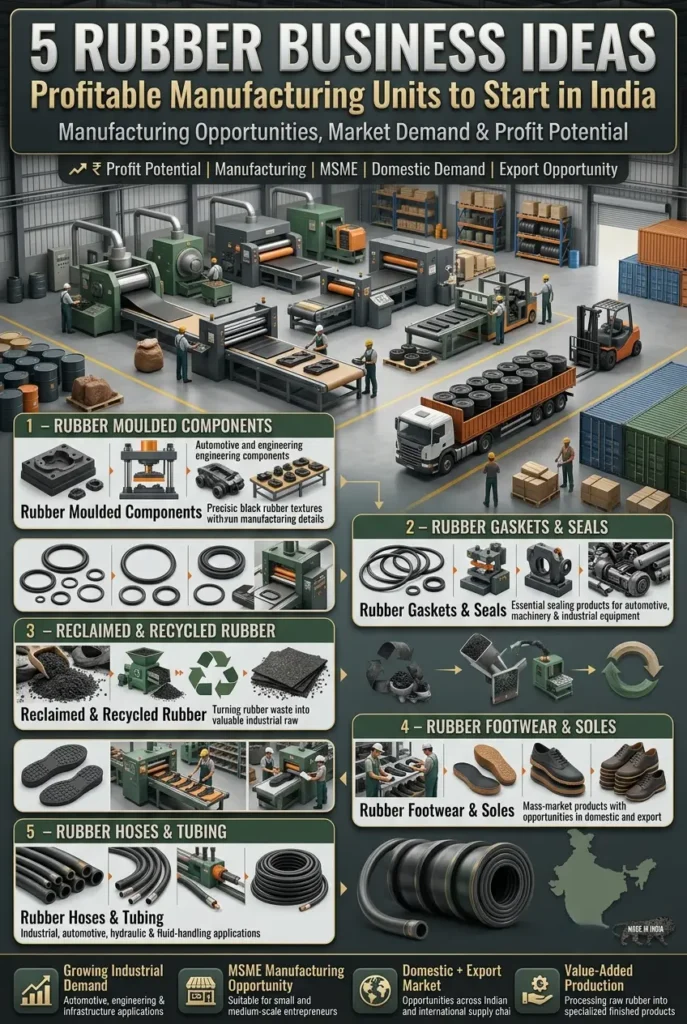
Idea 4 — Rubber Footwear and Soles
Rubber soles are an indispensable part of any shoes. Almost all shoe manufacturers buy soles, and the wide range of shoes in the local market indicates that there are many potential buyers. It is worth starting the production of rubber soles or footwear with a small line of products with a standard design. The main advantage of such a product is its simplicity and accessibility. Therefore, the entrepreneur should focus on a large market with a high degree of localization of demand. Local production will be able to withstand competition with foreign suppliers. The quality and affordable price of the soles will help the entrepreneur retain repeat customers. The potential for cost reduction is also high, which will allow the entrepreneur to increase profits.
Idea 5 — Rubber Hoses and Tubing
Rubber hoses and tubing are used almost everywhere: in engineering, in the agricultural sector, in the transport sector, and in the chemical industry. The wide range of applications for these products secures a demand for them. The most promising direction for the entrepreneur is the local market. Rubber hoses and tubing are used extensively by local industries, which is why they need a reliable supplier. An experienced producer will be able to find regular buyers and form a stable source of income. It is also essential to pay attention to the product catalog, which the entrepreneur will be able to develop. One of the few ways to differentiate from competitors and retain customers is to offer a wide range of diameters and pressures. Thus, the local market is the most promising for such a business.
Import–Export Opportunity Analysis
India’s import-export policy is beneficial for the export of local products. Some of the products described above may be in demand among foreign buyers. At the same time, India is also looking for local suppliers who can provide high quality and stable supply of goods. Therefore, an entrepreneur may decide to export the produced goods. The ability to withstand the competition of international trading companies and meet the requirements of foreign buyers is a guarantee of stable income for the domestic producer. Thus, the export opportunities for the rubber sector are attractive enough, which the entrepreneur should take advantage of.
Indian MSME Success Stories Worth Studying
Many MSMEs in India have had much experience in manufacturing rubber products. There are several successful local companies that have been operating in the rubber sector for decades. MRF Company was originally founded as a manufacturer of balloons but has since evolved into one of the largest tire manufacturers in the country. Its founder, K.M. Mammen Mappillai, was able to capitalize on his initial investment and dedication to quality. He demonstrated that with a consistent focus on high-quality products and a long-term vision, even a small business could grow significantly.
TVS Srichakra and other local companies became popular suppliers of rubber parts and components for automobiles. There are also many local manufacturers of rubber footwear known for their quality and affordable products. The key to their success has been a disciplined and consistent approach to manufacturing as well as a focus on quality. Therefore, local experience in the rubber sector is a valuable guide to developing a profitable business.
About NPCS
Niir Project Consultancy Services (NPCS) offers professional consulting services to entrepreneurs who want to start a new project. We provide a feasibility report that includes a detailed description of the manufacturing process, market research and analysis, product mix, process flow diagrams, machinery and equipment, raw materials, and project cost along with complete profitability analysis. Our reports also offer government approvals and incentives related to the business, if any. Our goal is to help entrepreneurs assess the viability, potential profitability, and scalability of a proposed project.
NPCS has published a comprehensive printed reference book on rubber manufacturing, covering technology, market analysis, investment parameters, and manufacturing processes in depth — the printed book: The Complete Book on Rubber Processing and Compounding Technology (4th Revised Edition)
For a detailed techno-economic Project Report on setting up a manufacturing business in this sector — including plant economics, machinery lists, financial projections, and applicable government incentives — the NPCS Project Report: Explore the Complete Rubber & Rubber Products Industry Guide
Indicative Project Snapshot
| Business Idea | Approx. Investment (₹) | Demand Outlook | Export Scope |
| Rubber Moulded Components | 30 lakh–1.5 crore | High | Moderate |
| Gaskets & Seals | 25 lakh–1 crore | High | Moderate |
| Reclaimed / Recycled Rubber | 30 lakh–1.2 crore | Rising | Low–Moderate |
| Rubber Footwear & Soles | 20–80 lakh | Very High | Moderate |
| Rubber Hoses & Tubing | 40 lakh–2 crore | High | Moderate |
Figures are indicative planning ranges and vary with capacity, automation, and product mix.

Conclusion
Rubber offers founders something valuable: dependable, component-driven demand that rarely disappears. Moreover, the schemes are practical, the value chain has gaps, and exports add stability. Therefore, the entrepreneurs who succeed are those who pick a focused product, perfect its consistency, and deliver reliably. Furthermore, a detailed feasibility report converts that discipline into a fundable, bankable plan…
Your Investment Deserves the Right Opportunity
Every serious investment begins with choosing the right sector and the right business model. With hundreds of industrial opportunities available across India’s manufacturing and clean-energy landscape, making the most informed choice is critical. NIIR’s Startup Selector tool helps entrepreneurs, MSMEs, and investors identify the most suitable business opportunities based on their investment capacity, location, and interests — so your capital is directed toward a venture with the strongest fit and potential. Explore your best-fit business opportunity today.