


India operates the world’s largest single railway system under a single management and each kilometre of the railway network is built upon prestressed concrete (PSC) sleepers. It is not a flashy product, but it is a concrete block, right under a rail line, as part of some of the biggest infrastructure investments plans in the country: Dedicated Freight Corridors, track renewal, metro expansion and high-speed rail. If you are a business owner considering capital-heavy but demand driven manufacturing, PSC sleepers should be taken into consideration.
This report is an overview of the global and Indian market for prestressed concrete sleepers, demand-supply gap, major domestic and international manufacturers, and a practical business case for the MSMEs and first-generation entrepreneurs.
What Are Prestressed Concrete Sleepers?
Known as concrete crossties, prestressed concrete (PSC) sleepers secure railway rails at the correct gauge, distribute the load of the wheels onto the ballast bed, and impart long-term stability to the railway track. They are produced by inserting high tensile steel wires or strands under tension into a precision concrete mould, by either the long-line (pre-tensioned) system or the post-tensioned system, followed by curing and unloading the tension to leave a permanent internal compression stress in the concrete. This prestressing is how an undersized concrete section can withstand the periodic and alternating tensile and bending forces of train axle loads without cracking.
PSC sleepers provide the following advantages over the wood sleepers they have mostly replaced:
- Service life – 50+ years compared to 15-20 years for treated timber.
- Greater load capacity — modern heavy haul specifications have a capacity of up to 25 tonne axle loads.
- Resistant to fire and pests, and will not suffer from fungal decay or termite damage.
- Reduced life cycle maintenance costs – higher initial cost than wood or steel sleepers
- The stability of the train length, which is important for the precision of the gauge at high train speeds
PSC sleepers used in Indian railways should meet the RDSO (Research Designs and Standards Organisation) specifications, which include the compressive strength, dimensional tolerances, prestress loss and rail seat geometry, and should be type approved before a plant is allowed to supply the network in India.
View Full Project Details: Prestressed Concrete Sleepers Manufacturing Project Report
Global Prestressed Concrete Sleepers Market Size and Growth
The growth rate is always strong, and estimates range from the market size of the PSC sleepers themselves to composite and steel sleepers being included as substitute products. According to the industry estimates, the global market for prestressed concrete sleepers is projected to grow to USD 4.57 billion by 2034 from USD 2.79 billion in 2025 at an estimated CAGR of 5.6%. The market for concrete sleepers is expected to be still larger, at approximately 8.3% CAGR, hitting USD 7.31 billion by 2029, according to a separate, broader estimate covering the broader concrete sleeper category, in keeping with the rest of the world where railway capital expenditures are even higher.
Note on figures: Figures provided are for illustration only, and like most infrastructure related manufacturing categories, there are many variations possible in the estimates depending on scope and outlook. NPCS does investment grade feasibility study of a project that is customized to your specific capacity and customer base (Indian Railways, metro corporations, private sidings or export)
Regional Breakdown
The expansion of railway systems by China alone has consumed more than 40% of global concrete sleeving for use in rail industry projects, including freight lines and high-speed rail lines, to date. The Indian Railways with its massive network of tracks, with a special focus on the construction of freight corridors and an expanding metro rail programme in over 20 cities, is the second largest consumer in the world. Technology is more advanced in Europe and Japan, particularly in high-speed applications, and in regions where rail lines are being expanded or upgraded at a massive pace in Asia, Africa and parts of Latin America.
India’s Position: The World’s Largest PSC Sleeper Consumer
Indian Railways has a network covering approximately 115,000 km and runs over 20,000 passenger & freight trains daily. It is currently using an estimated 350 million concrete sleepers on its existing network, with estimates of up to 700 million sleepers in the future, driven by the need for track renewal, conversion of gauge width and the construction of new lines, over the next few years.
This demand is being fuelled by a number of running infrastructure schemes:
- Track renewal and doubling: Indian Railways has reported large-scale annual track renewal targets, alongside thousands of turnout renewals and speed upgrades to 130 km/h across major corridors.
- Dedicated Freight Corridors (DFCs): The Eastern and Western DFCs, built for heavy axle-load freight movement, use higher-specification PSC sleepers than conventional lines.
- Metro rail expansion: More than 20 Indian cities now have operational or under-construction metro systems, each requiring PSC or composite sleepers for elevated and underground sections.
- High-speed rail: The Mumbai–Ahmedabad High Speed Rail corridor and planned future corridors under the National High-Speed Rail Corporation will require sleepers manufactured to more stringent international specifications.
Policy Tailwinds
- Increasing railway capital expenditures: Union Budget allocation for Indian Railways has increased substantially in the last ten years and the railway is seeing an increasing demand for railway materials such as PSC sleepers for their procurement purposes.
- RDSO type-approval framework: A barrier to entry, RDSO’s standardised type approval process (when it gets done) means that, once an approved manufacturer, one can count on the recurring order visibility, instead of one-off contracts.
- Public procurement policies: prefer materials from domestically produced over imported materials for this category, favour Make in India and domestic sourcing.
- MSME and state industrial incentives: PSC sleeper manufacturing units, depending on investment size and location, can qualify for MSME capital subsidy schemes and state-level industrial park incentives.

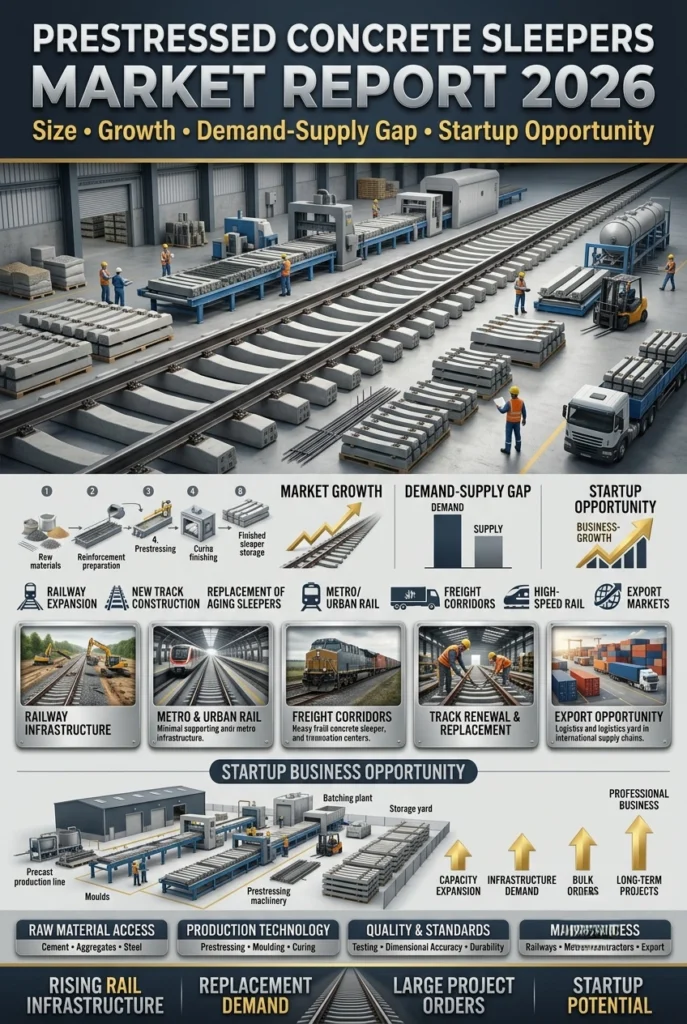
India Demand-Supply Gap: PSC Sleepers
| Parameter | Current Position |
| Indian Railways’ installed base | ~350 million concrete sleepers currently in the network |
| Projected total demand (Railways + private + metro) | Could approach ~700 million sleepers as renewal and expansion programmes scale up |
| Domestic manufacturing base | A mix of large integrated players (Patil Group, GPT Infraprojects) and RDSO-approved regional/MSME manufacturers spread across Gujarat, Maharashtra, Madhya Pradesh, Uttar Pradesh, and Uttarakhand |
| Nature of the gap | Not an import-dependency gap (India manufactures domestically) but a capacity and renewal-cycle gap — existing approved capacity needs to expand to meet accelerating track renewal, DFC, and metro rollout schedules |
| Opportunity for new entrants | RDSO approval is the core barrier; once achieved, demand visibility is high given Indian Railways’ scale and the metro/private-siding market beyond it |
Reading the gap: Unlike several other categories in this series, PSC sleepers are not an import-substitution story — India already manufactures the vast majority of what it consumes. The opportunity here is different: existing large players (Patil Group, GPT Infraprojects, GITA Group) currently fulfil a limited share of total Indian Railways requirement even at scale, and metro corporations and private siding operators represent a growing, separately-served demand pool. A new, RDSO-approved regional manufacturer entering at the right location — close to a cement/aggregate source and a rail freight corridor — competes on logistics cost and delivery reliability rather than displacing an established competitor nationally.
Check Out This Recommended Book: The Complete Book on Cement & Concrete Products Manufacturing
Major Indian PSC Sleeper Manufacturers (Capacity Snapshot)
| Company | Location / Plants | Installed Capacity | Notes |
| Patil Group | 12 plants across India (2 fully automatic) | ~4.85 million sleepers per annum | India’s largest supplier of concrete sleepers to Indian Railways; also the country’s first ISO-certified concrete sleeper manufacturing plant |
| GPT Infraprojects Ltd. | 1 India facility + 1 each in Namibia, Ghana, South Africa | ~2 million sleepers per annum (India) | Among India’s first concrete sleeper manufacturers (since 1982); has manufactured 15+ million sleepers cumulatively for Indian Railways, IRCON, RITES, SAIL, NTPC, and Tata Steel |
| GITA Group | Plants in Gujarat, Maharashtra, Madhya Pradesh, Uttar Pradesh, Uttarakhand (Himachal Pradesh upcoming) | Fulfils ~14% of total Indian Railways requirement (targeting ~25%) | Pioneered the “merry-go-round” stress bench technology, now used by 90%+ of global sleeper manufacturers |
| The Indian Hume Pipe Co. Ltd. | Rajkot, Gujarat and other locations | 2.75+ million sleepers supplied cumulatively | Introduced PSC monoblock sleepers to Indian Railways in 1970; also a major Hume pipe manufacturer |
| Shri Kesharia Concrete Products Pvt. Ltd. | Vidisha, Madhya Pradesh | ~33,000 units/month (~4 lakh/year) | RDSO-approved, ISO 9001:2015 certified regional manufacturer, representative of the MSME-scale entry format |
| Daya Engineering Works Pvt. Ltd. | Maharashtra (founded 1974) | Mid-to-large scale | Recognised for durability in high-salinity, high-monsoon environments; ~8.2% contribution to global heavy-haul segment volume by some industry estimates |
Major International PSC Sleeper Manufacturers (Capacity Snapshot)
| Company | Country | Notes |
| Vossloh AG | Germany | Widely regarded as the global market leader in rail fastening and concrete sleeper systems |
| China Railway Material Sleeper (Pingdingshan) | China | Leading APAC-region sleeper producer, backing China’s dominant 40%+ share of global consumption |
| Abetong | Sweden | European technology leader in prestressed concrete sleeper design |
| Kirchdorfer Group | Austria | Major European precast concrete and sleeper technology group |
| Leonhard Moll Concrete Group (Trackwork Moll) | Germany | Estimated ~14.5% share of the high-specification European PSC sleeper segment |
| WEGH Group | Italy | Global railway infrastructure solutions provider, including concrete sleepers and track systems |
| L.B. Foster | United States | Diversified rail infrastructure conglomerate with a significant sleeper/track segment |
| Schwihag | Switzerland | Specialised premium track systems manufacturer |
Market Segmentation
Type
- Monoblock PSC sleepers (dominant type for mainline broad-gauge track)
- Twin-block/bi-block sleepers
- Turnout and points & crossing sleepers
- Switch expansion joint sleepers
- Composite/fibre-reinforced sleepers (emerging, coastal and high-corrosion applications)
Gauge/Application
- Broad gauge (1,676 mm) — the dominant Indian Railways standard
- Metre gauge and narrow gauge
- Metro and light rail (often lighter-specification sleepers)
- High-speed rail (stringent international specifications)
End User
- National railway operators (Indian Railways/RDSO-approved supply)
- Metro rail corporations
- Dedicated freight corridor operators
- Private industrial sidings (cement plants, ports, steel plants, mining)
- Export markets (Africa, Middle East, Southeast Asia)
Related Article: Manufacturing Prestressed Concrete Sleepers: Business Ideas, Process & Profitable Opportunities in India
Key Growth Drivers
- A strong demand for rail transport services. The track renewal, doubling and new line construction projects budgeted by Indian Railways have increased significantly which gives multi-year estimates of demand visibility to approved sleeper manufacturers.
- Heavy haul and Freight Corridor. Sleepers for freight corridors have to be stronger for higher axle loads, and they can have to be higher specification than normal mainline sleepers, and may be priced accordingly.
- Metro rail in Tier-1 and Tier-2 cities. Every metro line adds one unique project that is separate from Indian Railways’ continuous procurement cycle and has a specific time limit.
- Replacement demand due to ageing wooden and older generation concrete sleepers. Much of the demand is not for new lines, but for replacement of the underlying infrastructure (sleepers), which offers a more stable and less cyclical revenue source than construction on new lines.
- Government promotion for home products. The regulations governing public procurement that reward locally manufactured track material restrict the competition from imports, thus allowing margins for local manufacturers (approved by RDSO).
Challenges and Restraints
- RDSO type approval is a real obstacle to entry. Time and technical investment is required for the new manufacturers to pass tests such as Compressive Strength, Transfer length, Dimensional Tolerance, Destructive and non-destructive batches testing before they are approved by Indian Railways as a supplier.
- High capital intensity. The investment required for precision moulds, prestressing benches, curing facilities and quality control laboratories is significantly higher compared to most other precast concrete products.
- Cost sensitivity of raw materials. Cement and high tensile prestressing steel strand represent 60-70% of operating costs and the commodity price volatility is a direct margin risk.
- Geographic logistics cost. Heavy, low-value-density products – sleepers – freight cost to track laying is a significant competitive factor, with plants sited close to demand corridors.
- Order concentration risk. A significant proportion of demand comes from a handful of big institutional buyers such as Indian Railways, metro corporations, DFCC, etc. and the timing of tenders and the relationship management is commercially significant.
Competitive Landscape
Large integrated players like Patil Group, GPT Infraprojects, GITA Group and The Indian Hume Pipe Co. Ltd. dominates the supply chain. However, several regional and MSME-scale players also operate in the market. These include Shri Kesharia Concrete Products, Daya Engineering, Vaman Prestressing, and Marathwada Prestress.
Many of these companies operate single or dual plants near railway zones. Even the largest player currently serves only a small share of Indian Railways orders. This shows that the market remains far from consolidated.
A well-capitalised company with RDSO approval can therefore secure substantial orders. The opportunity is particularly strong in regions with limited supplier networks and emerging metro markets.
Prestressed Concrete Sleeper Manufacturing: Business Opportunity for Startups and MSMEs
- Approved manufacturing unit in region by RDSO. The most obvious entry format is a single plant, set up near a rail zone where existing local capacity is limited, such as Indian Railways zonal procurement, private sidings, and metro projects in close proximity, similar to the successful regional entrants such as Shri Kesharia Concrete Products.
- Manufacturing that is focused on metros and light rail. Apart from the mainline procurement process of Indian Railways, Metro corporations may have own technical specifications and procurement process, which may involve lesser capital investments and a shorter approval cycle than the mainline procurement process of Indian Railways, which is IRS: T-39.
- Private siding and industrial rail infrastructure supply. There is a less tender-cycle dependent demand base at cement plants, steel plants, ports, and mining operations with captive rail sidings that will not necessarily require RDSO approval in each situation.
- Export-oriented manufacturing. Indian manufacturers that have a good quality reputation are ideally suited to provide African developing rail networks, Southeast Asian and Middle East markets, where labour and material are still cheaper.
The costs, capacity and margins of a PSC sleeper plant are greatly dependent on automation level (manual long-line vs. fully automatic stress-bench systems), target customer (Railways vs. metro vs. private), and logistics specific to the plant location. NPCS makes a detailed, bankable Project Report that lists all the machines, explains the process of RDSO approval and gives you an idea of the financial projections in your target market and capacity.
Smart entrepreneurs start here—find your perfect venture
How NPCS Supports Entrepreneurs Entering This Space
For any business person considering an investment in a PSC sleeper manufacturing project, the first step is to prepare a Detailed Project Report (DPR) that contains all the project details such as plant capacity, selection of machinery (long line process vs. stress-bench process), path for RDSO approval, raw materials sourcing, manpower planning, project cost, and financial viability of the project from the selected location and target customer base.
About NPCS (Niir Project Consultancy Services)
Founded in 1994, NPCS is an ISO 9001:2015 Certified Organisation based in New Delhi with more than 30 years of experience in Techno-Economic & Project Consultancy. For over 30 years, NPCS has provided over 150,000 project reports and profiles in 85 countries, covering almost all manufacturing and process industries, construction materials, precast concrete products and infrastructure linked manufacturing.
The three integrated platforms of NPCS are:
- niir.org — the primary repository of industry-specific Detailed Project Reports, business plans, and techno-economic feasibility studies
- entrepreneurindia.co — market research, project profiles, and manufacturing business opportunity content aimed at entrepreneurs and MSMEs
- npcsblog.com — industry insight, trend analysis, and manufacturing sector commentary
The main outcomes of NPCS relevant to a PSC ‘sleeper’ venture involve:
- Maintenance Project Reports (Maintenance DPRs) with plant capacity, machinery specification and layout
- Techno-economic feasibility studies, including guidance on the RDSO approval process
- Financial modelling – project cost, profitability analysis, ROI, break-even calculation
- Specific to Indian rail zones and export markets, the assessment of raw material and market.
- Support documents for MSME loan applications, subsidy schemes and bank funding requirements
Entrepreneurs evaluating this sector can access relevant PSC sleeper manufacturing profiles directly on niir.org and entrepreneurindia.co, or request a custom feasibility study scoped to a specific capacity and rail zone.
Government and Institutional Reference Links
- Ministry of Railways, Government of India
- Research Designs and Standards Organisation (RDSO)
- Ministry of Micro, Small and Medium Enterprises (MSME)
- Development Commissioner, MSME (DCMSME)
- National High Speed Rail Corporation Limited (NHSRCL)
- Bureau of Indian Standards (BIS)
- Press Information Bureau (PIB), Government of India
- Startup India, Department for Promotion of Industry and Internal Trade
- Invest India (National Investment Promotion and Facilitation Agency)
- Make in India
Entrepreneurs are advised to verify the latest RDSO approval procedures, tender norms, and MSME scheme guidelines directly on these portals, as policy provisions and technical specifications are periodically revised.

Conclusion
Prestressed concrete sleepers occupy a distinctive position among manufacturing opportunities. The business is capital-intensive and technically demanding. However, it is supported by durable institutional demand from Indian infrastructure.
India’s railway network must renew hundreds of millions of sleepers in the coming years. At the same time, metro networks and freight corridors are expanding rapidly. This creates long-term demand for prestressed concrete sleepers.
Entrepreneurs must invest in RDSO qualification and choose the right plant location. For those willing to meet these requirements, this business offers genuine long-term revenue visibility.
For entrepreneurs and MSMEs evaluating infrastructure-linked manufacturing investments, PSC sleeper production represents a technically demanding but demand-secure opportunity anchored to one of the world’s largest railway capital expenditure programmes.