
PMEGP 2026: Even some newcomers are making their way into the space of manufacturing under India’s entrepreneurial ecosystem. The story of PMEGP 2026 is apt for all that. It offers 35% subsidies on bank-linked financing amounting to 50,000 INR that can be used for manufacturing.
However, the purpose is converting into formal factories innovative ideas. Young entrepreneurs can leapfrog over traditional stages of growth and hire many of their fellow young Turks.
PMEGP, above the fund, is finance cum mentorship and access to markets. Thus, this article explains PMEGP, how it works, the potential for various manufacturing projects, and the ease with which one can set up as well as grow a manufacturing unit of his/her choice.
Read More: What is Pradhan Mantri Employment Generation Program (PMEGP) Scheme
PMEGP 2026: So What and Why The Importance
PMEGP is the subsidy program for self-employment through KVIC and its participating banks. It will have access to a loan up to INR 50,000 from a bank for projects under manufacturing for 2025-2026.
Depending on the category of subsidy, bank financing categories differ from 15% to 35% of the total amount financed. In the case of service sector projects, coverage is limited to INR 20,000.
This scheme also has a clear target in India’s ongoing drive to empowerment and reach out to women, youth, and first-time entrepreneurs. The requirement for bank credit compels serious commitment on the part of the project.
While India aims for further self-reliance through its Atmanirbhar Bharat initiatives, PMEGP is increasingly crucial to reducing imports and enhancing local manufacturing capacity.
The Importance of Modernization and Scales
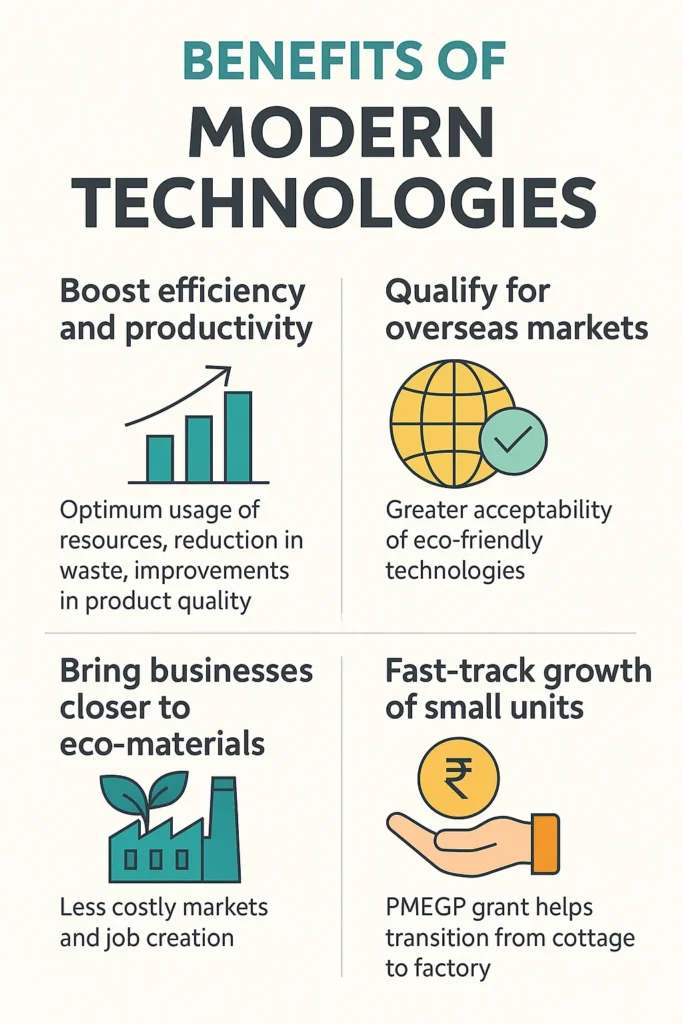
Modern technologies are such that they can boost efficiency and productivity through optimum usage of resources, reduction in waste, and improvements in product quality, and qualify overseas market acceptability.
Also, eco-friendly technologies bring businesses closer to less costly markets and eco-materials. Job creation, the enhancement of local supply systems. The PMEGP grant is making small units more easily transitioned from cottage to factory.
High-Potential Sectors Under PMEGP 2026
Food Processing and Agro Industry: Both the domestic and international markets are increasing in demand for processed food. Fruit pulping, frozen snacks, ready-to-eat meals, and spice processing are simple moderate investment and reap high rewards.
Chemicals and Specialty Products: PMEGP can fund small to medium scale plants for producing sodium silicate, potassium permanganate, eco-friendly solvents and agricultural chemicals that India imports and has with growing demand.
Packaging & Plastics Alternatives: Increasing demand for packaging, especially from e-commerce and fast-selling consumers’ goods (FMCG), leads to the need to set up production lines for corrugated cartons, PET recycling, and compostable packaging.
Green & Eco Products: These comprise production of biofertilizers, bamboo products, structures for solar panels, and assembly units for LEDs which contribute toward meeting sustainability targets.
Textiles & Technical Fabrics: Modern dyeing and finishing coupled with technical fabric production have raised overseas market demand. The market for technical textiles is also increasing in the industrial and healthcare sectors.
Furniture & Modular Manufacturing: Innovations on eco-materials and modular furniture units using CNC supply both the urban and export markets.
Read More: List of 55 Profitable Business Ideas for Micro and Small Enterprises (MSME)
Gaps in Imports & Exports
Identify bulky high imports that can be costed locally. Lithium-ion battery recycling, carbon fiber production, and specialty biodegradable polymers and chemicals are the main areas of confluence. Updated PMEGP units will plug the import dependence gaps and gain avenues for export contracts.
Suggested New Ventures Under PMEGP 2026
- Recycling batteries to recover cobalt and lithium.
- Carbon-fiber composite manufacturing for automotive and renewable energy sectors.
- Biofertilizers production for organic and export markets.
- Frozen foods and Ready-To-Eat meals for urban and export jurisdiction.
- Eco-packaging that manufactures compostable bags and trays.
Read Our Project Report: Click Here
Ways in Which the PMEGP Can Be Put to Better Use
- Target products that can replace imports or cater to exports.
- Prepare a DPR that meets banking standards with reasonable ROI and repayment.
- Invest in modular and scalable production equipment with upgrade options.
- Utilize PMEGP’s EDP training programs for entrepreneurial competencies.
- Use subsidy savings to reinvest in Enhanced Branding and Quality Management.
- Rapid bank approval can be gained through well-prepared DPR and clear economics proxy to the unit.
The Importance of DPR and NPCS
DPR, in the first instance, is necessary to sanction the loan because it contains the technical designs necessary for the project, its scope and costs, and what is anticipated to flow from that project.
DPRs, market surveys, and design process flows with financial models accompanying them are doable from NPCS. Tier 1 entrepreneurs with business models requiring DPRs significantly enhance their chances at approval and execution quality.
Read Our Book: Click Here
The Path to Factory
- Identify a feasible project for local raw materials availability and market gap distinctions.
- Once the project is identified, apply for it directly through KVIC or PMEGP online.
- Complete EDP training within other requirements.
- Prepare the DPR and get approval from the bank.
- Buy equipment and set up the factory.
- Initiate operations and pursue buyers local and international.
- Reinvest and grow your business through obtaining 2nd generation loans or Modernization Schemes.
Find the Best Idea for Yourself With our Startup Selector Tool
PMEGP Conclusion 2026
The year 2025 under PMEGP will prove to be another most promising opportunity for new manufacturing startups. An entrepreneur would be able to access 35% subsidy and a bank-associated finance for the establishment of a formal unit meant for exports.
On the other hand, the entrepreneur typically has to select the project with import substitution or export addition. Preparation of quality DPR and training, investments in manufacturing equipment with the potential for scaling would have to be done by the entrepreneur.
Immediate action is the most crucial step since the PMEGP will fund the idea strategically and according to the policy supports as it is transformed into a success in the industrial sector.
Frequently Asked Questions – PMEGP 2026
1. What does PMEGP 2026 mean?
A. Credit supported subsidy scheme with bank credit for manufacturing of up to 50 lakh at 35 percent subsidy.
2. Who is eligible for PMEGP application?
A. Youth, women, first-time entrepreneurs, and MSME’s can apply through KVIC and its associate banks.
3. Which is the project having maximum subsidy?
A. Maximum subsidy (35 percent) is given to people belonging to Priority Sector such as SC/ST, women, North Eastern states, and aspirational district.
4. What is the DPR, and why does it have to be?
A. A DPR is required by banks to analyze structure and costs likely to be incurred and the possible revenue and cash inflow coming from such investment. The better the DPR, the faster the approval.
5. How can NPCS help?
A. NPCS will transform your PMEGP application to be bankable using market surveys, DPRs, process flows, and financial structure design.