Introduction: Pectin Extraction Plant India.
India is among the most prolific citrus fruits including oranges, lemons, know, and sweet lime. Juice factories and fruit processors as well as markets produce a vast amount of citrus peel annually. The majority of this peel is disposed of as waste and most of the time the waste is of high quality and could be used to produce high demand industrial products.
Hesperidin and pectin are two of the most significant citrus peel products. Hesperidin and pectin find wide applications in the pharmaceutical and nutraceutical sector as antioxidants and anti-inflammatory agents and food processing as natural thickeners and stabilizers, respectively. Due to a lack of domestic production, India still relies on importation of high quantities of these materials in other countries.
The influence of supply and demand on production is that there is a great opportunity to establish the business of producing goods with the help of transforming low-cost waste into valuable products by using the business of manufacturing. When planned, connected to the market, and endowed with technology, a hesperidin and pectin extraction plant may be a viable and lucrative long-term business.
Why This Manufacturing Business Has Strong Growth Potential
Due to a number of economic and industrial trends, the hesperidin and pectin industry is rapidly developing. Over the past few years, the demand of health supplements and processed foods has grown tremendously which is directly contributing to the growth of this industry. Meanwhile, government policies are promoting domestic production and lessening reliance on imports.(Pectin Extraction Plant India)
Some of the main factors driving this industry’s growth include:
- Increased sales of nutraceutical products and pharmaceutical products.
- Growth of food processing sector.
- Availability of low-cost raw materials
- Subsidies and loans by the government.
- Increasing export opportunities
These reasons cause citrus peel extraction business to be one of the most promising manufacturing opportunities of small and medium-sized entrepreneurs.
Read the Complete Book Here: Handbook on Fruits, Vegetables & Food Processing with Canning & Preservation (3rd Edition)
Investment Required to Start a Hesperidin and Pectin Extraction Plant
The amount of investment to be made is dependent on the size of production and the extent of automation. New entrepreneurs who would like to venture into the manufacturing industry with moderate risk would use a small-scale plant. Approximately 200-300 kilograms of dried citrus peel can be processed by this kind of unit in a day.
The estimated cost of various sizes of plants is:
Small-Scale Plant:
₹85 lakh to ₹1.15 crore
Medium-Scale Plant:
₹2 crore to ₹2.8 crore
This investment typically consists of:
- Machinery and equipment
- Installation of factories and setting up.
- The electricity and water systems.
- Initial working capital
- Registration and licensing costs.
There are a lot of entrepreneurs who lower their start-up expense by renting industrial space rather than buying land.
Machinery Required for a Citrus Peel Extraction Plant
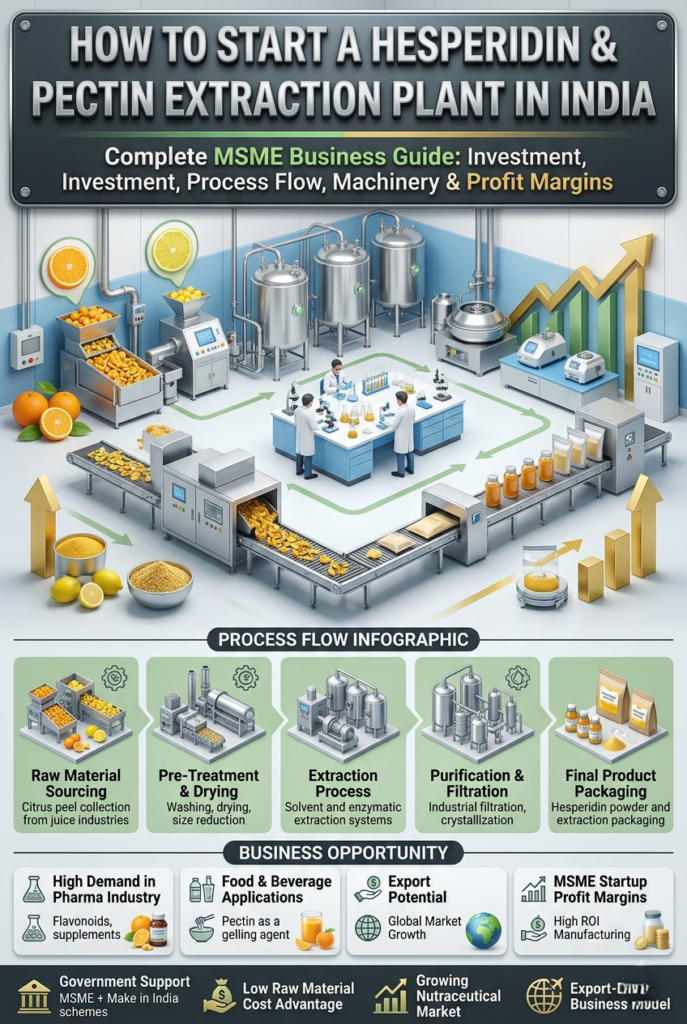
The process of production consists of a number of steps which convert the raw citrus peel into refined powder products. Despite the standard industrial equipment, it is necessary to carefully select the machinery to achieve consistent quality and efficiency.(Pectin Extraction Plant India)
The essence of machinery involved in this plant is:
- Peel washing and drying system
- Extraction vessel with agitator
- centrifuge or filtration unit.
- Evaporator for concentration
- Spray dryer or vacuum dryer
- Storage tanks and utilities.
A small unit with a capacity of 100 tonnes and level of automation has an estimated machinery cost of between ₹50 lakh to 70 lakhs.
Access Complete Business Plan: Pectin from Apple Pomace Project Report
Raw Material Availability and Supply Sources
Citrus peel is the main raw material to be used in this business and this is easily obtainable throughout India. The fruit processing industries produce huge amounts of peel on a daily basis and it is easy to acquire a constant supply.
Typical sources of raw material are:
- Juice factories
- Fruit processing units
- Wholesale fruit markets
- Agricultural cooperatives
Citrus peel is a comparatively inexpensive cost among other industrial raw materials. Fresh peel can be sold at a very low cost due to the fact that it is a waste to many processors. The low input cost goes a long way in enhancing the business profitability.
Production Capacity and Profit Potential
The high profit potential is one of the reasons why entrepreneurs are keen on this business. A small-scale plant can bring a lot of revenue even in case it is run properly and the quality of the products remains constant.
An average small unit will have the following financial performance:
- Monthly revenue: ₹30 lakh to ₹40 lakh
- Monthly operating cost: 8.5 lakh -11 lakh.
- Net profit margin: 18% to 26%
- Payback period: 3-5 years.
The profitability is even enhanced when the manufacturer sells directly to the pharmaceutical or food company rather than selling through traders.
Licenses and Registrations Required to Start the Plant
Entrepreneurs have to undergo a number of legal and regulatory processes before they can embark on production. These certifications assure that the plant is in compliance with the government-mandated safety, environmental and quality standards.
The most crucial licenses are:
- Udyam Registration of MSME recognition.
- Tax compliance GST Registration.
- Factories Act License of factory.
- Pollution Control Board permit.
- Food grade food safety license.
In case the company intends to provide pharmaceutical-grade hesperidin, other certification regarding the drug manufacturing standards can be also mandatory.
Find high-return business ideas based on your budget & ROI
Government Subsidies and Financial Support
To promote the new manufacturing industry, the Government of India provides various schemes. These initiatives offer financial support, lessen the risk of investment and assists entrepreneurs to grow their business.
The most helpful schemes to this industry are:
- PMEGP Scheme: Capital subsidy is provided to the extent of 35 percent.
- CGTMSE Scheme: Provides loans to MSMEs without collaterals.
- Startup India Scheme: Tax benefits and funding.
- PLI Scheme: Provides incentives on production and sales.
These schemes can greatly help in decreasing the financial load in the early years of the business.
Role of NPCS in Setting Up a Hesperidin and Pectin Extraction Plant
NIIR Project Consultancy Services (NPCS) is a top industrial consultancy firm that assists business people in setting up manufacturing plants in different industries. Most novice business owners are dependent on business advisors to make sure their project is both technically and financially feasible.
NPCS offers full assistance during the set-up process, such as:
- Detailed Project Reports (DPR)
- Market research and feasibility studies.
- Layout and machinery choice of plant.
- Budgets and cost analysis.
- Help with bank loan paperwork.
Consultancy support is typically a significant component of the planning process as banks and other financial institutions usually insist on the project report being prepared by a professional prior to granting loans. Through their collaboration with the seasoned professionals, the entrepreneur will be able to eliminate typical errors and begin their business without the difficulties.
Related Article: Profitable Business Opportunity: Pectin from Apple Peels
Future Opportunities in the Citrus Extraction Industry
The outlook of the hesperidin and pectin business in India is likely to be still good as the pharmaceutical and food processing industries are steadily increasing. With the growing consciousness of health and nutrition in the consumer population, a further growth in the demand of natural ingredients and plant-based compounds is probable.
Besides this, the multinational firms are also seeking trusted suppliers beyond the conventional production zones, and this has provided Indian manufacturers with new export benefits. Long-term stability of the market can be enjoyed by the entrepreneurs who invest in quality production and establish good customer relationship.
Frequently Asked Questions (FAQ)
How much capital would be needed to initiate a hesperidin and pectin extraction plant in India?
A small-scale plant may cost between 85 lakh and 1.15 crore as the minimum investment depending on the capacity, machinery and location.
Can this business be run by first-time entrepreneurs?
Yes, first generation entrepreneurs can initiate this business through appropriate planning, technical counsel, and funding.
In which time does it take to begin production?
It takes nine to fourteen months before the majority of plants are in production upon installation and obtaining necessary licenses.
What is the main raw material used in this business?
The main raw material is citrus peel that is acquired in the fruit processing units and the juice factories.
Is this business eligible to government subsidy?
Indeed, in schemes like PMEGP, CGTMSE, and Startup India, entrepreneurs can avail of financial aid.