


Author: Dr. Padma S Vankar | Publisher: Niir Project Consultancy Services (NPCS) | Price: ₹1,575 / US$ 150
The Colour Problem the Industry Cannot Ignore
Take a walk through any textile market in India – Surat, Tiruppur, Bhilwara, Panipat – and you will see a riot of colour. Miles of fabric in every hue imaginable, stacked and coiled, waiting for workers to cut, stitch and ship. What you will not see is the long list of chemicals required to create that colour – and the damage those chemicals cause to water sources, workers and the environment.
India’s textile and dyeing industry is one of the country’s major industries – in terms of value added, production and exports – but it is also among the most polluting.
Pali and Jaipur industrial clusters, once major textile manufacturing centres, have been completely shut down after the groundwater turned toxic due to dye effluents. Synthetic dyes have been the order of the day since their commercial introduction in 1856 – and many of these are carcinogenic or otherwise harmful. When Germany banned import of textiles dyed with carcinogenic azo dyes in 1994, it sent shockwaves through the global dyestuff industry and manufacturers. Eco-labels, GOTS certification requirements and consumer awareness have since contributed to more stringent scrutiny.
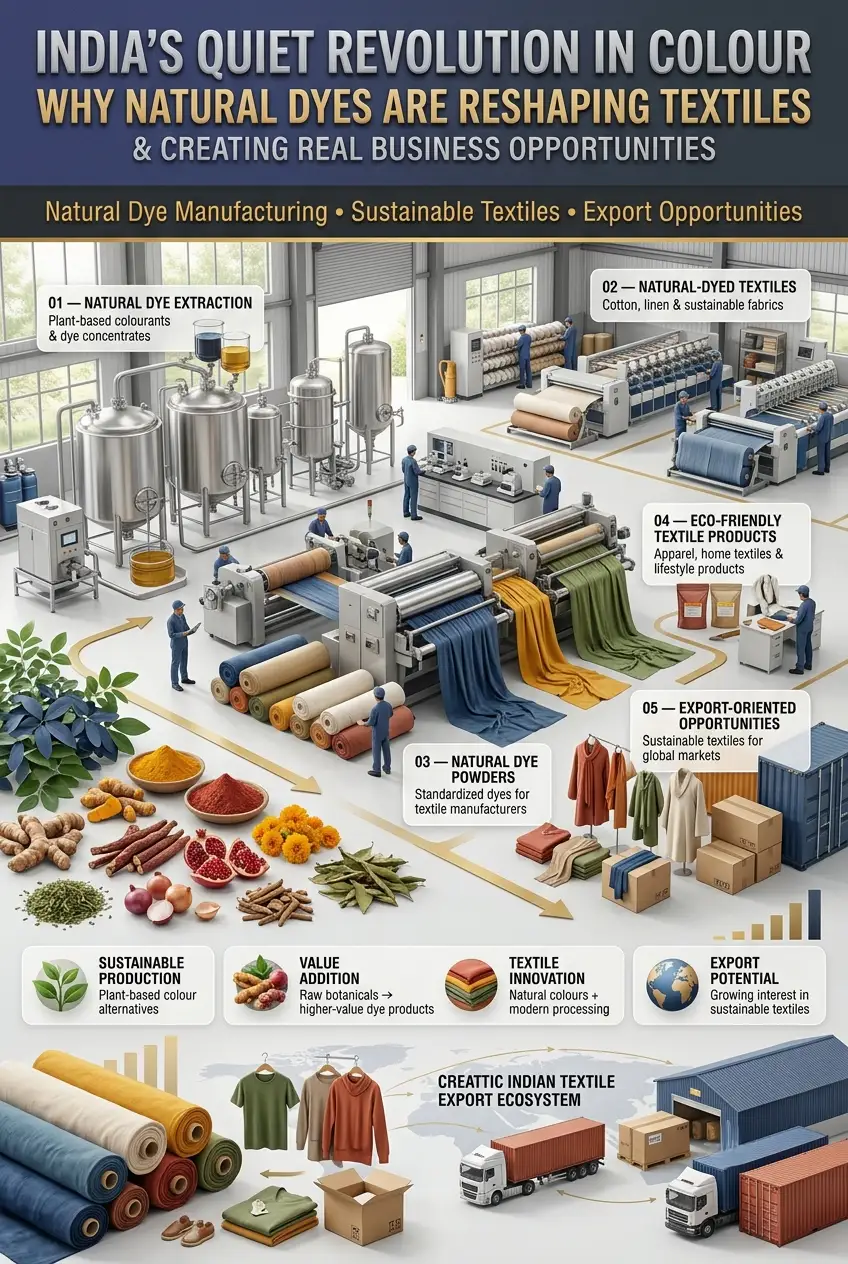
The return of natural dyes to the textile industry seems, if anything, overdue. However, it is not just a matter of ecology – there are business opportunities embedded in the shift.
A Market Quietly Accelerating
The global natural dyes market has been on a consistent upward trajectory, driven by the convergence of three forces: stricter environmental regulations in export markets, the growth of sustainable and organic fashion, and a genuine revival of interest among high-end buyers in heritage textiles and artisanal production processes.
India sits at a unique advantage in this landscape. The country has an estimated 500 plant species that can yield commercially usable dyes — from turmeric, marigold, and henna to lesser-known sources like Cassia fistula, Terminalia arjuna, and Eucalyptus bark. The tradition of natural dyeing in India runs deeper than virtually anywhere else in the world, from the Indigo plantations of Bengal described in colonial records to the kalamkari textile traditions of Andhra Pradesh and the block-printing heritage of Rajasthan.
Export demand is a significant pull factor. Buyers in Europe, North America, and Japan increasingly specify eco-certified, naturally dyed textiles for premium fashion and home décor lines. Handloom clusters that supply these markets — in Tamil Nadu, Uttar Pradesh, Manipur, and Gujarat — have created steady volume demand for standardised natural dye extracts. The Ministry of Textiles and the Development Commissioner for Handlooms have backed multiple projects and training programmes to make commercial natural dyeing viable at scale.
For MSMEs, the opportunity is specific and actionable. Natural dye extraction and supply is a low-capital entry point with ready industrial buyers. A small unit processing plant waste (bark, flowers, leaves) into standardised dye extracts can serve both the handloom and the mid-scale garment processing segments. The raw material — in many cases — is agricultural or forestry waste.
The Technical Challenge — And Why It Matters
Natural dyes are fairly straightforward at the prototype stage. The challenge comes in trying to develop standardized industrial processes – and for small-scale producers, understanding this complexity can be a hurdle. Experience shows that the same natural dye source can give varying results depending on the soil, climate and time of harvest. The extraction process may also vary for different plant material. Different mordants (treatment to help bind the dye to the fabric) create widely differing results – and some can be environmentally damaging. Prior to industrial application, standardization – getting consistent results with every batch of fabric – can be challenging. As a result, knowledge of natural dyeing at an industrial level is scattered – published primarily in scientific journals, with the practical know-how confined to a handful of researchers and practitioners.
This is where a practical handbook on industrial natural dyeing can prove invaluable.
Handbook on Natural Dyes for Industrial Applications (2nd Revised Edition): What This Book Actually Contains
The Handbook on Natural Dyes for Industrial Applications, 2nd revised edition by Dr. Padma S Vankar is a comprehensive reference on the subject. At 432 pages, it covers a wide range of topics – but the focus is on providing the reader with detailed guidelines on extracting dyestuff from 19 different plant sources, and using it to dye cotton, silk and wool.
Dr. Vankar is a Principal Research Scientist at IIT Kanpur’s FEAT (Faculty for Ecological and Analytical Testing), and has extensive experience in natural dyeing – including teaching workshops across the country, and designing eco-friendly dyeing processes using microwave. She has studied various natural dye extracts at length for their chemical properties.

What Makes This Handbook Different
Most books on natural dyeing are either intended for the craft market or are highly technical works on organic chemistry. This Handbook bridges the gap – it provides the technical details normally found in a university-level textbook on textile chemistry – but relates it to the practical application. Detailed instructions on extracting dyestuff using aqueous, solvent, Soxhlet, sonicator, supercritical fluid and subcritical water extraction methods are included. For each of the 19 plant species covered (Hibiscus rosa-sinensis, Plumeria, Nerium oleander, Ixora coccinea, Celosia cristata, Brassica oleracea (purple cabbage), Lawsonia (henna) and lac dye among others), the following information is provided:
- Photographs of the plant part used for dyeing
- Extraction methodology
- Mordanting procedures for cotton, silk and wool
- Colour measurement and K/S value
- Fastness properties
- Eco-friendliness and antimicrobial properties
- Shade cards showing the range of colours obtainable using that particular plant dye.
The inclusion of shade cards makes this a particularly valuable resource for manufacturers and product developers. It enables them to visualize the range of colours obtainable from various plant sources – which is critical to the decision-making process.
The Innovation: Sonicator Dyeing
One of the genuinely forward-looking aspects of this handbook is its coverage of ultrasonic (sonicator) dyeing — a method that uses 20 KHz frequency sound waves to drive dye penetration into the fabric, reducing the need to heat the dye bath to high temperatures. This matters for two reasons: first, it makes energy-sensitive dyes viable that conventional boiling conditions would otherwise decompose; second, it dramatically reduces energy consumption — a critical cost and sustainability factor for small manufacturers in India where energy resources are often constrained.
The same dye bath can be recharged and reused with sonicator dyeing — a material saving that makes a real difference to unit economics at small and medium scale. Dr. Vankar’s research at IIT Kanpur has demonstrated these advantages across multiple plant sources, and the handbook presents this data transparently.
Who This Book Is Written For
The publisher’s blurb suggests that this book is a must-read for professionals and entrepreneurs in the natural dye manufacturing space. While that certainly applies, this Handbook has value for a much wider audience.
- MSME entrepreneurs who intend to set up natural dye extraction or textile dyeing units
- Handloom clusters and weavers who want to adopt natural dyes
- Textile processing units looking to meet GOTS certification or eco-label requirements
- Fashion designers, product developers and retailers in the organic clothing space
- Researchers and students in textile, dyeing and allied fields of study
- NGOs, government agencies, and extension services supporting handloom and handicraft sectors
- Consultants and investors interested in the natural dyeing sector
Business Opportunity: Where the Money Is in Natural Dyes
The commercial case for natural dye businesses in India rests on several converging factors. Firstly, the raw material is widely available and, in many cases, is currently classified as waste. Eucalyptus bark, marigold flowers post-harvest, mango leaves, and pomegranate rind are all potential dye sources that are either underutilised or discarded.
Secondly, the value addition is significant. The difference between raw plant material and a standardised, quality-tested dye extract ready for industrial use can be substantial. European and Japanese buyers pay a premium for certified, documented natural dye sources with consistent quality metrics — shade cards, fastness data, eco-friendliness certificates. This is exactly the kind of documentation this handbook equips a producer to create.
Thirdly, institutional support is available. Under various MSME and handloom development schemes, state government industrial promotion agencies, the National Handloom Development Corporation, and central government schemes can provide funding and technical assistance for eco-textile projects. A well-prepared project report drawing on the technical foundation of a handbook like this one significantly strengthens any funding application.
The domestic market for naturally dyed textiles is also growing. With rising awareness of chemical sensitivity issues among consumers, and the expanding retail presence of sustainable and organic fashion brands, the addressable domestic market for naturally dyed products is larger today than at any point in the last century.
A Word About the Chemistry: Accessible, Not Intimidating
The handbook’s treatment of dye chemistry — chromophores, auxochromes, mordant bonding, UV-Vis spectroscopy — might look daunting in a contents listing. In practice, Dr. Vankar’s writing makes these concepts accessible without dumbing them down. The explanation of why mordants work, how metal salts interact with dye molecules and fibre surfaces to create colour-fast bonds, is one of the clearer explanations in print of a subject that is genuinely complex.
Understanding the science matters practically. A manufacturer who understands why chrome mordant increases light fastness, or why sonicator dyeing allows heat-sensitive dyes to remain stable, can better troubleshoot problems, optimise processes, and communicate with buyers who increasingly ask technical questions about their supply chain inputs.
Book Details at a Glance
| Book Title | Handbook on Natural Dyes for Industrial Applications (Extraction of Dyestuff from Flowers, Leaves, Vegetables) 2nd Revised Edition |
| Author | Dr. Padma S Vankar, Principal Research Scientist, IIT Kanpur |
| Publisher | NIIR Project Consultancy Services (NPCS) |
| ISBN | 9789381039755 |
| Pages | 432 |
| Edition | 2nd Revised |
| Format | Paperback |
| Price | ₹1,575 (India) | US$ 150 (International) |
Get Your Copy Today
Handbook on Natural Dyes for Industrial Applications (2nd Revised Edition)
If you are serious about entering the natural dye business, transitioning your textile unit to eco-certified production, or simply building a solid technical foundation in this subject, this handbook belongs on your shelf. At 432 pages, it covers more ground than most institutional training programmes — and it costs a fraction of what one consulting engagement would.
Dr. Vankar’s work at IIT Kanpur gives this book a research credibility that practitioner guides rarely have. The shade cards, extraction protocols, and machinery contacts make it immediately actionable. Whether you are a researcher, a manufacturer, a designer, or an investor evaluating the sector, this is the reference you will keep coming back to.
Price: ₹1,575 (India) | US$ 150 (International)

Your Investment Deserves the Right Opportunity
Every serious investment begins with choosing the right sector and the right business model. With hundreds of industrial opportunities available across India’s manufacturing and clean-energy landscape, making the most informed choice is crucial. Niir’s Startup Selector tool helps entrepreneurs, MSMEs and investors identify the most suitable business opportunities based on their investment capacity, location and interests, ensuring their capital is directed toward the venture with the best fit.