


Why Milk & Dairy Products Industry Consultants in India Matter Today
India occupies a special place in global dairy as it is the world’s largest milk producer accounting for over 20% of the total milk production in the world. However, despite this magnitude of production, there is still a significant amount of milk that is traded in unorganised markets and little value-added dairy products are produced compared to demand. The distance between imagination and reality is huge for anyone who wants to venture into this business as a new entrepreneur – from a pasteurised milk plant, a cheese unit, an ice cream plant or a dairy processing plant. That’s where milk & dairy products industry consultants in India are required.
Starting a dairy manufacturing business in India is not a simple endeavor of merely acquiring the plant and raw materials. A technically viable plant layout, an FSSAI compliant processing design, a realistic estimate of capital investment, a realistic demand study and a project report which meets the bankers and the state government incentive bodies are all essential ingredients for a first-generation entrepreneur. Founders may underestimate project costs, not calculate throughput capacity accurately, or miss critical regulatory requirements; all of which can result in months of commissioning delay and huge capital expenditure overestimation.
Besides, Indian dairy industry is undergoing rapid transformation. The competitive landscape is changing due to urbanisation, rising demand for modern retail stores, and export demand for skimmed milk powder and ghee. Premium products such as Greek yogurt, flavoured milk, and UHT milk are also gaining popularity. The foremost milk & dairy product industry consultant in India guides founders to create the product blueprint and define its commercial logic. This includes deciding which product to launch, what capacity to achieve, and which market to prioritise first.
Explore This Book: Modern Technology Of Milk Processing & Dairy Products
What Milk & Dairy Products Plant and Process Consultants Actually Do
It is important to remember that many business consultants are not experts in dairy technology and may be misled in this regard by many of the founders. These two are quite different in nature. A milk & dairy products plant consultant has practical experience with the technology of dairy processing, including spray drying, butter churning, cheese curd separation, ghee clarification, yogurt fermentation and pasteurisation & homogenisation. They know how process parameters are related to product shelf life, quality and cost. The difference between a credible dairy consultant and a generalist advisor is that they operate at that level of depth.
On the ground, the essential outputs of a dairy process consultant involve multiple work streams. Before the first rupee is spent on land or machines, feasibility studies are carried out — they determine the area of raw milk procurement catchment, variation of supply throughout the year, competitive position and financial feasibility. For units looking for bank loans, MSME subsidy or approval of government incentives, there is a Detailed Project Report (DPR). The DPR includes the manufacturing process, specifications of the machines, the requirements of raw materials, consumption of utilities, plant layout drawings, detailed financial projections, such as IRR and payback period.
<p>In addition to the DPR, numerous dairy plant consultants offer their services in EPC (Engineering, Procurement, and Construction) coordination, equipment vendor selection, plant commissioning, and process validation. Also, process engineering consultants can optimise the yield of existing dairy units, such as the milk solids recovery during paneer/ghee production, the reduction of steam consumption in pasteurisation and upgrade the packaging line to improve shelf life. This type of operational consulting can provide significant cost avoidance for MSME units while avoiding additional capital spending.
Another service area that is very important is regulatory navigation. The Indian dairy industry is a multi-layered compliance industry. The primary central regulator is FSSAI (Food Safety and Standards Authority of India) which regulates all aspects related to standards for composition, authorized additives, labelling and plant hygiene standards. The State Pollution Control Boards regulate effluent treatment requirements for dairy processing, which creates a large amount of wastewater that must be properly designed with an ETP. Labor protection and licensing is regulated by the Factory Act. A well-rounded dairy consultant ensures clients have the correct licences applied and in the correct order so they don’t end up paying unnecessary fees for delays due to incomplete applications.
View Full Project Details: Milk & Dairy Products: Complete Industry Guide
Why India Has Become a Hotspot for Dairy Consulting and Boutique Management Consulting Firms
This is an exciting time for milk & dairy products consulting in India. More than a few structural forces are coming together. Government policy has been a key factor. Private players as well as cooperative players have been encouraged to invest in capacity augmentation. They have also been encouraged to diversify their portfolio of products. Various schemes support this, including the Dairy Processing and Infrastructure Development Fund (DIDF), Production Linked Incentive (PLI) scheme for food processing, and Pradhan Mantri Formalisation of Micro Food Processing Enterprises (PM FME) scheme.
The need for bankable project reports is a key requirement in each of these schemes. This has also increased the demand for professional consultancy services.
Another factor driving growth for the sector is import substitution. Some of the dairy ingredients like specialty cheese varieties, whey protein concentrates and high value milk powders are always imported to India. The push policy has created new opportunities for investment for entrepreneurs who are willing to establish technologically advanced processing facilities; sometimes with the assistance of a dairy technology consultant who can appreciate the production process and the opportunity for import substitution.
India has been slowly expanding its exports of ghee, Skimmed Milk Powder and UHT milk into markets across the Middle East, Southeast Asia and Africa. In addition, the National Dairy Development Board (NDDB) has invested in strengthening the cold chain and bulk milk cooler network. This investment has enhanced the quality of raw milk for processors. As processing quality improves, demand is rising for boutique management consulting firms in India that offer market access advisory. Dairy startups also need help positioning themselves for institutional buyers, organised retailers and ecommerce platforms.
The sector is also gaining a new breed of NRI investors and domestic agri businesses, which view dairy as a defensive consumption play with high growth potential. Other platforms such as Invest India and Indian Dairy Associations (IDA) have regularly kept an eye on the investment opportunities and policy support available in this sector. Combined, these trends make it clear why the dairy consulting market in India is on an uptrend.

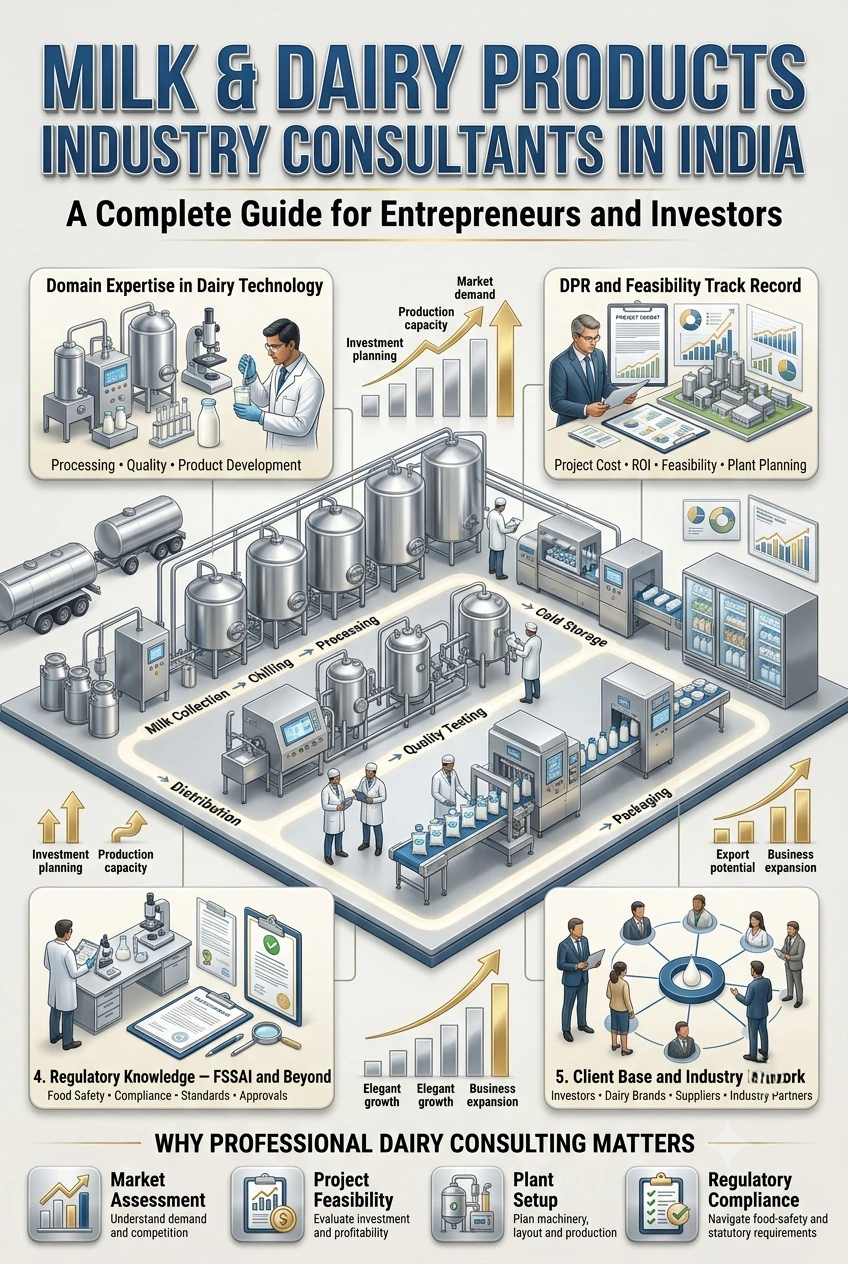
How to Evaluate and Shortlist the Best Milk & Dairy Products Industry Consultants in India
Domain Expertise in Dairy Technology
The first and foremost criteria is the sector depth. Has the consultant got first-hand experience with particular dairy technology and not with food processing in general? Refrigeration, CIP (Clean-in-Place) systems, milk reception and chilling, and continuous pasteurisation lines are key engineering requirements in the dairy industry. For fluid milk, ghee, ice cream, or cheese, ask prospective consultants about their completed projects. Also, request references from those plants. A consultant with experience in both small and large pasteurised milk units, as well as large dairy complexes, offers broader expertise than a generalist.
DPR and Feasibility Track Record
A credible DPR is not a template document! It should be based on market realities, reasonable raw milk sourcing costs within the target area, prevailing equipment market prices from trusted suppliers and a credible financial plan. Before selecting the best milk & dairy products industry consultants in India be sure to see a sample DPR. Determine whether it contains product-specific process flow diagrams, an adequate break-even analysis, and a sensitivity table showing profitability at varying capacity utilisation levels. Project reports now face greater scrutiny from banks and MSME lending institutions. If a report contains generic assumptions, it may face quick rejection.
Engineering and EPC Capability
The consultant’s engineering ability is a significant factor in greenfield dairy plants. Process engineering consultants who can prepare detailed plant layout drawings, specify civil works, size utility systems (chilled water, steam, compressed air), and coordinate with equipment suppliers offer much more value than consultants who only provide advisory reports. For a full EPC contract, check the consultant’s execution team. Do they have qualified dairy engineers on staff? Or are they only project managers who outsource technical work?
Regulatory Knowledge — FSSAI and Beyond
No dairy manufacturing unit in India will be able to operate without being compliant with FSSAI. A good consultant will help you determine the right FSSAI licence category (state or central). They will help you prepare your food product composition to meet the requirements of the Food Safety and Standards (Food Products Standards and Food Additives) Regulations. They will also advise you on product composition standards as per Schedule IV of the Standard.
In addition to FSSAI, an experienced consultant will help you navigate the Pollution Control Board’s consent-to-establish and consent-to-operate processes. They will also assist with Factories Act registration and the Goods and Services Tax (GST) registration process. This includes selecting the relevant HSN codes for your dairy product mix.
Client Base and Industry Network
Last but not least, evaluate the consultant’s clientele. Do they have experience with private dairy entrepreneurs, cooperatives, MSME units, and large corporate clients? Having a varied mix of clients implies flexibility. Moreover, an entrepreneur who has the right network can help the entrepreneur to reach the equipment suppliers, dairy technology institutes and animal husbandry departments of the respective states, which can help to implement the project quickly.
Related Article: A2 Milk & Desi Cow Milk Products Business Guide
Role of NPCS in Milk & Dairy Products Project Consultancy
Niir Project Consultancy Services (NPCS), New Delhi is one of the well-established industrial consultancy firm of India with significant experience in the milk & dairy products industry. NPCS has been in existence since 1994 and over the years, has prepared Detailed Project Reports and techno-economic feasibility studies for dairy entrepreneurs in India and abroad, for clients in more than 85 countries and accomplished over 150,000 projects across manufacturing sectors.
In the case of dairy entrepreneurs, NPCS provides detailed DPRs for the entire manufacturing process, from reception of raw milk and testing milk quality, to pasteurisation, homogenisation, product specific processing (butter, ghee and cheese, ice cream, flavoured milk, yogurt, condensed milk, casein, skimmed milk powder), packaging and cold storage. The machinery and raw material procurement details, market research and demand analysis, process flow diagrams, product mix and capacity planning, complete financial projections with profitability analysis, IRR and payback calculation are part of each project report.
The fact that the project is so broad is what makes NPCS so helpful to first-generation dairy entrepreneurs. Their milk & dairy products project profiles describe dozens of project concepts ranging from a small ghee plant to a large integrated dairy complex, providing detailed benchmarks of technical and financial information for each. This will enable investors to evaluate projects, the capital costs and narrow it down to the most feasible idea before investing their time into a full custom DPR.
NPCS’ website (Niir) also provides access to dairy project reports, market research studies, and business plan templates. These resources help founders prepare for meetings with banks, state agencies, and private equity investors. This catalog approach reduces research effort during the initial project identification stage. It also helps founders explore multiple project ideas in one place.
NPCS is a perfect example of how an existing Indian consultancy firm could act as a knowledge partner for the sector. Rather than being a generic advisory house, it could help with feasibility validation, DPR preparation, and project launch. This level of structured project intelligence is valuable to dairy entrepreneurs in India. It is particularly useful for NRI investors who want to invest in dairy projects remotely.
Turn your budget into a successful business plan
Regional Angle: Best Milk & Dairy Products Industry Consultants in Delhi and the Broader India Landscape
The number of industrial consultancy firms in Delhi-NCR is large. They account for a disproportionately high percentage compared to other parts of India. The best milk & dairy products industry consultants in Delhi provide an added advantage. They are located near key government bodies like the FSSAI head office, Ministry of Food Processing Industries (MoFPI), representation offices of NDDB, and key equipment suppliers. This location advantage means the government responds faster. Government documents are also easily accessible. There are better links with national dairy industry organizations such as the Indian Dairy Association (IDA), based in Delhi.
Outside Delhi, India’s dairy consulting sector is well-established in places like Anand (Gujarat), the cradle of the cooperative dairy model. It is also growing rapidly in Pune, Hyderabad and Chennai, where private investment in the dairy industry has increased. The Ministry of Food Processing Industries (MoFPI) has also set up a dedicated dairy sector portal. It highlights investment prospects and government support programmes across these geographies.
For data-driven project planning, resources from IBEF (India Brand Equity Foundation) and Invest India provide detailed sector snapshots that consultants and investors routinely use for market sizing. The National Dairy Development Board (NDDB) also publishes regular data on milk production, cooperative structure, and processing capacity that is essential for demand analysis in any dairy DPR. State-level consultancy firms in Punjab, Haryana, Rajasthan, and Uttar Pradesh — India’s primary milk belt states — often offer deep local knowledge of raw milk procurement, cooperative relationships, and state-specific incentives. Founders setting up plants in these states may benefit from engaging consultants with national-level credentials and strong local networks.
Milk & Dairy Products Consulting Services: Types, Focus Areas, and Best-Fit Clients
| Consulting Service Type | Core Focus | Key Deliverables | Best-Fit Client |
| Techno-Economic Feasibility Study | Pre-investment viability assessment | Market analysis, cost estimates, financial projections, go/no-go recommendation | First-generation entrepreneurs, NRI investors |
| Detailed Project Report (DPR) | Full project documentation for bank loans / government schemes | Process flow diagrams, machinery specs, plant layout, financial model with IRR and payback | MSME founders, cooperative dairy units seeking loans or PLI/PM FME support |
| Process Engineering Consulting | Plant design and dairy technology optimisation | Process flow sheets, equipment sizing, utility design, CIP system layout | Greenfield dairy plants, units upgrading from manual to automated processing |
| EPC / Project Management Consulting | End-to-end execution of dairy plant construction | Civil, structural, and MEP coordination; equipment procurement; commissioning support | Large-scale dairy processors, integrated dairy complexes |
| Regulatory Compliance Advisory | FSSAI licensing, PCB consents, Factory Act registration | Licence applications, inspection preparation, Schedule IV documentation | New dairy units; existing units requiring upgrades or renewals |
| Market Entry and Business Strategy | Product positioning, channel strategy, pricing, and brand development | Market research report, competitive benchmarking, go-to-market strategy | Corporate dairy groups entering value-added product segments |
| Operational / Yield Optimisation | Improving efficiency in existing dairy operations | Process audit, yield improvement roadmap, cost reduction recommendations | Existing dairy MSME units with 2–5 years of operations |

Conclusion: Your Next Steps as a Dairy Entrepreneur in India
India’s milk & dairy products industry stands at a genuinely exciting inflection point. Moreover, Domestic consumption is rising, exports are growing, government support is substantial, and the organised processing share — though improving — still leaves significant room for new entrants with the right product positioning and operational efficiency. However, the opportunity is only accessible to founders who plan rigorously before they invest.
Therefore, Engaging the right milk & dairy products industry consultants in India early — at the project idea stage, not after land is purchased — is the single most impactful decision a dairy entrepreneur can make. A credible feasibility study tells you whether your project makes economic sense. A well-prepared DPR gives your bank the confidence to sanction a loan. Sound process engineering prevents expensive retrofits after commissioning. And regulatory expertise means you open on time, not after months of licence delays.
For example, For founders exploring multiple dairy project ideas, the NPCS milk & dairy products project catalog at niir.org is a practical starting point — offering benchmarked project profiles across dozens of dairy product categories. Use it to compare investment levels, understand processing requirements, and shortlist the product that best matches your resources and market access.
Beyond that, connect with institutions like NDDB, the Indian Dairy Association, and your state’s animal husbandry department. They can help you understand raw milk availability and the cooperative landscape in your area. Verify FSSAI licensing requirements for your intended product category early. When shortlisting consultants, prioritise demonstrated sector expertise over low fees. The cost of a poor DPR or a missed regulatory requirement is far greater than the difference in consulting charges.
India’s dairy sector rewards well-prepared investors. The infrastructure is improving, the market is growing, and the policy environment is supportive. With the right professional consultancy support behind your project, the distance between idea and operational dairy plant is shorter than it has ever been.
Key References and Resources
Food Safety and Standards Authority of India (FSSAI)
National Dairy Development Board (NDDB)
Indian Dairy Association (IDA)
Ministry of Food Processing Industries — Dairy Sector Portal
India Brand Equity Foundation (IBEF) — Dairy Sector
Invest India — Indian Dairy Landscape
NPCS — Milk & Dairy Products Project Profiles
NIIR Project Consultancy Services