Metal Fabrication Business in India
India’s manufacturing ecosystem is experiencing a remarkable expansion however businesses continue to overlook particular sectors. The industry offers three elements which make metal fabrication a profitable business opportunity that exists in permanent need. From automotive to aerospace, construction to consumer durables, fabricated metal parts are the backbone of industrial production. For founders with mechanical expertise, relatively little capital and a focus on quality, metal fabrication can be a very lucrative business venture.
Explore This Book: The Complete Book on Ferrous, Non-Ferrous Metals with Casting and Forging Technology
What is Metal Fabrication?
Metal fabrication enables the transformation of raw metals into functional components through multiple metal fabrication methods which include cutting and bending and welding and machining and finishing. Metal fabrication functions through its physical production process because industries which manufacture actual products require their own fabricated components:
- Sheet metal enclosures for electrical panels
- Welded frames for automobile components
- Precision machined parts for pumps and compressors
- Laser cut brackets and fittings for construction projects
The ongoing demand for these components means that there is a steady demand making metal fabrication a resilient business opportunity.
Understanding the Market Demand in India
India’s metal fabrication industry is amongst the largest in Asia, with a variety of industrial clusters:
1. Automotive Industry
Demand for fabricated parts is anchored by automotive manufacturing. Every vehicle; cars, two-wheelers, tractors and commercial vehicles, require components such as:
- Chassis members
- Body panels
- Brackets and mounts
- Fuel tanks
Important centers of automobile industries are Pune, Chennai, Gurgaon, and Aurangabad. Startups who achieve IATF 16949 certification gain access to two essential benefits which include high volume procurement pipelines and long term client relationships.(Metal Fabrication Business in India)
2. Construction and Infrastructure
India’s construction boom creates an ongoing need for fabricated structural steel and architectural metalwork and handrails and platforms and equipment enclosures. The local suppliers who provide fast delivery services become the preferred choice for businesses which require their products to be delivered within short time frames:
- Industrial sheds and pipe racks
- Mezzanine floors, Pre-engineered building components
- Road, rail, port and power plant projects
3. Emerging High-Value Sectors
The defence and aerospace industries create a major requirement for high-precision sheet metal and machined components which operate under the Make in India program. Margins are higher but these industries need strict quality systems, traceability and process documentation and separate the serious manufacturers from small workshops.
Startup Opportunities for Metal Fabrication
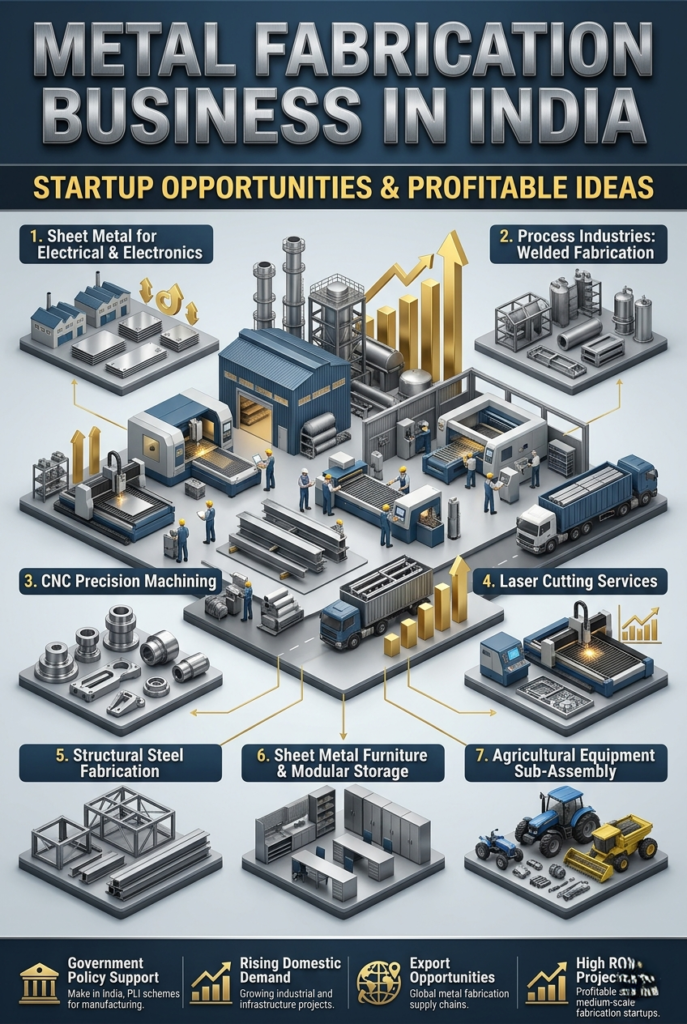
Metal fabrication includes multiple business sectors which present significant opportunities for new business ventures:
Access Complete Business Plan: Steel Structure Unit Business Guide
1. Sheet Metal for Electrical & Electronics
Focus on manufacturing:
- Control panels
- Server racks
- Switchgear enclosures
The production process requires CNC Press brakes and laser cutting and powder coating and BIS certification as essential components.(Metal Fabrication Business in India)
2. Process Industries: Welded Fabrication
Examples of high-margin products include:
- Pressure vessels
- Storage tanks
- Heat exchangers
- Pharmaceutical or Food Processing Skids
Stainless steel and GMP compliant welding materials achieve market prices which reach two to three times higher than carbon steel. The company requires skilled welders who have expertise in TIG welding.
3. CNC Precision Machining
Supply precision parts to automotive and engineering OEMs, including:
- Shafts and flanges
- Housings and valve bodies
- Gear blanks
Margins: 35-50%, more than structural fabrication. Export readiness ISO / International Automotive Task Force (IATF) certified
4. Laser Cutting Services
A capital efficient entry point: Process customer designs into final parts. Potential clients include:
- Furniture manufacturers
- Signage companies
- Automotive Tier-2 suppliers
5. Structural Steel Fabrication
Industrial sheds, mezzanine floors and pre-engineered buildings are in constant demand. Entrepreneurs with industrial clusters or real estate centers can order large amounts of orders.
6. Sheet Metal Furniture & Modular Storage
Government institutions and offices need office furniture and modular storage units. Registering on GeM (Government e-Marketplace) opens predictable order streams, often higher margins than component level fabrication.
7. Agricultural Equipment Sub-Assembly
OEMs that order tractor frames, lift arms, PTO guards and hydraulic mounts are Tier-2 suppliers. Qualification can result into repeat orders and steady production pipelines.
Find high-return business ideas based on your budget & ROI
Investment, Returns and Certification
Capital Requirements
- Small sheet metal unit: ₹25–60 lakh
- CNC and precision fabrication: Crore 1-3
Profit Margins
- Structural fabrication: 18–28%
- Precision machining: 35–50%
Break-even is usually between 12-24 months depending on scale and customer acquisition.
Key Certifications
- ISO 9001: Basic quality system
- IATF 16949: Automotive supply chain
- IBR/ASME: Pressure vessels, process and export
- BIS under IS standards Electrical enclosures
Certifications not only help in building credibility but also help in gaining access to higher margin clients.
Export Potential
India’s metal products have become more competitive in the global market because of skilled manpower, cost benefit and certification. Important segments to be exported are:
- Precision-machined car parts (USA, Germany, Japan)
- Enclosures, sheet metal (Middle East, Africa)
Startups can use export houses to get to overseas buyers initially, but as they build consistent quality, direct export them.
Support from the Government for Metal Fabrication Startups
A number of government programs help promote growth and alleviate capital constraints:
- MSME Technology Upgradation Scheme (TUS): 15 – 25% subsidy on the machines for CNC, laser cutting, welding, and inspection
- Production Linked Incentives (PLI) for Specialty Steel: Ensures the availability of raw materials
- SIDBI & CGTMSE: Favourable financing options
- EEPC India: Export promotion through trade fairs, buyer facilitation and freighter assistance
Leveraging these initiatives reduces risk and makes startups grow faster.
Related Article: 10 Best Manufacturing Business Ideas in India for 2026 (Low Investment & High Profit)
Building a Sustainable Fabrication Business
Successful entrepreneurs in this sector are disciplined:
- Start with job-work: Build the capability and customer relationships
- Invest in quality systems and certifications: Distinguishes itself from competitors
- Secure anchor customers: Targeting OEMs or institutional customers
- Scale strategically: Progress to high value precision or export-oriented production over time
Conclusion
Metal fabrication in India provides a structural driven Multi sector opportunity for MSME founders. Entrepreneurs need to invest in high-quality systems and certification programs and build strong customer connections to establish businesses that will grow at a sustainable rate. The business sector provides an ideal environment for startups which seek to create sustainable businesses because government support and export opportunities and persistent local market demand combine to support their operations.
Successful businesses need three essential components which include professional conduct and specialized knowledge and methods to grow their operations from basic products to complete export-ready manufacturing.
FAQ: Quick Insights
What is the smallest amount of investment?
₹25 lakh to 60 lakh for small sheet metal unit with equipment’s and working capital.
Which certifications are most important?
ISO 9001 For all markets IATF 16949 For automotive IBR/ASME For process industries BIS For electrical enclosures
How can I acquire customers?
Proximity to industrial clusters, networking (using MSME associations), online (IndiaMart), starting job-work followed by OEM supply (6-18 months)
What are typical margins?
Structural fabrication 18-28%, Precision machining 35-50% Complex products fetch higher price.
Is exporting feasible early?
Yes, through export houses. Direct exports can be made after 2 -3 years of consistent quality.
How is working capital controlled?
Raw materials are purchased in advance, WIP is significant and with 45-90 days for receivables. Credit lines of 20-35% of annual revenues are commonplace.