A Practical, Capex-Aligned Guide for New-Age Industrial Founders
If you have been tracking India’s industrial landscape closely, one theme is becoming increasingly clear: the capex cycle is back. This is not just a headline-driven recovery—it is a behavioral shift across corporate India, public sector undertakings, and state-led infrastructure programs. When capital expenditure revives, it sets off a chain reaction: contractors accelerate execution, equipment suppliers report longer lead times, logistics capacity tightens, and lenders become more confident about funding cash-generating manufacturing projects.
For first-generation manufacturing entrepreneurs, this phase presents a rare window of opportunity. Demand visibility improves, buyers are willing to commit earlier, and supply gaps emerge faster than new capacity can be created. However, success depends less on ambition and more on project selection discipline.
According to the feasibility consultant, the most bankable manufacturing projects for the year 2026 have four characteristics in common:
- Predictable and repeatable demands
- Working capital cycles that can be managed without any stress
- Product mix that is both scalable and standardized
- Clear import-substitution or export potential
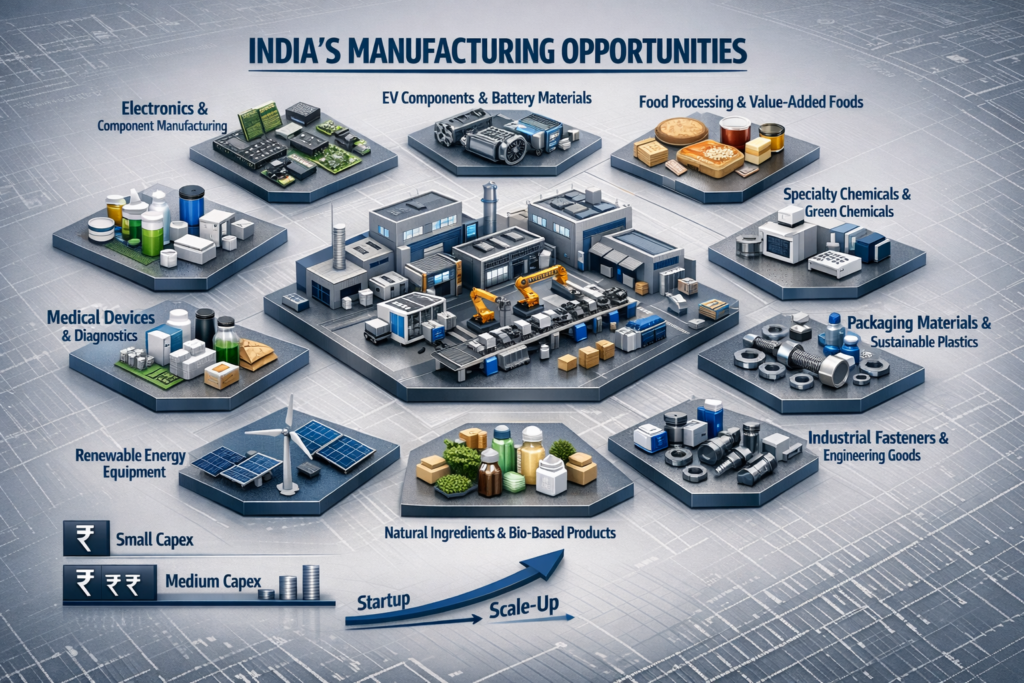
Ten potential manufacturing projects for the year 2026 are discussed in this paper and they are in line with India’s capital expenditure revival as well as the country’s direction in policy towards infrastructure, healthcare, renewable energy, and manufacturing.
Read:Top 10 High-Demand business ideas for Indian Entrepreneurs in 2025
Understanding Capex Signals: What Entrepreneurs Should Read Between the Lines
Wise founders do not interpret capex news as a separate case but rather look for patterns—across healthcare, infrastructure, defence, logistics, and consumer staples—that signal the coming of sustained procurement rather than one-time projects.
Some of the key signals of capital expenditure that are significant for the startups in the manufacturing sector comprise:
- Rising capital expenditure among corporations and public sector units in every sector
- Major investments in healthcare and hospital infrastructure
- Investment summits organized by states that attract investors by offering land, tax rebates, and entry into clusters
- Prompted the visibility of defence, aviation, and public procurement
- Making logistics, agriculture, and value-added processing strongly interlinked
These signals usually result in a massive increase in the need for various types of products like components, consumables, packaging, fabricated structures, electrical systems, and industrial inputs—where MSMEs can do brilliantly.(Manufacturing Opportunities India 2026)
1. Auto-Component Manufacturing Aligned to Emission and Efficiency Norms
The auto supply chain is in need of a complete and radical re-design of parts and components as the emissions coming from vehicles and fuel consumption regulations are getting stricter and stricter. MSMEs manufacturing plastic injection-moulded components, brackets, HVAC ducts, sensor housings, wiring harness accessories, and engineered fasteners are paving the way for the mentioned auto supply chain not just for the immediate future but for a longer period through their process-driven pieces and repeat orders.
Auto makers, instead of starting manufacturing from the ground up, should go in for Tier-2 and Tier-3 suppliers, where the investments made in tooling can be recovered and the volumes are also steady.
Feasibility insight: Pick components where tooling costs would be recouped in 18-24 months and there could be quality risks but basic QC systems can control them.
2. Injection-Moulded Plastic Components for Healthcare and Industrial OEMs
The healthcare sector investment brings about a very strong multiplier effect. Upgrading hospitals, diagnostic centers, and medical infrastructures continuously create the demand for medical-grade plastic components and packaging which will never run out.
The cleaning and sterilizing processes for surgical instruments and other medical equipment, hence the need for medical-grade plastic parts and packaging will always exist. Also, the presence of the healthcare utilities across hospitals, clinics, and labs will invite the supply of trays, housings, caps, dispensers, small enclosures, and utility industrial parts directly to OEMs and the institutional buyers. The consumer plastics segment is in contrast to this sector since it demands nothing but flawless editions, strict adherence to regulations, and absolute delivery reliability.
Feasibility insight: Profit margin increases with the use of multi-cavity moulds, standard resins, and a limited yet repeat SKU portfolio.(Manufacturing Opportunities India 2026)
Read:Top 20 Resin Business Manufacturing Opportunities for Startups and Entrepreneurs
3. Fabrication and Galvanizing Units for Infrastructure and Power Projects
The fastest way to see the infrastructure capital expenditure is through steel-intensive execution. Fabrication and galvanizing the units of solar mounting structures, transmission towers, cable trays, lighting poles, crash barriers, and support frames are the classic ones that would benefit most from the revival of capital expenditures.
Business might be traditional but it still has great scalability potential if strong project discipline and good location strategy are in place.
Feasibility insight: Favor contracts with frequent billing milestones and mobilization advances to keep the cash flow protected.
4. Packaging Materials: Corrugated Boxes, Mono-Cartons, Labels, and Flexible Packaging
Packaging is the manufacturing segment that is most resilient and will not be affected during any growth cycle. The sectors that are expanding—FMCG, pharma, engineering goods, e-commerce, and exports—are all consumers of packaging materials.
This variety of customers gives packaging units the ability to resist shocks and at the same time to be scalable. Export-oriented clients furthermore demand very good quality secondary and tertiary packaging.
Feasibility insight: Having a mixed customer base and strategically timing raw material procurement will help to protect margins.
Read More: N-Butyl Acetate – Manufacturing Plant, Detailed Project Report, Profile, Business Plan, Industry Trends, Market Research, Survey, Manufacturing Process, Machinery, Raw Materials, Feasibility Study, Investment Opportunities, Cost and Revenue, Plant Layout
5. Specialty Chemicals and Home-Care Liquids (Fabric Softeners, Cleaners)
Steady usage patterns along with more and more private-label demand make home-care and fabric-care chemicals an intriguing place for manufacturing investment. Regional brands, institutional laundries, and retail chains are outsourcing their manufacturing increasingly.
Success in this area, however, is more about the discipline of the formulation, the quality of the packaging, and the alignment of the distribution rather than the complex technology..
Feasibility insight: Create 2-3 different formulations with different price bands and concentrate on distributor-led repeat sales fully.
6. Renewable Energy Supply Chain Manufacturing
The Indian government’s commitment to renewable energy sources has resulted in a big increase of demand for solar mounting structures, fasteners, cable trays, clamps, junction boxes, and conduits. The EPC contractors lean towards the suppliers with a good reputation, who can deliver the components with the same quality and on-time, even when the schedules are very tight.
This part of the industry is also having the opportunity of exporting its products to the neighboring developing markets.
Feasibility insight: It is more valuable to be consistent with galvanizing quality, documentation, and on-time delivery than to just focus on scale alone.(Manufacturing Opportunities India 2026)
7. Agri-Linked Value-Added Manufacturing: Tea Blending and Packaging
Agriculture-linked manufacturing still remains as one of the most reliable opportunity zones in India. The tea blending and packaging process is a scientifically structured industrial operation that requires careful control of moisture, sealing integrity, SKU management, and institutional procurement.
The opportunities in the market are not only through the retail brands but also in private-label packaging, institutional bulk supply, tea bags, and export-ready formats.
Feasibility insight: B2B and institutional contracts provide the manufacturers with stronger margins than that of mass-market branding.
8. Precision Parts and Assemblies for Defence and Aerospace
The increase in the defence sector and public sector activities has made MSMEs that are responsible for the supplying precision-machined parts, sheet-metal components, electrical sub-assemblies, and connectors very much needed.
Although the onboarding cycles are slow and full of documentation, payment reliability gets better when the approvals are in place.
Feasibility insight: Only enter if you can handle the slow first year while the certifications and approvals are getting done.
Read More: Glass Manufacturing – Manufacturing Plant, Detailed Project Report, Profile, Business Plan, Industry Trends, Market Research, Survey, Manufacturing Process, Machinery, Raw Materials, Feasibility Study, Investment Opportunities, Cost and Revenue
9. Industrial Electrical and Automation Add-Ons
Every new factory and infrastructure project requires electrical integration. Manufacturing control panels, enclosures, junction boxes, cable glands, and cable management systems is a scalable MSME opportunity.
This segment benefits from standardization, repeat orders, and institutional procurement.
Feasibility insight: Margins improve when enclosure sizes and wiring practices are standardized.
10. Recycling and Circular Manufacturing Units
Higher capex leads to greater consumption and, in turn, to more waste. Well-managed plastic and metal recycling plants that change scrap into reliable industrial-grade inputs are regarded more and more by OEMs that are mainly concerned with cost and sustainability.
Feasibility insight: Procurement discipline and contamination control matter more than high-end machinery.
What Successful Industrial Groups Teach New MSME Founders
India’s large industrial groups succeed not through luck, but through process discipline, supply-chain control, and long-term thinking. These lessons apply directly to MSMEs:
- Focus on procurement and distribution, not just production
- Standardize operations and avoid scattered product lines
- Treat quality and reliability as your primary brand
Read More: Power Project For Glass Industry – Manufacturing Plant, Detailed Project Report, Profile, Business Plan, Industry Trends, Market Research, Survey, Manufacturing Process, Machinery, Raw Materials, Feasibility Study, Investment Opportunities, Cost & Revenue
Where Professional Feasibility Planning Makes the Difference
Many manufacturing ventures fail not because the idea is weak, but because of emotional decisions—wrong capacity sizing, poor product mix, underestimated working capital, or inappropriate machinery selection.
Professional Detailed Techno-Economic Feasibility Reports (DPRs) help founders stress-test assumptions the way banks and institutional investors do—covering market demand, manufacturing process, capacity planning, machinery, raw materials, and financial viability.
A good DPR does not sell dreams. It filters risk.
Frequently Asked Questions (FAQ)
- What is the fastest way to shortlist the right manufacturing project?
Start with buyer visibility. Repeat institutional or OEM buyers matter more than theoretical market size. - Are B2B manufacturing projects safer than consumer products?
B2B projects often scale faster due to repeat orders and lower marketing costs. - What is the most common mistake new manufacturing entrepreneurs make?
Underestimating working capital and receivable cycles. - Should exports be the primary strategy from day one?
No. Build stable domestic demand first, then use exports as a margin enhancer. - Is low-capex manufacturing always better?
Not necessarily. Moderate capex with higher entry barriers often offers better long-term margins.
Final Thought
A capex revival creates opportunity—but also noise. Entrepreneurs who succeed are those who apply feasibility thinking, prioritize repeat demand, manage cash flows rigorously, and treat quality as a long-term sales strategy. That is how macroeconomic cycles are converted into durable manufacturing businesses.