


A huge infrastructure initiative at the national level is silently paving the way for a significant reconfiguration of the business landscape of Uttar Pradesh and central India. The central government has given permission to build a 118km-long greenfield, access-controlled highway that will link Kanpur to Kabraai in Mahoba district, one of the oldest industrial centres in the country. It’s more than just a road, it’s a project that will be built, operated and then transferred to the National Highways Authority of India (NHAI), and it’s estimated to cost around ₹7,145 crore. It is a structural shift in the flows of goods, persons and investments in the region.
Kanpur has enormous manufacturing depth in the leather, textile, chemicals, plastics and engineering goods sectors. The Bundelkhand region is endowed with natural resources like granite, limestone and agricultural produce, but is under-connectivity due to lack of connectivity. The corridor ultimately passes through the Kanpur-Bhopal Economic Corridor framework, which brings mineral and industrial depth to the equation — in Madhya Pradesh. The better these three zones are connected, the more economic ramifications ripple through the region; and the more business opportunities emerge for those who are watching closely, for entrepreneurs, MSMEs, manufacturers and investors.
What This Development Means for Indian Businesses
This infrastructure project has the most immediate commercial implications in terms of saving freight time and logistics cost between Kanpur and Bundelkhand – Madhya Pradesh belt. Now, the time taken to cover the road distance between Kabraai and Kanpur is more than 3.5 hours. With the four-lane access-controlled corridor in place, that trip will be about 1.5 hours. Maximum speed limits of 80 and 100 km per hour are possible and the plan also provides for future expansion to six lanes.
This “compression” of journey time has a significant effect on the viability of businesses. The immediate advantages are for industries requiring timely freight transport, such as food processing, pharmaceuticals, chemical shipping, e-commerce last mile and more. Kanpur manufacturers benefit by quick, secure supply of raw material from Bundelkhand and MP. The industrial estates route along the highway opens to investors’ eyes. The corridor will also link to NH-34, NH-35, Bundelkhand Expressway, Kanpur Ring Road and various state highways which will extend its supply chain effect many folds.
The development offers a true opportunity window for entrepreneurs and MSME promoters. Historically, this sort of investment in infrastructure has resulted in additional private investment in industrial complexes, warehouses, logistics parks, and ancillary manufacturing. The best time to assess and prepare for business entry is when the business is still in the development stage – not after the highway is built and land values have had time to adjust.
Related Article: Uttar Pradesh Startup Policy
Why This Industry Could See Stronger Growth
This highway is not a stand-alone project. It is specifically mentioned as a strengthening link in the PM GatiShakti National Master Plan – a multi-modal infrastructure integration policy to lower logistics costs and up industrial competitiveness for India by developing 16 economic corridors.
The demand for structures in this corridor is lasting. Bundelkhand is very rich in granite, sandstone, limestone and agricultural products which have tremendous value when tied to processing and manufacturing units. Kanpur is still key leather goods exporting city, a chemical manufacturing city, and an engineering products manufacturing city. The addition of mineral exports, agro-processing and medicine manufacturing in Madhya Pradesh adds to the mix. A more rapid, secure and low-cost road corridor between these zones will sustain freight demand for decades.
The project also fills a missing infrastructure link in the Mahoba-Chitrakoot-Banda corridor, which despite its resource potential, has been underdeveloped for quite some time. This usually leads to a snowball effect of investment in agro-processing, light manufacturing, and warehousing and cold storage facilities in these areas. On top of these are the continuous efforts of the Government towards the development of Industrial corridors, promotion of MSME clusters and policy frameworks that encourage investment in Uttar Pradesh. Add to this the Government’s relentless efforts in the field of Industrial Corridor development, MSME cluster promotion and the policy frameworks that promote investment in Uttar Pradesh and the commercial case becomes compelling.
Government Policies and Incentives
Multiple government frameworks support businesses looking to capitalise on this infrastructure development. At the national level, the PM GatiShakti National Master Plan provides an integrated approach to infrastructure development and is the overarching policy framework under which this corridor is being built. The plan aims to reduce logistics costs and improve supply-chain efficiency across the country.
MSME entrepreneurs can access financial and technical support through the Ministry of Micro, Small and Medium Enterprises, which administers several credit guarantee, technology, and cluster development schemes relevant to manufacturing businesses in logistics-intensive sectors.
For construction-material manufacturers and infrastructure suppliers, the Ministry of Road Transport and Highways provides procurement guidelines and vendor empanelment frameworks that businesses can explore to engage with highway construction supply chains.
At the state level, the Uttar Pradesh Industrial Development Authority (UPIDA) and Invest UP — the state’s premier investment facilitation agency — offer land allocation, single-window clearances, and sector-specific incentives that are especially relevant for businesses planning to set up manufacturing or logistics operations along this corridor.
Startups and technology-driven enterprises can leverage the Startup India platform for registration, funding access, and compliance simplification — particularly relevant for logistics-tech startups, freight-management platforms, and infrastructure-services ventures looking to operate in the UP corridor belt.
India’s export-oriented businesses can seek guidance from the Export-Import Bank of India (EXIM Bank) for financing export manufacturing, particularly for leather goods, granite, and processed agricultural commodities from this region.
The NITI Aayog also provides strategic policy frameworks for industrial cluster development, infrastructure investment prioritisation, and cross-state coordination — reference material that serious entrepreneurs and investors should review when evaluating medium-to-long-term business viability in this corridor.

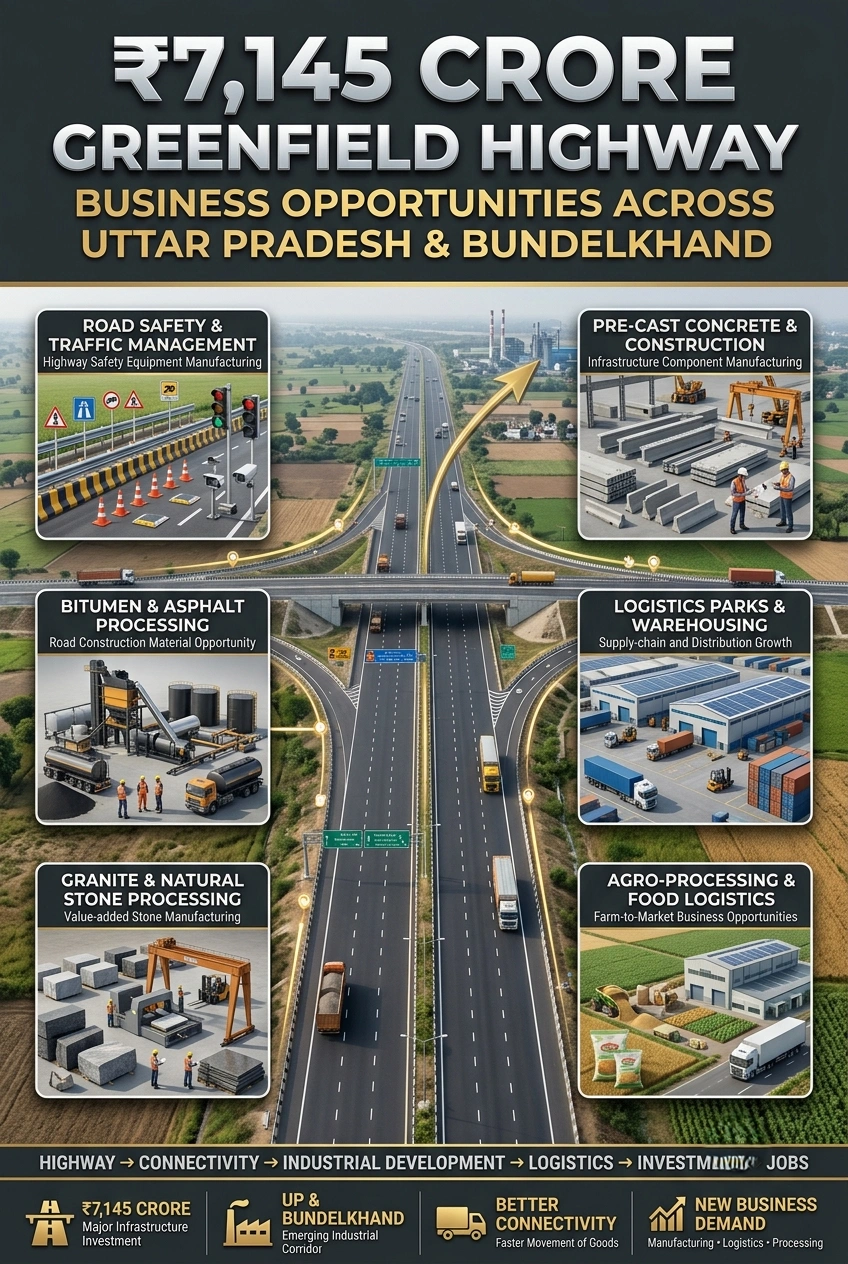
Manufacturing Business Opportunities Emerging From This Development
1. Road Safety and Traffic Management Equipment Manufacturing
Direct usage demands for crash barriers, guardrails, road delineators, reflective road studs, signage boards, and traffic management systems arise during the construction of the 118 km highway. The highway is four-lane and access-controlled. These materials must be used in substantial quantities during construction. They are also needed for replacement and maintenance throughout the highway’s service life. Manufacturers with expertise in making galvanised steel crash barriers, thermoplastic road-marking paint, and aluminium signage panels have a marketable niche to target. Quality certification must follow Indian Roads Congress (IRC) standards. The Kanpur industrial cluster can tap its existing steel fabrication capacity.
2. Pre-Cast Concrete and Construction Components Manufacturing
Highway construction requires substantial pre-cast concrete products. These include drainage channels, culverts, median barriers, bridge beams and retaining wall elements. A pre-cast concrete manufacturing unit in the Kanpur-Bundelkhand belt can cater to this project. It can also serve upcoming highway and expressway projects across UP and MP. Local sourcing of raw materials is possible, such as cement, sand and aggregate. The business has moderate investment needs, and can be expanded to meet the continuing demand for construction in the region.
Get Detailed Insights from This Book: The Complete Book on Cement & Concrete Products Manufacturing
3. Bitumen and Asphalt Compound Processing
Modified bitumen, polymer modified bitumen (PMB) and asphalt mixes are essential to quality highway construction. Base bitumen is a product of the petroleum refinery, but there is a viable opportunity for MSMEs in value-added processing such as manufacturing petroleum or asphalt mix binder (PMB), production of bituminous emulsion, and warm-mix asphalt formulations. The Kanpur area is close to the road transport network and also in close proximity to the Mathura refinery corridor. Chemistry or chemical engineering graduates can venture into this area with an investment of ₹2 to 5 crore in the processing unit with a moderate capacity.
View Full Project Details: Read the Complete Asphaltic Roofing Sheet Manufacturing Guide
4. Logistics Parks and Warehousing Development
With a good connectivity between Kanpur and Bundelkhand through the highways, there will be a rise in the demand for organised warehousing and logistics infrastructure at intermediate points along the highway corridor. The NH-34/35 Bundelkhand Expressway integration makes natural multimodal freight aggregation points. At nodes, developers and entrepreneurs can use a warehousing park, including a cold storage for agro-produce from Bundelkhand. These facilities are often offered on subsidised land by state government industrial development authorities. A business that requires a high investment but is stable and returns a steady income.
Get Detailed Project Report (DPR): Explore the Warehouse Business Guide
5. Granite and Natural Stone Processing Units
Important granite and natural stone deposits are present in Bundelkhand especially in Mahoba-Lalitpur-Banda belt. Poor connectivity has hindered the commercial realisation of these resources in the past. The highway cuts down transportation time and costs, making granite quarrying and processing more viable for export. She entrepreneurs can set up stone-cutting, polishing and processing units for domestic construction market and export market of Middle East, Europe and South East Asian countries. There are processing units available in the range of ₹1 crore to ₹3 crore which can be used for both domestic architects and export buyers.
Access Complete Business Plan: Minerals, Marble, Granite, Gypsum, Quartz, Talc, Mica Projects
6. Agro-Processing and Food Logistics Units
Oilseeds, pulses, coarse grains and horticulture produce are grown in the Bundelkhand region. One key constraint faced by agro-value-chain development has been poor road connectivity. The new highway and better freight logistics offer opportunities for those who want to locate agro-processing units nearby. These include dal mills, edible oil processing, spice grinding, and dehydration units. A complementary opportunity is cold-chain logistics. These units can transport perishables to Kanpur and then to metro markets.
Check Out This Recommended Book: Profitable Agro Based Projects with Project Profiles (Cereal Food Technology)
Import-Export and International Market Opportunity
Leading Exports: Kanpur is known as a global leather goods hub. Leather goods from Kanpur are exported to Europe, North America and the Middle East. These include finished leather articles, shoes, gloves and leather accessories. Regional inputs, such as hides and chemicals, are more responsive for export units. Better highway connections support faster supply. This also helps lower manufacturing costs. Likewise, Bundelkhand’s granite and natural stone can benefit from enhanced freight infrastructure. These products can compete in major stone markets in the UAE, Saudi Arabia, Italy and Germany.
Opportunity to Import Substitute: There are some categories of products in the infrastructure and road-safety sector that are currently imported. High-performance polymer-modified bitumen, advanced crash barrier systems, smart traffic management sensors, and modular bridge components are key fields. Local manufacturers can acquire competitive capabilities in these areas.
NHAI government procurement policies increasingly favour products made in India over imported products of similar quality. This preference gives domestic manufacturers an ongoing market advantage. It supports manufacturers capable of producing quality products and competing with imports in the road-infrastructure supply chain.
Indian MSMEs and Startups in Related Industries
Ceigall India Limited is a mid-sized infrastructure construction company in India. It is listed on the Indian stock exchanges. The company specializes in highway and expressway construction projects. It operates mainly in northern states like Uttar Pradesh and Punjab. The Ceigall example shows a focused highway construction company. It has expanded continuously through BOT and EPC contracts awarded by the government. MSME opportunities are available across the supply chain. These include supplying safety equipment, building materials, and civil-engineering parts to construction companies.
This is a market that has been proven to be viable and sustainable in the region. Maha Cement and other regional cement and pre-cast concrete manufacturers recognize the demand generated by the close proximity of highway construction activity. UP’s structural concrete manufacturers have seen a steady increase in their businesses. This growth has followed the state’s expressway expansion programme. The lesson for entrepreneurs: Defence in the supply-chain comes from product lines that are specialised in infrastructure and also quality-certified…
In logistics-tech, for instance, Vahak, an Indian B2B freight marketplace, has created a platform for truck owners and transport firms in northern India. Improving freight dynamics along the Kanpur-Bundelkhand corridor presents a genuine start-up opportunity. This opportunity suits logistics-tech players familiar with tier-2 city markets and industrial freight challenges.
What Entrepreneurs Should Evaluate Before Investing
Realistic timelines of market demand need to be applied to any business opportunity that is linked to this corridor. Typical cycle of approval to opening of this type of highway construction project is 3-5 years. Demand for an entrepreneur should cover two stages – the construction period (materials, equipment, services) and the post-opening period (logistics, warehousing, value-chain businesses). Investment plans that focus on one phase introduce risk.
Raw Materials and Location Strategy: For businesses such as granite processing, pre-cast concrete, or road safety equipment, location is key. Units should be near raw materials and road construction sites. Entrepreneurs should consider specific nodal locations within designated industrial estates or growth centres. These locations can provide government land incentives and infrastructure support.
Technological and Quality standards: Road infrastructure supply chains run with high quality standards as defined by NHAI and the Indian Road Congress. Products are required to conform to specified requirements and quality inspections. The entrepreneurs need to invest in suitable testing centers, quality management systems (ISO certification), and in some instances, third party product approvals. The risk of compromising the quality in this supply chain is large in terms of contractual and reputation implications.
The Payment Cycle: Construction projects on highways, whether built with BOT funding or government contracts, generally have long payment cycles. Highway contractors’ suppliers should ensure that they have sufficient working capital buffers. Bill discounting and MSME Credit Guarantee Fund Trust (CGTMSE) facilities can help manage cash flow, but the payment period is expected to be about 60-90 days.
Build a profitable business with the right idea
Regulatory and Compliance Framework: Manufacturing units in UP have to adhere to the pollution control norms, labour laws, and environmental clearance norms. Industrial plots in designated UPSIDC or UPIDA estates make this easier. To minimise compliance complexity and risk, entrepreneurs would benefit from a proposed industrial development on a site that already follows regulatory requirements rather than on a greenfield standalone site.
Competition & Scalability: One of the identified opportunities is pre-cast concrete, agro-processing is a competitive market. Clearly articulated differentiation is a crucial element in entrepreneurs’ approach to a product or service, cost, geographic market, or technology. An evaluation of the business model should ensure scalability for the single highway project and its applicability across the entire highway construction pipeline in UP.
How NPCS Can Help Entrepreneurs Evaluate the Opportunity
Niir Project Consultancy Services (NPCS) is one of the most experienced industrial and business consultancy firms in India. It has been providing assistance to entrepreneurs, MSMEs, manufacturers, and investors in the identification, evaluation, and planning of industrial projects across various sectors for many years.
NPCS can help entrepreneurs interested in manufacturing or business opportunities in India’s growing infrastructure and highway development sector with:
- Detailed Project Reports (TFR, TDR, FPR) of technical dimensions, financial dimensions and market dimensions.
- Specific infrastructure-linked manufacturing sector market research and demand assessment.
- Technical studies for plant production sites, logistics sites and processing units
- Plant layout, selection of machinery and evaluation of technology.
- Sourcing frameworks and supplier identification for raw materials
- Financial modelling, investment analysis and break-even assessment.
- Advice on government initiatives, incentives and regulatory requirements.
NPCS project reports and feasibility studies are widely used by entrepreneurs, banks, financial institutions, and government bodies to evaluate the commercial and technical viability of industrial investments. For those seriously evaluating any of the manufacturing opportunities discussed in this article, an NPCS feasibility study provides a structured, evidence-based starting point for investment decision-making.
Business Opportunity Snapshot
| Parameter | Details |
| Industry | Road Infrastructure & Industrial Logistics |
| Market Driver | Government-backed greenfield highway connecting UP’s industrial hub (Kanpur) to Bundelkhand and Madhya Pradesh |
| Key Development | 118 km Kanpur–Kabraai access-controlled greenfield 4-lane highway approved; ₹7,145 crore project under BOT-Toll model by NHAI |
| MSME Opportunity | Construction materials, logistics services, fabricated steel structures, ready-mix concrete, road signage, traffic management systems |
| Manufacturing Potential | Highway-grade safety equipment, bitumen/asphalt products, pre-cast concrete elements, road marking materials, crash barriers |
| Export Potential | Moderate-to-high for region’s agro-processed goods, leather goods (Kanpur), granite/stone products (Bundelkhand) |
| Import Substitution | Road safety hardware (crash barriers, signage), advanced bitumen compounds, modular bridge components |
| Government Support | PM GatiShakti National Master Plan, MSME Ministry schemes, UP InvestSummit incentives, Startup India support |
| Investment Consideration | Medium to high; ancillary manufacturing units viable at ₹50 lakh–₹5 crore scale; logistics parks viable at higher ticket sizes |
| Risk Level | Moderate — project execution risk, land acquisition, regulatory approvals; long-term demand outlook positive |
| Growth Outlook | Strong; multiple expressways + economic corridor effect expected to sustain demand for 10–15 years |

Conclusion
The government-approved ₹7,145 crore, 118 km greenfield highway linking Kanpur to Kabraai is not merely a transport infrastructure project. It is a structural investment in the industrial and commercial geography of Uttar Pradesh — one that connects Kanpur’s manufacturing base, Bundelkhand’s natural resources, and Madhya Pradesh’s industrial depth through a faster, safer, and more economical freight corridor.
For entrepreneurs, the opportunities are concrete: road safety equipment manufacturing, pre-cast concrete production, bitumen compound processing, granite and stone processing, agro-processing, and logistics infrastructure development. Investors, the long-term industrial activity this corridor will generate provides a durable demand backdrop for infrastructure-linked manufacturing. For MSMEs, the construction-phase supply chain alone represents a significant business opportunity — provided quality standards and delivery capability are in place. Uttar Pradesh’s aggressive infrastructure investment programme is supported by PM GatiShakti and the broader national highway expansion plan.
This ensures that the development is not a one-off event. Instead, it is part of a sustained wave of opportunity. Entrepreneurs and investors who conduct disciplined market research and commission credible feasibility studies are well-positioned to benefit. Detailed project reports and careful investment planning can further support their success. This is one of India’s most significant infrastructure-driven industrial opportunity cycles in recent years. The time to research, plan, and act is now — before the highway opens and the opportunity window narrows.