


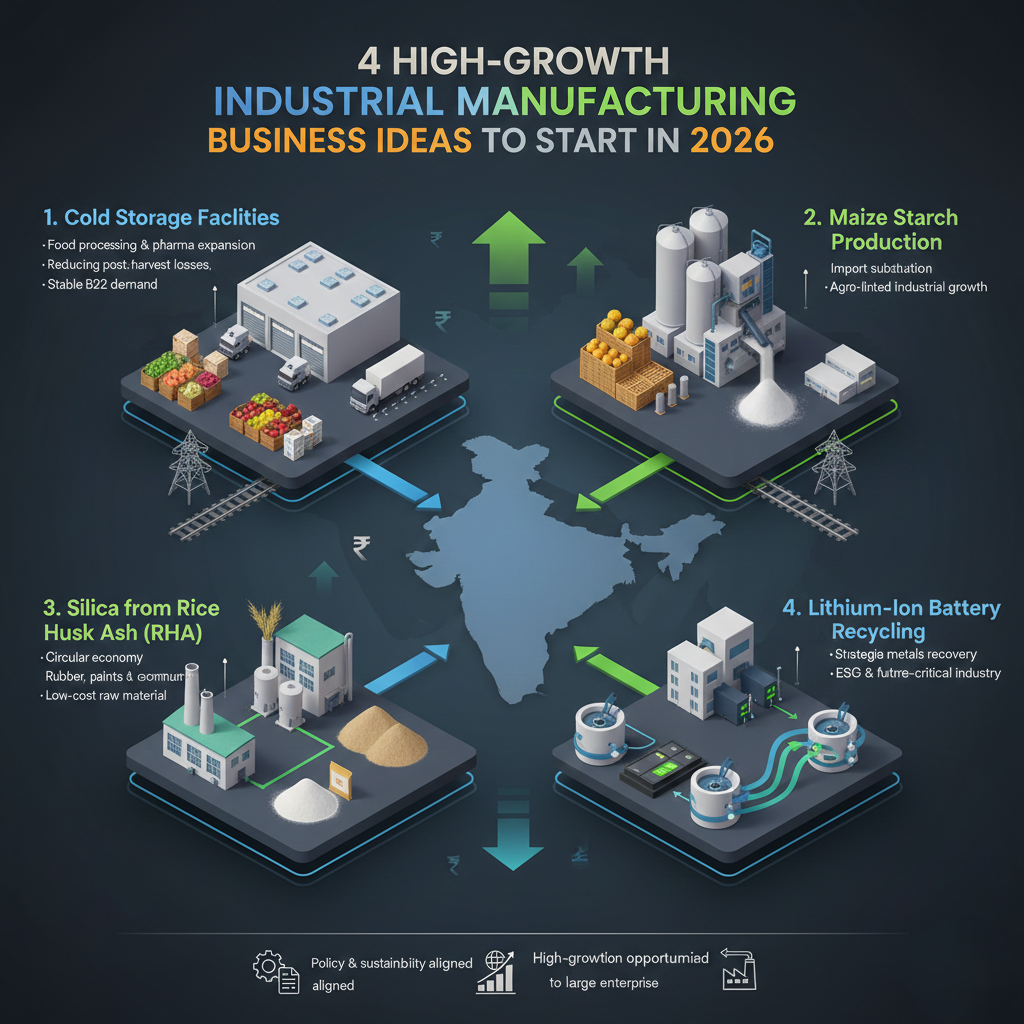
Industrial Manufacturing Ideas 2026 are gaining strong momentum as the industrial manufacturing sector changes rapidly, driven by sustainability, technology, and shifting consumer demands. High-growth opportunities for entrepreneurs include cold storage facilities, maize starch production, silica from rice husk ash, and lithium-ion battery recycling. The industries serve expanding markets that include food and pharmaceuticals and construction and electronics and clean energy.
The article examines four industries through their market prospects and field uses and startup business factors.
Read More: Business Ideas for Startup in Drugs & Pharmaceutical Industry with Project Profiles (3rd Edition)
Cold Storage Facilities: Enhancing Food and Pharma Growth
Cold storage is a term used to describe a group of refrigerated warehouses that keep products at a controlled low temperature. The process of preserving perishable food items which include meat dairy products and fruits and vegetables and seafood and pharmaceuticals which contain vaccines and biologics requires cold chain storage. The worldwide food trade expansion together with online grocery shopping and increasing demand for biotech products has created a requirement for cold chain logistics systems.(Industrial Manufacturing Ideas 2026)
The global cold storage market is worth approximately $150-160 billion in the mid-2020s and can be worth $200 billion in 2030 with a growth rate that ranges between 4-6%. Asian Pacific countries lead the market growth through their development of industrial facilities while European and North American markets focus on adopting automation and ultra-low temperature storage solutions for pharmaceutical requirements.
Important points for start-up entrepreneurs:
- One of the expenses that make up 50-60% of operational costs is energy.
- Proximity to production centres, ports or urban centres is also essential.
- avoid redundancy and ensure that the concerned employee can access the necessary information.
Despite competition, underserved regional and niche markets, such as frozen seafood or medical cold rooms, provide great opportunities for startups.
Read More: Best Businesses You Can Start with Low Cost (2nd Revised Edition)
Maize Starch Production: A Multipurpose Industrial Ingredient
Maize starch, which comes from the kernels of corn, is a staple raw material in food, paper, textile, adherent, and biodegradable plastics industries. In food, it is used as a thickener, stabilizer or filler for sauces, soups, confectionery and baby foods. In industry use, it is used to strengthen paper, size textiles and as a base for biodegradable plastics and adhesives.
Analysts value the global maize starch market at $22–25 billion and expect it to nearly double by 2033, growing at about 7–8% per year. Developing countries process more food which drives demand along with the clean label trend and the shift towards bio-based materials.
Things you need to think about when starting a business:
- Suggestions for future research: – The operation requires an uninterrupted supply of corn to maintain production standards.
- As for niche markets, the following recommendations apply: – Focus on specialty starches such as pregelatinized or adhesive grade starch.
- The company can generate additional revenue streams through the use of maize germ oil and fiber which serve as byproducts.
The starch production facilities which operate in regions with high corn production such as Asia and Latin America create local employment opportunities while reducing the need for imported starch products.
Read More: Aromatic Plant Cultivation & Processing – Manufacturing Plant, Detailed Project Report, Profile, Business Plan, Industry Trends, Market Research, Survey, Manufacturing Process, Machinery, Raw Materials, Feasibility Study, Investment Opportunities
Silica from Rice Husk Ash: Waste to Industrial Value
Rice husk ash (RHA) which comes from the combustion of rice husks contains 85-95% amorphous silica. RHA serves as an agricultural waste product which enables the extraction of high-purity silica for multiple industrial applications. The production of fine silica powder or gel for industrial purposes requires two main processes which include acid leaching and calcination.
Applications include:
- Construction: Micro-silica high-strength concrete
- Rubber and plastics are used as a reinforcing filler
- Paints, adhesives and coatings
- Advanced applications: electronics, glass, nanomaterials
Analysts estimate the RHA market at $3 billion, and it is growing about 5% per year. Abundant rice production in India, Southeast Asia, and Latin America is assuring a stable feedstock supply. Entrepreneurs may also integrate silica extraction with biomass power plants, and put the combustion ash to great use. Challenges include dealing with chemicals, high temperature equipment, and quality consistency for industrial standards.(Industrial Manufacturing Ideas 2026)
Read More: High-Growth MSME Manufacturing Opportunities in India’s Power, Energy and Infrastructure Sectors
Lithium-Ion Battery Recycling: A Green Metals Opportunity
The transition to electric vehicles (EVs) and renewable energy storage is creating demand for lithium ion batteries, and therefore for their recycling. Recovering metals such as lithium, cobalt, nickel and copper reduces the dependence on mining and decreases the environmental impact, as well as compliance with regulation by manufacturers.
Experts estimate that the Li-ion battery recycling market will grow from $16–20 billion in the mid-2020s to more than $56 billion by 2032, at a CAGR of 17–18%. Asia-Pacific and Europe are leading the growth because of high adoption of EVs and stringent recycling regulations by the governments.
Highlight for entrepreneurs:
- Advanced recycling involves the use of hydrometallurgy or pyrometallurgy, whereas new direct recycling techniques keep cathode materials intact.
- The company establishes a reliable material supply chain through partnerships with electric vehicle manufacturers and battery manufacturers and scrap collection organizations.
- The implementation of safety protocols becomes essential because used batteries present a potential risk of fire outbreaks.
Early movers in regions with high adoption of EVs can have a competitive advantage, with high-value recovered metals and sustainability-oriented supply chains.
Read More: 10 High-Demand Downstream Steel Product Manufacturing Ideas in India
Conclusion
Cold storage, maize starch production, silica from rice husk ash, and lithium-ion battery recycling are four industrial manufacturing sectors that have high growth potential. Entrepreneurs can build future-ready businesses that generate profits by using market knowledge together with environmentally friendly methods and current technological solutions.(Industrial Manufacturing Ideas 2026)
FAQs
What is cold storage & why it is important?
Cold storage is the term used when referring to refrigerated storage facilities used to preserve perishable goods and medicines at low temperature. It cuts down on waste, guarantees food safety and assists vaccine and biotech distribution.
How is maize starch used in the industry?
Maize starch is used to thicken and stabilize food products, promote strong paper, size textiles and as a base to produce adhesives and biodegradable plastics.
Why take out silica from rice husk ash?
RHA is plentiful, inexpensive and environmentally friendly. The construction, rubber, plastics, and electronics industries can use its high-purity silica as a substitute for mined quartz.
Why do we need to recycle lithium ion battery?
The recycling requirements have grown because of electric vehicle adoption, energy storage system development, and metal shortages and environmental regulations and corporate sustainability initiatives.
What do entrepreneurs need to take into consideration before launching these businesses?
The main elements of the project include market studies and materials procurement and law compliance and financial resources and specialized expertise especially in chemical processing and battery operations.