
Introduction: Indian Railways capex opportunities
For manufacturing entrepreneurs, long-term success has less to do with trends and more to do with the visibility of demand. When capital expenditure is continue, policy backed and execution driven then it generates predictable industrial consumption on multiple supply chains.
In recent years, Indian Railways has grown up to be one of the biggest infrastructure investors in the country. With record capital allocations, accelerated electrification, expansion of freight corridors and station redevelopment initiatives, there is consistent component level purchase demand in the railway sector.
For Micro, Small and Medium Enterprises (MSMEs) – this is not just a policy announcement but an opportunity for manufacturing based on institutional spending.
As we enter 2026, there is perhaps one of the most structured and bankable industrial entry points in India – railway linked manufacturing.
Read More: Investment Opportunities In Infrastructure Projects
The Magnitude of Railway Capital Expenditure
Railway capital expenditure has crossed historic levels as it reached over ₹7 lakh crore recently. This investment is turning into measurable physical expansion including:
- Thousands of kilometres of track renewals
- Rapid electrification of railway routes
- Expansion of freight capacity
- Modernization and redevelopment of stations
- Procurement of new rolling stock
Freight movement has crossed 1.5 billion tonnes annually and this has laid foundation for the strategic role of railway logistics in India’s industrial economy.
Every kilometre of track laid, every station enhanced and every freight wagon deployed requires steel structures, electrical systems, mechanical components, fabricated assemblies and safety equipment. These are not one-off purchases – railways need to be maintained, replaced, and upgraded on a regular basis.
This translates into recurring demand cycles which are ideal for MSME manufacturing businesses.
Why Railway Manufacturing Is A Lower Risk Sector For MSE’s
Compared to trend-based industries, such as consumer electronics or fashion manufacturing, railway-linked production has structural advantages:
- Multi-Year Budget Visibility
Railway projects have the backing of approved annual and multi-year capital allocations which reduces the uncertainty.
- Standardized Technical Specifications
Products are produced according to predetermined railway standards, which makes it possible to repeat production.
- Institutional Procurement Systems
Tendering and vendor approval processes for transparent and structured purchasing.
- Maintenance Driven Recurring Demand
Existing infrastructure needs constant maintenance and replacement parts.
- Powerful Domestic Manufacturing Push
Government policies also focus more on local sourcing and import substitution.
Because railway projects are phased out across zones and fiscal years, MSMEs have distributed demand as opposed to being dependent on one project.
Read More: India Glass Fibres and Glass Woven Fabrics Market
High Potential Railway Manufacturing Segments for MSMEs (2026)
1. Steel Fabrication in Railway Infrastructure
Steel fabrication is one of the most accessible outlets for the new entrepreneur.
Railway infrastructure works need:
- Platform sheds
- Foot over bridges (FOBs)
- Cable trays
- Signage frames
- Fencing systems
- Gantries and supporting structures
Why this segment is working for MSMEs:
- Fabrication technology is mature and widely available
- Raw materials such as structural steel are easily available
- Plant capacity can be scaled up (or down) gradually
- Geographically diversified orders
Investment requirements are moderate as compared to heavy engineering industries and hence suitable for MSME with initial capital of Rs 2-5 Crore.
2. Railway Electrification Hardware Production
Electrification of railway routes is being carried out at a faster pace. Overhead equipment (OHE) needs special components such as:
- Masts and portals
- Cantilever assemblies
- Insulator fittings
- Earthing systems
- Brackets and hardware
Why this is an attractive segment:
- Designs are standardized
- Volumes are high
- Maintenance to assure repeat orders
Import substitution opportunities are available
MSMEs who have precision fabrication, galvanizing facilities and quality control systems are able to develop long-term relationships for supply in this space.
3. Electrical Panels and Signalling Cabinets
As a result of modernization, the need for:
- Traction substation panels
- Relays and interlocking cabinets
- Control and protection systems
- Distribution boxes
continues to grow.
Electrical panel manufacturing is already MSME driven in India. Alignment of this capability with railway standards can substantially improve margins because of technical value addition.
Once vendor’s approval is obtained, the manufacturers may also attempt to explore the export possibilities in developing infrastructure markets.(Indian Railways capex opportunities)
Read More: Ethanol as Biofuel – Manufacturing Plant, Detailed Project Report, Profile, Business Plan, Industry Trends, Market Research, Survey, Manufacturing Process, Machinery, Raw Materials, Feasibility Study, Investment Opportunities, Cost and Revenue
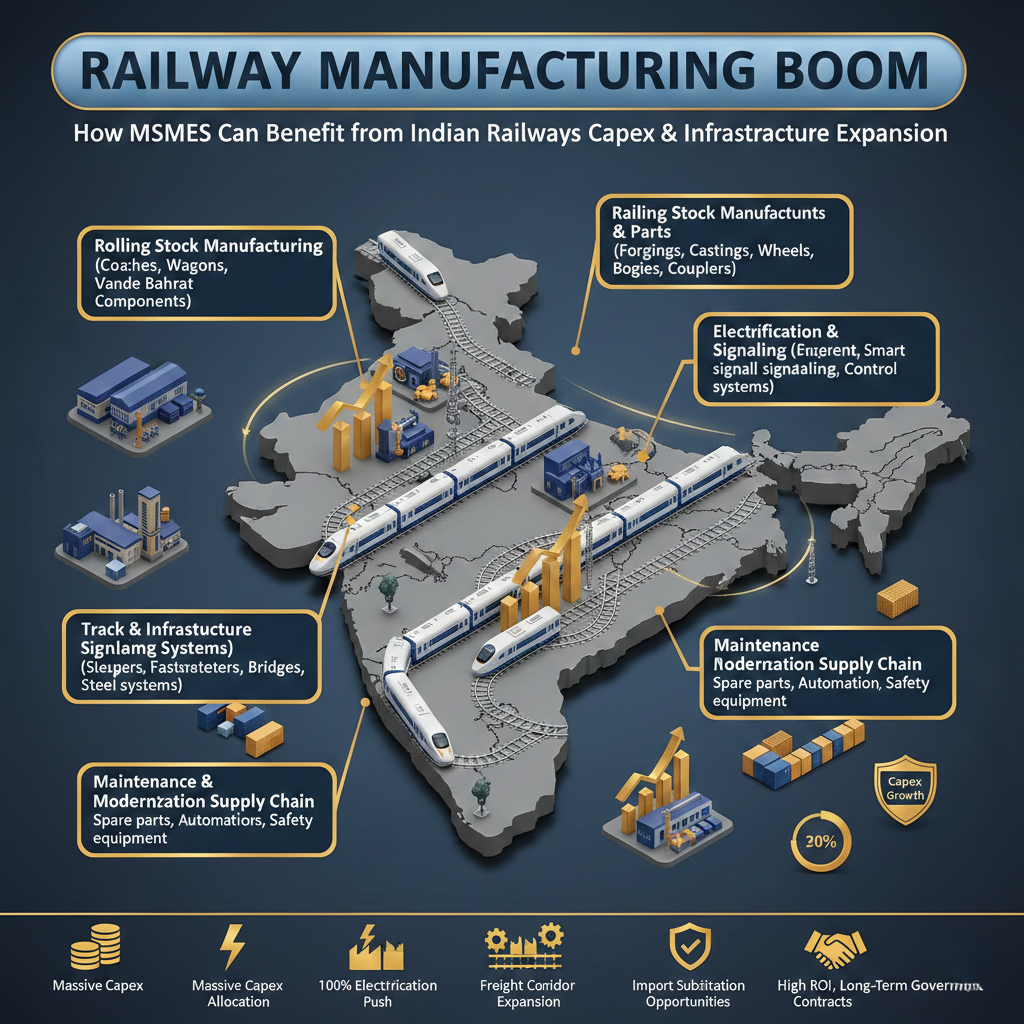
5. Rolling Stock Components And Workshop Supplies
With more than two lakh freight wagons and tens of thousands of passenger coaches in operation, the maintenance requirement alone is keeping alive a huge ecosystem of component manufacturers.
Products may include:
- Brake assemblies
- Suspension components
- Couplers
- Mechanical fittings
- Workshop tools
Growth in freight movement is further enhancing this opportunity, ensuring long-term consumption of spares and replacement parts.
6. Station Infrastructure & Passenger Amenities
Station redevelopment programs throughout the country are creating demand for:
- Modular seating systems
- Stainless steel railings
- Safety barriers
- Modular toilets
- Drinking water kiosks
These products lie well within the manufacturing capability of the MSME and have relatively lower technical certification requirements compared to rolling stock components.
Because of the phased city by city approach to upgrades, the demand is geographically distributed.
Read More: Railway Infrastructure Boom: Manufacturing Business Opportunities for New Entrepreneurs
How To Become A Vendor Of Railways
In order to turn railway capex into a bankable business, entrepreneurs should follow an orderly plan:
1.Identify components that are procured regularly
2.Study railway technical specifications
3.Assess realistic capacity of plants
4.Perform a techno-economic feasibility analysis
5.Apply vendor registration with railway units/Zonal authorities
6.Develop quality assurance systems
Approval of vendors improves credibility not only in India but also in international infrastructure markets.
Investment Range and Financial Feasibility
Depending on the segment:
- Basic fabrication units may start around 2-3 crores
- Electrification hardware manufacturing may require 4-6 crore
- Precision fastener and forging units can be in the range of 5-10 crores
Infrastructure-aligned manufacturing projects are often looked upon favorably by banks because of predictable institutional demand.
A well-prepared project report and realistic capacity planning are very helpful in improving funding prospects.(Indian Railways capex opportunities)
Read More: Top Most Profitable Business Ideas for the Next 10 Years
Why 2026 Is a Strategic Entry Window
Infrastructure is also a national priority. Railway electrification, freight corridor expansion and modernization of stations are programmes of execution and not plans.
The convergence of:
- Policy continuity
- Domestic sourcing emphasis
- Strong freight growth
- Institutional procurement systems are:
creates an advantageous environment that is rarely found in more than one sector at the same time.
Entrepreneurs coming in 2026 can front load with long-term infrastructure cycles.
Conclusion
Railway capital expenditure is not just government expenditure – it is an engineering blueprint for manufacturing. The expansion and modernization of Indian Railways has taken an execution-heavy phase and there is a steady demand across the spectrum of steel, electrical, mechanical and infrastructure.
For MSME entrepreneurs, 2026 is strategically important to establish stable, scalable and institutionally anchored manufacturing businesses in line with national infrastructure growth.
Success, however, is dependent on disciplined feasibility planning, adherence to technical standards, and long-term quality commitment.
Entrepreneurs who put these factors together with the steam of railway capex can be at the heart of the next manufacturing growth cycle in India.(Indian Railways capex opportunities)
Frequently Asked Questions (FAQ)
Is Railway manufacturing suitable for small MSMEs?
Yes. Many components like fasteners, panels, fabricated structures and fittings can be made or manufactured at MSME scale.
Is the demand stable in the railway sector?
Railway demand is institutional and comprises both the new project execution and existing maintenance cycles and is therefore relatively stable.
Can MSME export railway components?
Approval by vendors and quality certification improves the credibility and enables participation in international infrastructure projects.
Do the Banks help railway-linked manufacturing projects?
Yes. The manufacturing is generally viewed as lower risk relative to cyclical industries such as consumer industries that are infrastructure-aligned.