


India EV market
The electric vehicle market in India is undergoing a major transformation because the country is developing its sustainable energy-efficient transportation system. The increasing fuel prices together with environmental issues and strong government policies are driving the quicker adoption of electric mobility across multiple vehicle types.
In recent years, India has crossed the initial adoption phase of electric vehicles and is in the phase of accelerated growth. Electric two-wheelers, passenger cars, three-wheelers, and commercial electric fleets are all increasing at a steady rate. According to industry data, India registered about 2.36 million EVs sales in 2025 which represented about 8.36% of all vehicle registrations.
The Indian EV market size reached nearly USD 8.49 billion in 2024 and analysts believe the size of the market will grow at a compound annual growth rate of over 40% until 2030. Some projections are that the market may grow to more than USD 110 billion by 2029, an indication of the magnitude of the opportunity in the sector.
This growth is closely related to India’s national target of electric vehicles in new vehicle sales of 30% by 2030. The required annual sales of 17 million electric vehicles will help the country achieve its target which needs a substantial increase from present sales levels.
Read More: Handbook on Electric Vehicles Manufacturing (E- Car, Electric Bicycle, E- Scooter, E-Motorcycle, Electric Rickshaw, E- Bus, Electric Truck with Assembly Process, Machinery Equipments & Layout)
Evolution of Electric Vehicle Market in India
The Indian market for electric vehicles has been primarily driven by the adoption of electric two-wheelers and three-wheelers. These vehicles provide budget-friendly options that make them appropriate for daily commuting and short-distance travel needs.
Electric passenger vehicles are also catching on fire as new models with better range and a lower cost enter the market. As battery technology advances and the charging infrastructure grows, consumer confidence in EVs continues to grow.
Currently the EV market in India can broadly be segmented into the following:
- Scooters and motorcycles are also expected to be included in the following month.
- Electric passenger cars and SUVs
- Electric Three-wheeler for passenger transport
- Electric cargo vehicles and delivery fleets
- Electric buses for public transport
Of these, EVs of two-wheelers are dominating the market and passenger EVs are witnessing maximum growth rates.
Demand-Supply Gap in the Indian EV Ecosystem
Despite explosive growth in EV sales, the ecosystem that supports EVs is still maturing. There is a large demand-supply gap for several components of the EV value chain.
India currently relies to a large extent on imports for critical EV technologies, particularly lithium-ion battery cells and high-tech electronics. This reliance supplies the risk of supply and raises the cost of electric vehicles.
Some of the key areas that supply currently falls short of demand include:
- Manufacturing of lithium-ion battery cells
- EV charging infrastructure deployment
- Power electronics & semiconductor components
- Electric motor components & rare earth magnets
- Control electronics and the battery management systems
Because these technologies are very important for EV production, domestic manufacturing capacity will have to grow rapidly in the next decade.
Read More: Set Up Electric Vehicles Business | High Demanding Industry
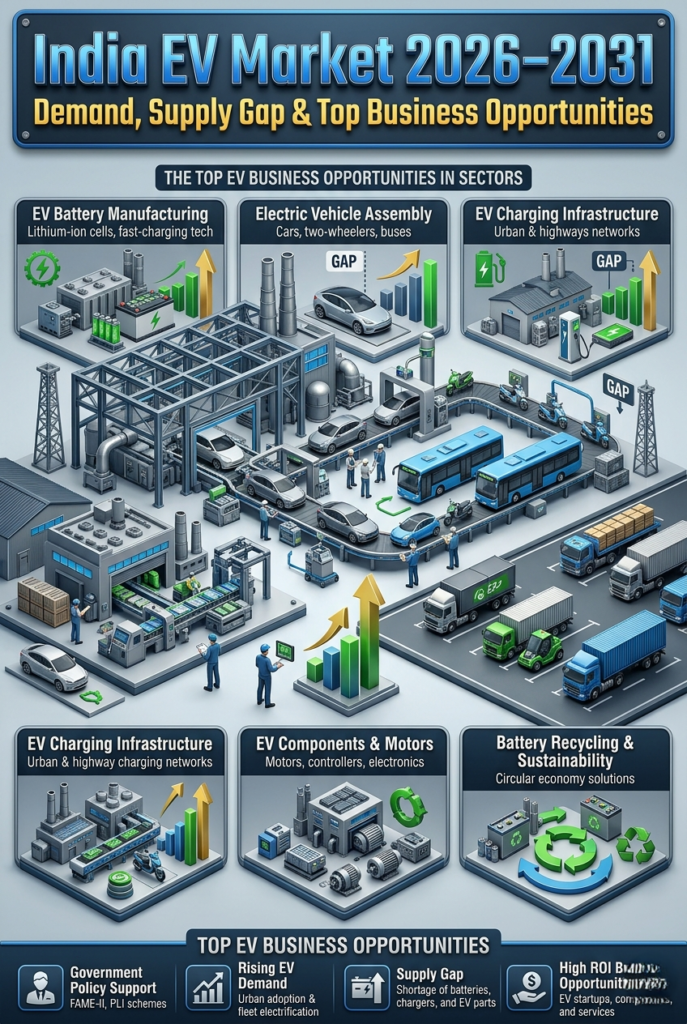
Lithium-Ion Battery Market Opportunity
Lithium-Ion batteries are the most significant part of the electric vehicle because they determine the cost of the electric vehicle and driving range. The last ten years have seen battery prices decrease drastically which enables electric vehicles to compete against conventional gasoline vehicles.
India depends on foreign sources for its lithium-ion battery cell supply because the country lacks domestic production capabilities. The country mainly imports battery cells from China South Korea and Japan.
Industry forecasts suggest that there will be a huge increase in battery demand in India in coming years. For example:
Indian
- Battery demand in India was about 15 GWh in FY24
- It is expected to reach around 54 GWh by FY27
- By FY30, demand could exceed 120 GWh annually
The government established the Advanced Chemistry Cell (ACC) Production Linked Incentive program to support the establishment of extensive battery production facilities in India.
Read More: Project Reports & Profiles
Charging Infrastructure: A Critical Challenge to Growth
The public charging station network represents one of the main challenges that India faces when trying to implement electric vehicles. The current pace of EV sales growth requires the establishment of new charging stations to proceed at a rate faster than existing infrastructure development.
As of 2025, India has around 29,000 public EV charging stations. This translates to a ratio of about one charger per 235 electric vehicles, which is far from international standards.
International standards require charging stations to provide one unit for every six to twenty electric vehicles. This implies that there will be a need to install hundreds of thousands of more chargers in India in coming years.
The country needs to establish more than one million charging stations before 2030 to facilitate the growth of electric vehicles. This requirement offers opportunity to businesses involved in:
- EV charger manufacturing
- Installation of charging stations
- Charging network software platforms
- Fleet charging solutions
The PM E-DRIVE scheme provides financial support for charger installation which helps to boost infrastructure development through government programs.
Major Companies Leading Indian EV Market
The EV ecosystem in India is being shaped by the traditional automobile manufacturers as well as new technology-focused startups. These companies are spending a lot of money on research, manufacturing, and charging infrastructure.
Some of the major players of the Indian EV market are:
- Tata Motors – leader in electric passenger vehicles
- Mahindra & Mahindra – Strong presence in Electric SUV and three-wheelers
- TVS Motor Company – major manufacturer of electric scooters
- Bajaj Auto – adding to its electric two-wheeler portfolio
- Ather Energy – technology focused electric scooter startup
Multiple organizations, including vehicle manufacturers, are currently investigating battery technology and charging station systems. Firms like Amara Raja, Exide Energy Solutions and Tata Power are playing an important role in building the EV ecosystem.
Read More: EV Battery Materials & Critical Minerals: Startup Opportunities in India
Startup/ MSME Opportunity in EV Sector
Because of the development stage of the EV industry, it provides many opportunities for entrepreneurs and small manufacturing companies. Many segments of the EV value chain are underserved.
Some promising areas for startups are:
- Lithium ion battery pack assembly
- Battery management system development
- EV charger manufacturing
- Electric motor parts and controllers
- EV wiring harness production
- Recycling and second life applications: Battery recycling
The future will become increasingly dependent on battery recycling. The recycling process of millions of electric vehicle batteries requires advanced recycling technologies which will enable the extraction of essential materials including lithium and cobalt and nickel.
Another up-and-comer is EV service and maintenance. Because electric vehicles require special diagnoses and repair tools, new service networks dedicated to maintaining EV vehicles are likely to spread across the country.
Read More: Benefits of Electric Vehicles
Investment Perspective for Indian EV Market
The long-term investment opportunity on India’s EV sector is extremely strong. While there have already been billions of dollars invested in EV startups and manufacturing facilities, far more money will be needed to reach the country’s 2030 electrification goals.
Industry analysts estimate that more than USD 100 billion in further investment is likely to be required in the next decade to develop manufacturing capacity, supply chains and charging infrastructure.
The funding will create benefits for multiple sectors including battery manufacturing vehicle production energy infrastructure development and software platforms that oversee electric vehicle operations.
For entrepreneurs and investors, the EV industry is one of the biggest emerging opportunities in the Indian manufacturing and technology sectors.
Conclusion
India’s electric vehicle market is expected to grow fast in the period between 2026 and 2031. Strong policy endorsement, rising consumer demand and technological innovations are providing a spur to the country’s shift to electric mobility.
However, there are still a few challenges that the EV ecosystem faces, especially with regards to the battery manufacturing process, the charging infrastructure and the supply chain of components. These gaps provide huge opportunities for startups, MSMEs and investors.
Businesses that choose to enter the EV ecosystem early on – specifically, in manufacturing, infrastructure and recycling – will achieve long-term advantages from their investments in the Indian clean transport sector which experiences continuous growth.
Frequently Asked Questions (FAQs)
What is the current size of EV market in India?
The Indian electric vehicle market will reach a total value of USD 8.49 billion in 2024 and drivers will purchase 2.36 million electric vehicles during the year 2025.
How fast is the EV market growing in India?
The market is projected to find growth at a compound annual growth rate of over 40% during 2025-30, making India one of the fastest growing EV markets in the world.
What is the biggest challenge in the EV industry in India?
The greatest challenge is the reliance on imported lithium-ion battery cells and lack of charging infrastructure.
Which companies are dominating the EV in India?
Major players in EV market are Tata Motors, Mahindra & Mahindra, TVS Motor Company, Bajaj Auto and Ather Energy.
What EV businesses can be started by startups in India?
Startups can consider opportunities such as battery packs assembly, EV chargers manufacturing, battery recycling, EV parts manufacturing, and EV servicing networks.


