
India curcumin market
India is becoming the world leader in curcumin production and establishing itself as the backbone of value-added turmeric ingredients. The country is ready to become the main producer of curcumin because it has easy access to raw materials and has established export systems which function well between 2026 and 2031. For entrepreneurs, investors, and nutraceutical brands, the demand-supply gap, regulatory landscape, and startup opportunities are very important to capture premium margins in this high-growth sector.
Read More: Our Books
India’s Curcumin Advantage, Raw Material Dominance, Export Leadership
India holds the title of primary turmeric producer because it cultivates the spice across 3.24 lakh hectares which results in 11.61 lakh tones of production for the 2022-23 season. The country produces more than 75% of the world’s turmeric supply delivery. The country holds more than 62% of the global turmeric market which makes it the primary location for curcumin extraction and ingredient manufacturing.
The SPICED government initiative together with the National Turmeric Board establishes value addition programs while ensuring that turmeric products meet quality standards and develop new products. The 2026-2031 period will experience strong demand for export grade curcumin which meets good quality standards.
Demand-Supply Gap: Quality Versus Quantity
The curcumin market is not constrained by the availability of turmeric. Instead the challenge is getting a consistent supply of standardized, high quality curcumin. Export buyers become increasingly focused on:
- Concentration of curcuminoids and consistency of assay
- Residue control (heavy metals, pesticides)
- Microbiological compliance
- Traceability & sustainability documentation
- Regulatory acceptability in the international markets
Curcumin is a low yielding molecule. Turmeric powder contains about 2.86% curcumin, 5.69% total curcuminoids while oleoresin extracts contain ~19.5% curcumin. The production of 1 tonne of curcumin with a purity of 95% requires 30-35 tonnes of turmeric powder thus procurement strategy and extraction efficiency have a direct bearing on profitability.(India curcumin market )
Read More: Curcumin Extraction Unit
Regulatory Landscape: Curcumin as a Mainstream Ingredient
Curcumin is known worldwide as a safe food additive and nutraceutical food ingredient:
- FAO/WHO JECFA: Curcumin (INS 100(i)) as obtained by solvent extraction and crystallization.
- FSSAI (India): Includes curcumin (100(i)) and turmeric (100(ii)) on the list of colour additives with defined usage limits.
The nutraceutical and cosmetic industries demand premium formulations which include nano and micellar and water dispersible curcumin because these products provide superior bioavailability. For start-ups, meeting export and nutraceutical standards provides access to multiple revenue channels while minimising market risk.
Major Indian Curcumin Companies
Several Indian companies dominate the turmeric/curcumin ecosystem proving that India is not only an exporter of turmeric but also a world-class ingredient manufacturer:
- Arjuna Natural (BCM-95 / Curcugreen) – Patented extracts, bioavailability-focused curcuminoid compositions.
- Sabinsa (Curcumin C3 Complex) – Standardized extracts of turmeric with worldwide manufacturing roots.
- Synthite – is a leader of spice extract and oleoresin supplier for food, nutraceutical and personal care industries.
These companies emphasize the commercial potential of the production of high-quality, standardized curcumin.(India curcumin market)
Read More: Curcumin Manufacturing, Extraction, Curcuminoid of Turmeric (Curcuma longa), Curcumin – from Curcuma longa (Turmeric), Turmeric oleoresin, Spice Oil Extraction of Curcumin Pigment, Extraction of Curcumin and Essential Oil from Curcuma longa L.
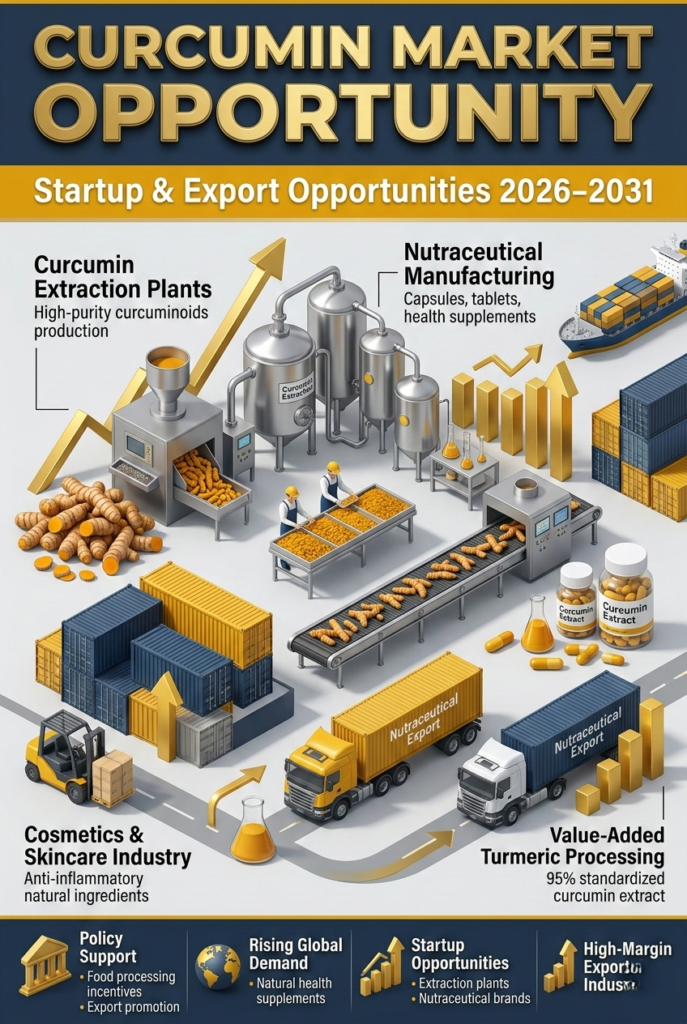
Startup Opportunities: 2026 to 2031 Window
Curcumin presents MSMEs and growing startups with a valuable agricultural connection which leads to international business opportunities. The main reasons consist of:
- Expanding nutraceutical and functional foods markets – India’s nutraceutical market is projected to reach USD 63.3B by 2030 after starting at USD 35.1B in 2024.
- Robust market growth: The global curcumin market is expected to expand at a compound annual growth rate of 13.3 percent from 2025 to 2031 because of the demand for supplements and functional foods and premium products.
- Government support for value addition and compliance: National Turmeric Board initiatives reduce market discovery risks and improve export readiness.
Three Scalable Project Profiles
- Standardized Curcumin (95% curcuminoids) – The B2B segment of the market requires attention from both supplement brands and companies that export their products. Emphasise solvent recovery, crystallisation and assay consistency.
- Water-Dispersible / High-Bioavailability Curcumin – The company should focus on delivering its products through advanced delivery systems which include nano and micellar and encapsulated curcumin.
- Export-Linked Turmeric Processing Cluster – The company needs to establish partnerships between farmers and farmer producer organizations while also establishing programs for residue control and creating processing centers near farming areas. The company should create value through operations that originate from the base and through operations that execute their work near their base.
Trade Insights: Exports and Imports
India’s turmeric trade shows stability and potential as a processed ingredient:
- Exports (2024–25): 176,325 MT, Rs. 187,586.79 lakhs
- Spice oils & oleoresins:- 18,762 MT, Rs. 412,300.59 lakhs
Imports, albeit smaller, show domestic dependence on specialist processed ingredients:
- Turmeric: 14,638 MT, Rs. 15,006.52 lakhs
- Spice oils & oleoresins 5,179 MT 118,193.26 lakhs
These figures point to the scope for import substitution through high quality Indian curcumin.
Read More: Top 25 Curcumin Manufacturing Business Ideas
Feasibility Check List for Investor and Entrepreneur
Before setting up a curcumin project, consider the following:
- Raw Material Strategy: Lock in turmeric lots of known curcuminoid content.
- Regulatory Compliance: Compliance with food-grade, nutraceutical-grade, or cosmetic-grade.
- Export Readiness: Use of quality labs, SPICED schemes, and compliance documentation.
- Multi-Product Strategy: Obtain oleoresin fractions, essential oils and use biomass for energy recovery.
The chemistry-based facility needs to achieve solvent recovery together with assay reliability and extraction performance to secure higher profit margins which it seeks to obtain.
Read More: From Seed to Success: A Startup’s Guide to Dominating India’s Vegetable Seed Market
NPCS Support to Curcumin Entrepreneurs
Niir Project Consultancy Services (NPCS) offers detailed consulting services for curcumin projects including:
- Study of market – Market survey & demand analysis
- Process flow diagrams (PFD/BFD)
- Machinery & Raw materials specifications
- Import-export dependency analysis
- Financials and profitability assessment
For new entrants, NPCS reports minimize risk and ensure chemical compliance to globally compete.
Conclusion
The 2026–2031 period is ideal for startups and MSMEs to enter India’s curcumin market. The combination of raw material control and clear regulations plus increasing worldwide demand and government-supported quality systems creates an exceptional chance to develop a high-margin chemistry-based enterprise through export-ready standardized curcumin with superior bioavailability.
New businesses can capture a major portion of the rapidly expanding international nutraceutical and functional ingredient markets through their emphasis on process regulations and value creation activities.(India curcumin market)
FAQs: Curcumin Market in India 2026 to 2031
Q1: What is the demand for curcumin in India?
A1: The market demand for nutraceuticals together with dietary supplements and functional foods shows growth potential for both domestic consumption and export activities
Q2: Is there a shortage of turmeric to extract curcumin?
A2: India produces 11.61 lakh tonnes of curcumin yet the market lacks accessible compliance-approved and standardised versions of the product.
Q3: Why are curcumin plants margin volatile?
A3: Low yield of curcumin (around 2.86% in powder) and the fluctuations in the price of raw materials have a direct impact on economics.
Q4: Is curcumin regulated as a food ingredient?
A4: The substance receives recognition from JECFA through its INS 100(i) designation and from FSSAI through its 100(i)/100(ii) designation with established GMP threshold limits.
Q5: Which are the important export markets for Indian curcumin?
A5: Top Importers of Turmeric and Curcumin Ingredient are Bangladesh, UAE, USA, Malaysia, and Morocco.