


If you’ve been looking at manufacturing business concepts for the last couple of years, this is the time that will shape your next decade. It is one of the most ambitious industrial policies enacted by Haryana – Make in Haryana Industrial Policy 2026 – and at its geographic core is IMC Hisar, a 2,988-acre integrated manufacturing cluster under development under the prestigious Amritsar-Kolkata Industrial Corridor. Combined, the two make for a once-in-a-lifetime combination of world-class plug-and-play infrastructure, a broad range of fiscal incentives, and an intent, if not speed, from a state government, for once. The time is now for startup founders, first generation manufacturers and MSME investors, and it will not be around for long.
Why IMC Hisar Is a Once-in-a-Generation Industrial Opportunity
There are structural imbalances in the manufacturing sector of North India. The majority of the serious investment in industry goes to the Delhi/Noida-Gurugram-Faridabad belt of Manesar. The area to the west of Rohtak and south of Ambala is indeed a supply desert, as industry observers put it. IMC Hisar is specifically created to rectify that lacuna. The cluster is close to the recently inaugurated Maharaja Agrasen International Airport and is at a rare meeting point of Dedicated Freight Corridor of Eastern and Western corridors, providing the corridor manufacturers with simultaneous access to ports, rail infrastructure and air cargo infrastructure.
IMC Hisar has an investment potential of ₹32,417 crore, project development cost of ₹4,680 crore and an estimated employment generation of 1.25 lakh. It is not an ambitious figure, but is based on a finalised master plan signed under State Support and Shareholder Agreements by NICDC, Government of Haryana and Haryana Airports Development Corporation. Phase 1 is 1,605 acres in extent. Land values are still at accessible levels. The first-mover advantage at IMC Hisar is both actual and quantifiable to a manufacturer.
The master plan has already zoned the cluster into six key industrial sectors: metal fabrication and engineering, textiles and apparel, food and agro-processing, defence supply chain, logistics and warehousing, and light manufacturing. This sector-specific zoning is not cosmetic. It means MSMEs can plug directly into large value chains from day one. Furthermore, as per NICDC’s official announcement, freight cost savings of 25–35% compared to road transport make bulk manufacturers of steel, textiles, and food products significantly more competitive.
Government Policies and Incentives: What Investors Are Actually Getting
Policy landscape in Haryana has been transformed. The Cabinet approved the Make in Haryana Industrial Policy 2026 on 18 May 2026 which supersedes the previous HEEP 2020 and aims at investment of ₹5 lakh crore and creation of 10 lakh new jobs in the next five years. The policy will be implemented between 26th May 2026 and 26th May 2031. Important, it was designed by the government to incorporate 109 ideas from the industrialists in the consultation process, indicating this is not a document formulated from above and nothing to do with reality.
Key Incentives Available to Manufacturers in Haryana
Meanwhile, the separately notified Haryana Progressive MSME & Export Promotion Policy 2026 is also a force to reckon with for MSME units. Capital subsidy is available for small industries from 15- 30% based on the zone. Apart from this, the state provides rebate of 100% electricity duty for 10 years, reimbursement of net SGST for 7 years, reimbursement of stamp duty and employment generation subsidy and interest subsidy – 3% under export credit interest subvention scheme.
The state has also launched the PADMA (Programme to Accelerate Development for MSME Advancement) umbrella scheme under Invest Haryana, which identifies block-level industrial clusters and provides developed industrial parks with subsidies and market linkages. Financial assistance under the PADMA Cluster Infrastructure Development Scheme ranges from 50%–85% of project cost with a maximum of ₹45 crore per cluster. For eligible units in Hisar — a D-block incentive-priority district — these benefits are even more generous.
The Single Window 2.0, which is in place through the Haryana Udyog Portal, is also AI-powered for approvals, land, incentives and investment support. The policy requires 50% of the incentives to be made available in 7 working days and the remaining 50% in 45 working days. The interest rate for delayed payment is 8% annually. In the governance of industries in Haryana, this form of accountability is a novelty and it instills a sense of confidence in investors. The state budget also provided for revamping ageing industrial estates with ₹500 crore Saksham Fund and a ₹200 crore venture capital fund for innovation-driven startups and MSMEs, including Hisar.
Manufacturing Business Ideas for Startups at IMC Hisar
The special zoning in IMC Hisar is suitable for a specific group of industrial companies. Five high potential ideas are mentioned below which are based on the industrial logic of the cluster and demand ecosystem of Haryana.
1. Precision Metal Fabrication and Structural Steel Components
Metal fabrication is the core of engineering zone at IMC Hisar and that makes sense. Haryana is already providing structural steel parts to the industries all across Delhi NCR, Rajasthan and Punjab. But the precision fabrication (laser cut, CNC-machined and robot welded components) is yet to be met in the region. A precision fabrication business established at IMC Hisar can target automotive OEMs (Original Equipment Manufacturers), infrastructure contractors, and defence supply chains. It can serve all these markets at once. The freight corridor offers an added benefit. Raw materials can be sourced more cheaply from the steel belts in Jharkhand and Bengal. Finished goods can also be transported efficiently to markets in the north and east.
Furthermore, the zoning of IMC Hisar is defence based which provides an ideal platform for aspiring units to join the Ministry Of Defence’s Positive Indigenisation List for defence related work. The range of initial investments in precision manufacturing unit of medium scale is from ₹2 crore to ₹5 crore with the profit realized within 18 months of the contract of anchor OEMs.
View Full Project Details: Metal Fabrication Unit Based on Water Jet Cutting Machine
2. Technical Textiles and Apparel Manufacturing
Hisar is already one of the leading textiles exporting districts of Haryana. The state has recently announced a new MSME policy, which has textiles as a thrust sector and IMC Hisar has a dedicated zone for textiles and apparel. In fact, the true market potential is in technical textiles, namely geo-textiles, agro-textiles, and protective fabrics for industrial applications. The demand for technical textiles has been increasing in India at a rate of more than 10% per year due to the government’s initiatives under the National Technical Textiles Mission.
The capital subsidy, the reimbursement of SGST and the freight subsidy are availed simultaneously to the start-up in IMC Hisar setting up a technical textile unit, hence the economics of the unit is better than that of the Apparel Plant. Under the new MSME policy, the export freight assistance has been increased to ₹30 lakh per industrial unit per year. Hence, an export-oriented technical textile unit at IMC Hisar is one of the best risks adjusted business ideas for a first-generation entrepreneur these days.
Get Detailed Insights from This Book: The Complete Technology Book on Textile Spinning, Weaving, Finishing and Printing

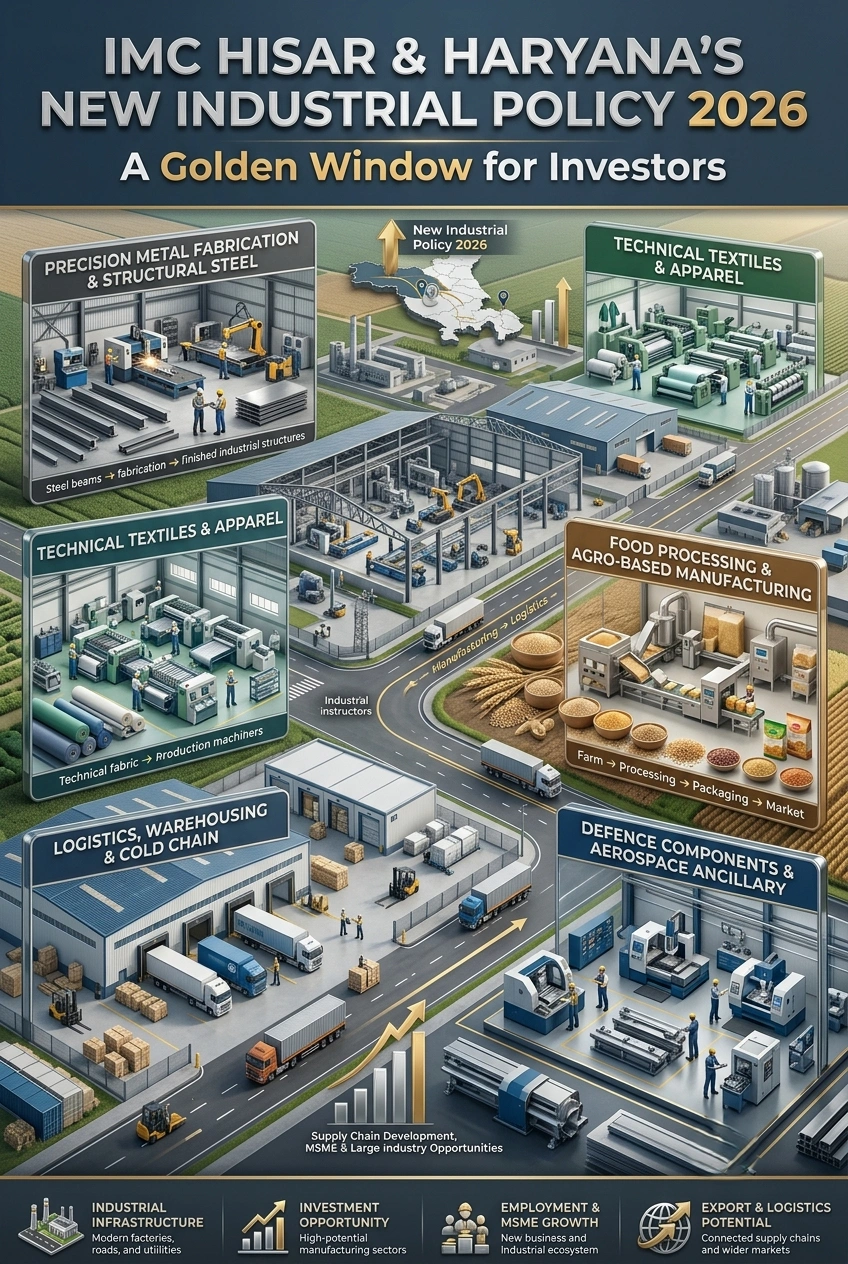
3. Food Processing and Agro-Based Manufacturing
Haryana is one of the leading agricultural states of the country with high wheat, mustard, vegetables and dairy production. IMC Hisar’s food and agro-processing zone establishes a natural linkage between the field and factory. From processing wheat into flour to making mustard oil, frozen vegetables into ready-to-eat snacks, entrepreneurs can think of various value addition options. The Haryana Agri-Business and Food Processing Policy 2026 is a companion policy to MSME, and provides extra capital subsidies, power rebates, and tax benefits for food processing units. Structural low cost of raw materials is due to its vicinity with agricultural hinterlands of Haryana and Rajasthan.
Air cargo facilities at Maharaja Agrasen Airport support perishable exports, including fresh produce. Chilled dairy products can reach Gulf and Southeast Asian markets on time. A food processing start-up at IMC Hisar can serve domestic retail chains and international markets from the same production facility.
Explore This Book: Handbook on Fruits, Vegetables & Food Processing with Canning & Preservation
4. Logistics, Warehousing, and Cold Chain Infrastructure
IMC Hisar is not all about manufacturing; it’s also a logistics hub. It is situated between the Eastern and Western Dedicated Freight Corridors. It also has a warehousing advantage that few other industrial clusters in India can offer. Logistics operators investing at IMC Hisar in multi-commodity warehouses, temperature-controlled cold stores, or bonded logistics are investing in infrastructure that grows in value with each manufacturing unit added to the cluster. Logistics infrastructure has been identified as one of the best investment areas by the CII in emerging industrial corridors. The cluster development plan has specific logistics and warehousing areas with modern infrastructure already part of the master plan. Thus, logistics infrastructure stands as one of the best-protected business concepts in the IMC Hisar ecosystem, with limited competition from existing players and strong corridor-oriented demand.
Get Detailed Project Report (DPR): Warehouse
5. Defence Component Manufacturing and Aerospace Ancillary
Hisar is becoming an aerospace & advanced manufacturing hub, especially with the creation of an ecosystem around the Maharaja Agrasen Airport. There is a special defence supply chain zone provided in the master plan of IMC Hisar. The indigenisation drive undertaken by the Ministry of Defence (MoD) is creating a need for component suppliers in the country. The MoD has prepared Positive Indigenisation Lists comprising 400+ defence items. This creates opportunities for MSMEs with precision machining or Defence grade component units at IMC Hisar. Such MSMEs can potentially become Tier-2 or Tier-3 vendors to HAL, DRDO, or private defence OEMs like L&T Defence and Tata Advanced Systems. Hisar is one of the most favourable locations for this business category in North India. This is due to its proximity to the airport, freight corridor, and dedicated aerospace policy support.
Import–Export Opportunity Analysis: The Trade Logic Behind IMC Hisar
IMC Hisar is a project of an infrastructure nature that helps in export. It is in the process of becoming the western link in the Amritsar-Kolkata Industrial Corridor, which will build a manufacturing and trade corridor between the agricultural and industrial hub of North India and the eastern ports of Kolkata and Haldia. For IMC Hisar manufacturers, it means faster lead-times, reduced freight charges and consistent cargo movement to international markets.
The airport connection for the cluster gives a vital dimension to air cargo — especially for time-sensitive and high value exports like engineering precision components, processed food, pharmaceuticals and textiles. A new MSME policy was released by Haryana that specifically aims to double the state’s merchandise exports within 5 years. The Export Credit Guarantee Corporation (ECGC) offers more risk protection to export MSMEs, thereby making the trade more financially secure. Furthermore, the new export freight assistance cap of ₹30 lakh per unit per year provides a cost-cutting advantage to manufacturers, which many other states in India do not have.
The freight corridor, on the other hand, brings down a huge cost benefit to the industries in eastern India in terms of raw material procurement from the region. The dual-port advantage of IMC Hisar, which is located between the EDFC and WDFC, gives manufacturers an added flexibility in moving export shipments and raw material inwards from both ports at the same time, which is an exceptional advantage. In addition, SIDBI provides exclusive trade finance products to MSME exporters establishing in priority industrial corridors thus providing another financial support.
Indian MSME Success Stories: What the Leaders Did Differently
Bector Foods – Manish Bector, Ludhiana
Cremica Group was started by Mrs. Rajni Bector and later scaled up by Manish Bector. It became one of India’s leading regional food manufacturing firms and grew into a national powerhouse. Bectors had been operating a bakery in Ludhiana. They then made a radical change and invested in large-scale food processing plant infrastructure. The facilities were designed to meet export quality standards. They also sought institutional supply contracts from QSRs such as McDonald’s.
Their lesson for entrepreneurs heading to IMC Hisar is simple. Location advantage and entry into the institutional supply chain are not independent decisions. They happen together. The food processing unit at IMC Hisar can target institutional buyers from day one. This approach provides a structurally more efficient route to profitability than a retail distribution path.
Shivalik Bimetal Controls – Neeraj Sharma, Solan
Shivalik Bimetal Controls is a precision metals MSME from Solan, Himachal Pradesh, that has become a global leader in bimetal and trimetal strip technology — supplying to clients across 45 countries. Promoter Neeraj Sharma made one critical decision: focus on a technically complex, niche product that global markets can’t easily substitute. The FICCI has repeatedly cited companies like Shivalik as examples of how Indian MSMEs can build durable export franchises through technical specialisation. For metal fabrication entrepreneurs eyeing IMC Hisar, Shivalik’s model is instructive. The freight corridor advantage at IMC Hisar means export competitiveness is structurally built in. Adding technical complexity — precision machining, defence-grade components, or certified aerospace parts — creates a durable moat that protects margins even as competition increases.
Vardhman Textiles – Sachit Jain, Ludhiana
Vardhman Group, led by Sachit Jain, grew from a small yarn manufacturer into one of India’s largest textile conglomerates by consistently investing in vertical integration and export market development. The group operates across yarn, fabric, and garments, with exports to over 60 countries. Their model carries a direct lesson for entrepreneurs evaluating the textile zone at IMC Hisar: vertical integration — from fibre processing to finished fabric or garment — creates compounding margin advantages. With the new MSME policy’s freight subsidies, export credit support, and capital subsidies, a textile startup in Hisar that builds vertically from day one has a faster path to export-scale operations than at almost any other location in North India. More detailed project-level benchmarking for textile ventures is available through the Ministry of MSME’s sectoral reports.
Turn your budget into a successful business plan
How NPCS Can Help You Plan Your IMC Hisar Venture
Evaluating an opportunity at IMC Hisar requires more than enthusiasm — it demands a rigorous feasibility framework. At Niir Project Consultancy Services (NPCS), we provide professional consulting for the preparation of Market Survey cum Detailed Techno-Economic Feasibility Reports (DPRs) for setting up new industries or businesses. Our reports cover detailed manufacturing processes, market research and demand analysis, process flow diagrams, product mix and capacity planning, machinery and raw material sourcing details, and complete project financials with profitability analysis. Our objective is to help entrepreneurs evaluate feasibility, profitability, and long-term scalability before committing capital. For an IMC Hisar project — whether in metal fabrication, food processing, textiles, or defence components — a well-prepared DPR is not optional. It is the document that unlocks bank financing, government subsidy approvals, and investor confidence.
IMC Hisar & Haryana Industrial Policy 2026 – Key Investment Metrics
| Parameter | Details / Value |
| IMC Hisar – Total Area | 2,988 acres |
| Phase I Development Area | 1,605 acres |
| IMC Hisar Investment Potential | ₹32,417 crore |
| IMC Project Development Cost | ₹4,680 crore |
| Projected Employment at IMC Hisar | 1.25 lakh jobs |
| Make in Haryana 2026 – Investment Target | ₹5 lakh crore over 5 years |
| Job Creation Target (Make in Haryana 2026) | 10 lakh new jobs |
| MSME & Export Policy Investment Target | ₹55,000 crore |
| MSME & Export Policy Job Target | 5 lakh jobs |
| Capital Subsidy for MSME Units | 15% to 30% (zone-dependent) |
| SGST Reimbursement Period | 7 years |
| Electricity Duty Exemption | 100% for 10 years |
| Employment Subsidy (Doubled) | Up to ₹1 lakh per employee/year |
| Export Freight Assistance (ceiling) | ₹30 lakh per unit/year |
| MSME Insurance Premium Assistance | Up to 33% of premium |
| Export Credit Interest Subvention | 3% (max ₹10 lakh/year) |
| PADMA Cluster Support (max per cluster) | ₹45 crore |
| Saksham Fund for Industrial Estates | ₹500 crore |
| State VC Fund for MSME Startups | ₹200 crore |
| Incentive Payout SLA (50% tranche) | Within 7 working days |
Conclusion: The Window Is Open — Act Before It Closes
IMC Hisar represents a genuine inflection point in North India’s manufacturing geography. The infrastructure is planned. The policy framework is in place. The incentives are the most comprehensive Haryana has ever offered. However, as every seasoned industrial consultant will tell you, first-mover advantage is time-bound. Land values at IMC Hisar are still accessible. The supply chain ecosystems are still forming. The competition for anchor customer relationships has not yet begun in earnest.
Entrepreneurs who evaluate their business ideas now will be in a stronger position. They can prepare a credible feasibility report, identify their sector zone, and secure financing. This will help them when the cluster reaches full operational momentum. The Make in Haryana Industrial Policy 2026 and the Haryana Progressive MSME & Export Promotion Policy 2026 together provide the financial scaffolding. IMC Hisar provides the physical infrastructure. What remains is the entrepreneur’s decision to move. In industrial investing, the best timing is almost always before the opportunity becomes widely visible. For IMC Hisar, that moment is right now.