
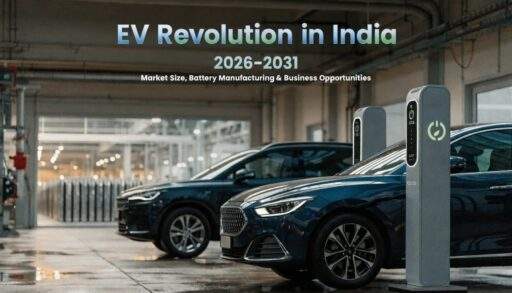


Electric Vehicle Business Opportunities in India
The Indian Electric Vehicle Revolution drives rapid changes in the automotive sector. For a time cars with internal combustion engines were the norm.. Now Electric Vehicles are becoming very popular. The government is giving incentives to people who buy Electric Vehicles. The increasing public knowledge about electric vehicle advantages This situation enables startups and small companies to fund electric vehicle development projects.
The Indian electric vehicle market will reach a value above USD 100 billion by 2030. The current market value ranges from USD 3.5 billion to USD 5 billion. The battery manufacturing industry has expanded its production capacity which serves as the primary driver for this market development. The government provides sector support through implementation of programs such as PLI and FAME which creates numerous business opportunities for new ventures.
Read More: Handbook on Electric Vehicles Manufacturing
India’s Electric Vehicle Market: Understanding the Numbers
Market trends show us which business opportunities exist within Electric Vehicle sector. The following indicators show their significance:
- Electric Vehicles make up around 6-8% of the two-wheeler market: The government wants to increase this to 30-40% by 2030.
- The demand for Lithium-ion batteries is increasing fast: It is expected to grow from 15-20 GWh today to over 120 GWh by 2030.
- There are 12,000 public charging stations in India: The government wants to increase this number to over 4,00,000.
- The government has allocated INR 18,100 crore for the production of Advanced Chemistry Cell batteries. This shows that the government is serious about supporting the Electric Vehicle sector.
The numbers present themselves as future forecasts however they use actual data and current trends for their calculations. The rising fuel prices along with better battery technology and new financing solutions are driving more people to choose electric vehicles.
Read More: Battery for Auto Vehicles
Why Startups Should Consider the Electric Vehicle Sector
The Electric Vehicle industry provides numerous benefits that companies can utilize. Startups should investigate this industry because of its various advantages for their business operations:
- Disaggregated Value Chain: The electric vehicle manufacturing process contains multiple stages which divide into separate parts that include battery cells and battery pack assembly and electric motors and power electronics and charging infrastructure and software and recycling. Startups can enter the market because of this modularity which allows them to start business operations without needing full control of the entire production process.
- Tangible Government Support: The PLI for Advanced Chemistry Cell (ACC) batteries and the FAME program are examples of central programs that give direct financial help. The states of Gujarat, Tamil Nadu, Maharashtra, Telangana, and Karnataka provide multiple incentives which include tax breaks, land grants, and capital subsidies.
- Export Opportunities: India serves as an effective supplier to Africa and Southeast Asia and the Middle East due to its affordable prices and worldwide product demand. The “China Plus One” sourcing strategy moves the purchase of parts to India especially wiring harnesses and power electronics and battery management systems.
These factors make the Electric Vehicle sector very attractive for startups and small businesses.

Key Business Opportunities in India’s Electric Vehicle Sector
There are business opportunities in the Electric Vehicle sector. Here are some of the promising ones:
Lithium-Ion Battery Pack Assembly
Battery packs are a very important component of Electric Vehicles. They make up around 35-40% of the cost of an Electric Vehicle. India currently imports most of its battery cells.. There is a lot of opportunity for domestic assembly of battery packs. Startups can set up assembly units with an investment of INR 5-25 crore.
Read More: India Lithium-Ion Battery Market Analysis & Forecast
EV Charging Infrastructure
Indias charging network is still in its stages. This presents an opportunity for businesses to set up charging stations. The government is supporting the development of charging infrastructure. Private players can set up charging networks along highways in areas and at commercial properties. The investment required for this is relatively low around INR 50 lakh.
Electric Two-Wheeler Assembly
The two-wheeler segment is driving the adoption of Electric Vehicles in India. Startups can assemble Electric Two-Wheelers using components sourced from established suppliers. This approach has been successful in the smartphone industry. The investment required for this is around INR 10-50 crore.
EV Component Manufacturing
There are components that go into an Electric Vehicle, like motors, controllers and battery management systems. Many of these components are currently imported. There is an opportunity for businesses to manufacture these components in India. The investment required for this is around INR 3-15 crore.
Read More: Startup Selector
Battery Recycling and Second-Life Applications
As the number of Electric Vehicles on the road increases there will be a need for battery recycling and second-life applications. The government has mandated that manufacturers must collect and recycle batteries. This presents an opportunity for businesses to start battery recycling and second-life applications. The investment required for this is relatively low.
EV Fleet and Logistics Services
Electric Vehicles are being used more and more for fleet and logistics services. Businesses can operate Electric Vehicle fleets for last-mile delivery ride-hailing and courier services. The investment required for this is relatively low around INR 1-10 crore.
Read More: The Rise of Electric Vehicles: Government Policies Fuelling the Change
Lessons from Indian Electric Vehicle Pioneers
There are businesses in India that have been successful in the Electric Vehicle sector. Here are some lessons from these pioneers:
- Bhavish Aggarwal of Ola Electric has shown that it is possible to build an Electric Vehicle business by integrating manufacturing, vehicle design and consumer delivery.
- Tarun Mehta of Ather Energy has shown that a focus on engineering and product strategy can help a business differentiate itself in the market.
- Sohinder Gill of Hero Electric has shown that consistent execution and a focus on the mass market can help a business capture a share of the market.
The Electric Vehicle industry presents multiple pathways which lead to successful outcomes according to these examples.
Read More: Best Franchise Business in India Under 10 Lakh – Low Investment & High Profit
How NPCS Supports Electric Vehicle Entrepreneurs
Niir Project Consultancy Services (NPCS) delivers consultancy services which assist Electric Vehicle entrepreneurs. The organization offers Techno-Economic Feasibility Reports which include the following content:
- Market research and demand analysis
- Production planning and process flow diagrams
- Machinery and raw material requirements
- Projections including profitability, IRR and NPV analysis
Entrepreneurs who use NPCS services can test their Electric Vehicle business ideas for viability while they evaluate risks and decide whether to proceed with their investments.
Conclusion
India’s electric vehicle market is now expanding into multiple growth segments which create various business opportunities for new companies. The combination of modular value chains and strong government support and growing domestic and international markets creates a unique chance for entrepreneurs to develop successful and scalable businesses.
The investment partnership with Niir Project Consultancy Services (NPCS) establishes a solid basis for success through market research and techno-economic assessment and financial evaluation. The entire electric vehicle industry creates new business possibilities for emerging Indian entrepreneurs through battery assembly and component production and charging station development and fleet management services.
Frequently Asked Questions (FAQs)
- What is the minimum investment required to start an Electric Vehicle business in India?
The minimum investment required to start an Electric Vehicle business in India is approximately INR 50 lakh for EV charging stations and between INR 5-25 crore for battery assembly and between INR 3-15 crore for component manufacturing.
- Which government schemes support Electric Vehicle startups?
The government provides three main supporting schemes for Electric Vehicle startups through PLI for ACC batteries FAME vehicle and charging station subsidies and state tax incentives and grant programs.
- Is there export potential for Electric Vehicle components?
Yes there is a lot of export potential for Electric Vehicle components. India can export motors, battery systems, wiring harnesses and power electronics to countries in Africa, Southeast Asia and the Middle East.
- How can I evaluate the viability of my Electric Vehicle business?
The Techno-Economic Feasibility Report evaluates your Electric Vehicle business through its cost analysis and break-even point assessment and its profitability projection.
- Is battery recycling a business today?
Yes battery recycling is a business today. The government has mandated that manufacturers must collect and recycle batteries. This presents an opportunity for businesses to start battery recycling and second-life applications.