


Introduction: Why 2026 Is a Turning Point for Agri-to-Energy Businesses
He agriculture sector of India is no longer just a food producer; it has become a key source for bioenergy manufacturing business in India. By 2026, crop residues, cow dung, and waste from sugar, poultry, and food processing industries will serve as major raw materials for producing clean energy, industrial fuels like CBG and ethanol, and high-quality organic fertilizers.
This transition of sources is supported by many powerful and strong drivers:
- The rapidly increasing energy demand and the reliance on imported fuels
- The government’s clear focus on biofuels, waste-to-wealth initiatives, and the circular economy
- The rural issues like crop burning, waste disposal, and low farm incomes
The interrelation of energy demand and agricultural supply plus the government support have made the situation that agriculture and energy as well as manufacturing are directly and positively interlinked. From the 2026 point of view, the manufacturing of energy from agriculture has become a solid long-term opportunity for industrial entrepreneurs.
India’s Bioenergy Landscape in 2026: From Policy Push to Profitable Manufacturing
By 2026, bioenergy in India will no longer be a pilot or experimental concept. CBG plants, ethanol distilleries, and biomass fuel units will be well‑established, commercially proven, and bank‑funded manufacturing businesses.
The strength of this ecosystem is visible in a few clear areas:
- Continuous availability of raw materials across rural India
- Long‑term offtake agreements with Oil Marketing Companies (OMCs)
- Active financing of bioenergy projects by banks and NBFCs
- Standardized and replicable plant models suitable for MSMEs
As a result, bioenergy manufacturing in 2026 has become a low‑marketing, demand‑driven industrial segment.
Read More: Compressed Bio Gas (CBG) Units: Profitable Green Energy Startup Opportunity
Why Startups & MSMEs Should Enter Bioenergy Manufacturing in 2026
Most digital startups today rely heavily on customer acquisition and marketing expenditure. Bioenergy manufacturing follows a very different model.
Key advantages of this sector include:
- OMCs, CGD networks, and industrial fuel consumers are some of the assured buyers.
- The availability of feedstock on the local market has resulted in low supply chain risk.
- At the same time, dual revenues are coming from both the fuel and organic fertilizer produced at the same facility.
- The alignment between ESG and sustainability has resulted in strong funding and policy support.
These factors contribute to making bioenergy manufacturing an attractive option for those entrepreneurs who want to invest in a long-term asset, ensure a steady cash flow, and start a scalable industrial business.(Bioenergy Manufacturing Business in India)
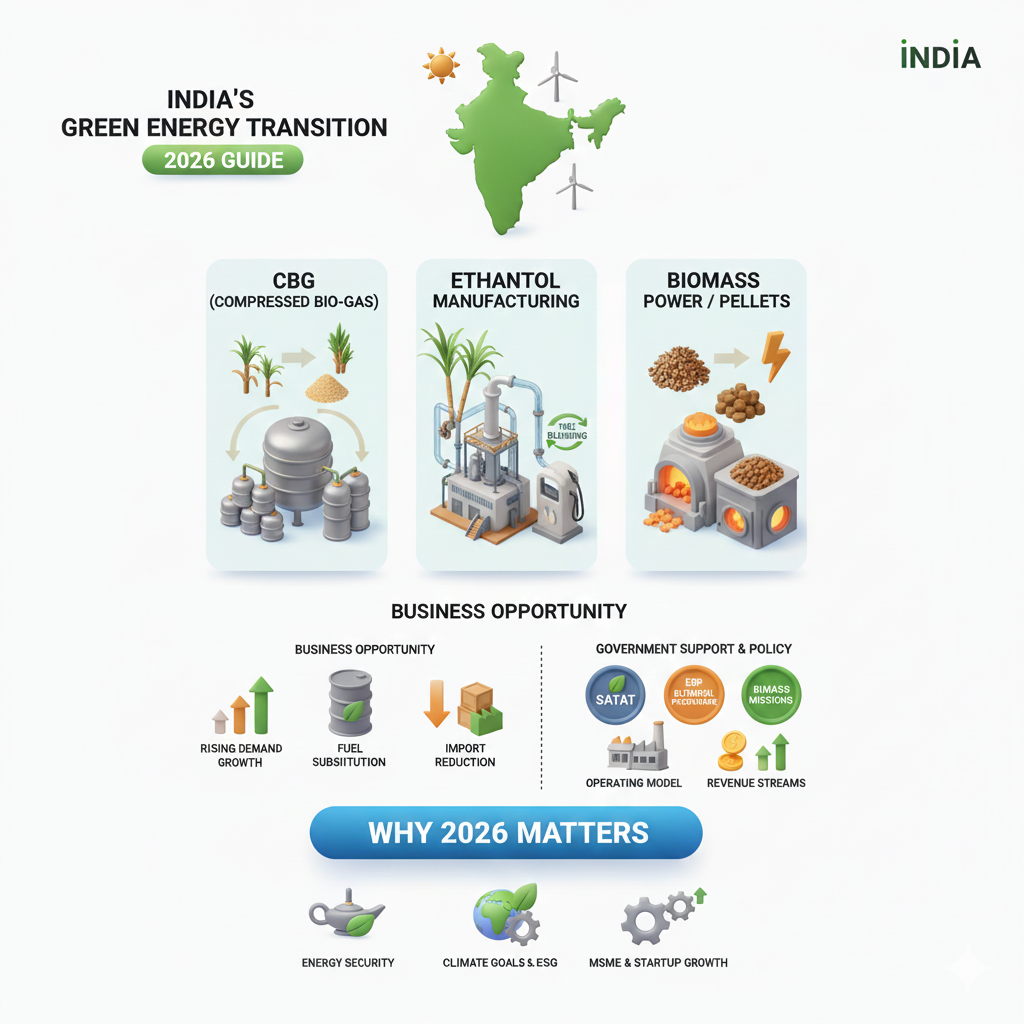

Compressed Biogas (CBG) Manufacturing Business in India
Compressed Biogas will be the main component of India’s clean fuel roadmap by the year 2026. Moreover, CBG is the refined biogas meeting the natural gas equivalent specifications and it is applied in the transport sector, city gas distribution, and industrial fuel applications.
CBG Plants Common Raw Materials
- Cattle dung and poultry litter
- Crop residue and agricultural waste
- Press mud from sugar mills
The production process primarily incorporates anaerobic digestion as the main technique in which biogas is generated, purified, and packed for sale. At the same time, The leftover material from the digesting process is turned into fermented organic manure which is a new source of income.(Bioenergy Manufacturing Business in India)
Read More: Clean Air and Clean Fuel Compressed Bio Gas (CBG) Bio CNG plant | Compressed Bio Gas (CBG) Bio CNG plant Produces Renewable Energy That Does Not Emit Greenhouse Gases or Soot
Ethanol Manufacturing Business Opportunities Under EBP 2026
India’s Ethanol Blending Program (EBP) will, by 2026, fully connect agriculture with fuel manufacturing. The large-scale production of ethanol has expanded the raw materials to sugarcane, maize, broken rice, and even damaged food grains.
Beyond distilleries, the ethanol value chain offers several high‑demand supporting manufacturing opportunities, including:
- Grain handling, storage, and milling systems
- Yeast, enzymes, and fermentation inputs
- Effluent treatment plants (ETPs) and biogas recovery units
These ancillary manufacturing units provide MSMEs with lower‑risk and faster‑execution business models.
Organic Manure & Digestate Processing Business
Digestate generated from CBG and biogas plants is not waste. In fact, With scientific processing, it is converted into high‑quality organic fertilizer, for which demand is steadily increasing in horticulture, organic farming, and soil‑restoration projects.
Key benefits of this business include:
- The required amount of capital is quite low compared to other businesses
- Moreover, the existing biogas and CBG (Compressed Biogas) plants can easily incorporate it
- Additionally, there is less risk due to seasonal changes and the demand is strong and recurring
Therefore, for the year 2026, digestate processing is the only manufacturing activity that can easily attract new entrepreneurs.
Read More: Biogas and Compressed Biogas (CBG) Production Handbook (from Waste & Renewable Resources)
Biomass Bridqutes & Pellets Manufacturing: A Coal‑Replacement Opportunity
Coal is being phased out and biomass briquettes and pellets are taking its place in terms of cost and policy alignment. As industries move further, coal isn’t going to be around for long Therefore, cleaner alternatives will take over, among which biomass briquettes and pellets are the new emerging lords of the throne that is, cost-effective and policy-aligned substitutes.
Common Biomass Raw Materials
- Rice husk
- Sawdust
- Cotton stalk
- Groundnut shells
The fam of this business can be attributed to its:
- Technology that is simple and needs no proof
- Raw materials that are easily available in local clusters
- Break even periods that are considerably short
This project is for entrepreneurs who desire fast installation and stable industrial demand of their product.
Import Substitution, Export Potential, and Long‑Term Outlook
The manufacturing of bioenergy not only cuts down the dependency of India on imported fuels and fertilizers. Furthermore, After 2026, the possibilities for biomass pellets, organic manure, and bio-energy consultation and service exports are also anticipated to grow gradually.
From a long‑term perspective, the sector:
- India’s energy security gets strengthened
- Rural area employment and farmers’ incomes get support
- A global climate and sustainability goals alignment is achieved
Read More: Start Manufacturing of Compressed Bio Gas (CBG)/Bio CNG Using Napier Grass
How NPCS Aids Entrepreneurs in the Development of Money-Making Bioenergy Project
The success of bioenergy production is not solely attributed to the concept but, rather, it also heavily relies on techno economic clarity and good execution planning. Niir Project Consultancy Services (NPCS) supports entrepreneurs by providing full-fledged feasibility support throughout the entire process.
NPCS’ project reports usually include:
- Analysis of market demand and pricing
- Selection of manufacturing process and technology
- Estimation of machinery, utilities, and total project cost
- Projections of financial feasibility, IRR, and ROI
NPCS seeks to provide entrepreneurs with confidence and transparency prior to investing in capital
Most Common Questions and their Answers (FAQs)
Q1. Will the CBG plant business be profitable in the year 2026?
Definitely. Guaranteed offtake agreements, solid government backing, and diversified revenue streams are the factors that turn CBG production into a business that is profitable in the long run.
Q2. What is the minimum investment required in the ethanol production business?
Investment varies with the capacity and feedstock, but ancillary units present relatively less investments for MSMEs as compared to other areas.
Q3. What is the future demand for biomass briquettes?
The demand for biomass fuels in industries is forecasted to rise owing to coal substitution policies and carbon reduction goals set for the industries.
Q4. Is there any government support for bioenergy production projects?
Government support is there. The public policies that are the strongest are the ones supporting the initiatives such as SATAT, the Ethanol Blending Program, and waste-to-energy policies.
Read More: From Seed to Success: A Startup’s Guide to Dominating India’s Vegetable Seed Market

Conclusion: Manufacturing Opportunities Beyond 2026
CBG, ethanol, and biomass manufacturing are not short‑term trends. in fact, They represent a structural transformation of India’s energy system, waste management, and rural economy.(Bioenergy Manufacturing Business in India)
Entrepreneurs who start well‑planned, technically sound, and scalable bioenergy manufacturing projects with a 2026 outlook can, as a result, build strong, sustainable industrial businesses in the years ahead.