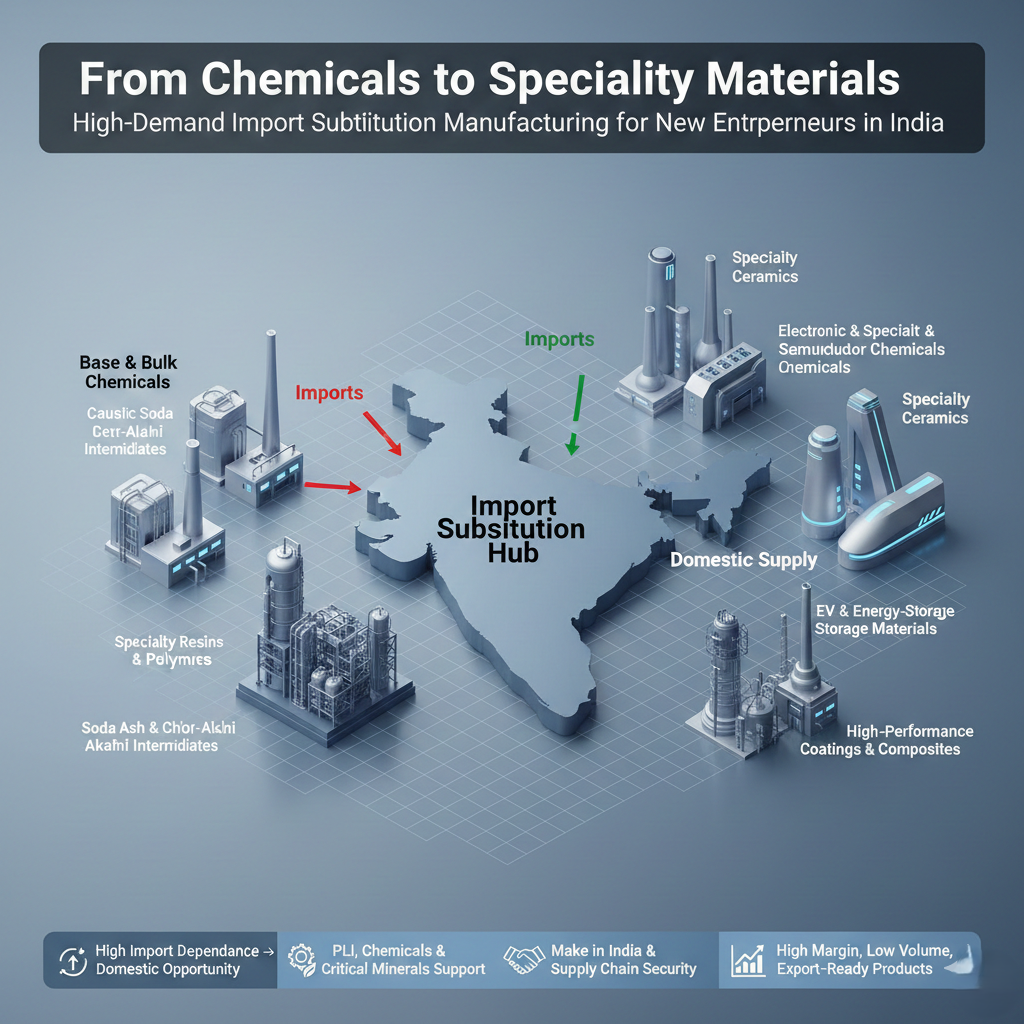
Import substitution manufacturing in India is standing at a decisive moment in its industrial evolution. As global supply chains realign, domestic consumption rises, and advanced manufacturing gains momentum, import substitution has emerged as one of the most practical and profitable strategies for new industrial entrepreneurs.
Despite strong progress under Make in India, the country still imports large quantities of specialty chemicals, advanced materials, electronic inputs, battery chemicals, engineering plastics, and industrial intermediates. This gap between demand and domestic supply is no longer a weakness—it is a clear business opportunity.
With policy support from the Ministry of Heavy Industries and growing localization efforts by large Indian corporations, new MSMEs now have the chance to enter high-value manufacturing segments with long-term demand visibility.
It is a Strategic Opportunity to Import Substitution
Import substitution is getting the greatest support from various structural factors:
- Domestic supply is not able to keep up with the industrial demand
- Initiatives of the government are in favor of local manufacturing
- Big Indian corporations are gradually becoming less dependent on imports
- Worldwide purchasers are more and more inclined towards suppliers from India
The trends in India’s ambition to become a one-trillion-dollar manufacturing economy create a continual need for industrial inputs produced locally.
Read More:The Potential of Specialty Chemicals: A Startup’s Guide to High-Growth Markets
Silica from Rice Husk Ash
Silica for specialty applications finds its usage in various industries including tires, rubber goods, cosmetics, construction chemicals, coatings, plastics, and certain electronics. India imports high-purity grades due to the strictness of quality and the need for consistent supply.(Import Substitution Manufacturing India)
This segment is, in a way, highlighted for the above mentioned reasons, as India is the biggest producer of rice husk ash—a waste product from farming that is able to be transformed into high-value silica.
Reasons for this being the best opportunity ever:
- Very low and readily available raw material
- Great domestic market for the tires and rubber industries
- Reliance on imports for top-quality grades
- Export market for eco-friendly, biomass-based materials
The new entrepreneurs receive a rare mix of cost advantage, sustainability, and premium pricing in specialty silica.
Epoxy Resins and Hardeners
Epoxy systems are considered the most important for electronics, industrial flooring, composites, wind energy components, adhesives, and electric vehicles. Basic epoxy resins are manufactured locally while several specialized formulations are still imported.
Electronics manufacturing, renewable energy installations, and infrastructure projects are the ones driving the demand.
The key demand drivers are:
- Increase in the production of electronics and PCB manufacturing
- Composites’ growing usage in EVs and wind energy
- Industrial tendency towards suppliers that are localized and customized
Epoxy resins ensure customer-to-customer demand that is constant and very appropriate also for small and medium enterprises aiming at niche grades and contract manufacturing.
Read More: Tata Chemicals Sodium Bicarbonate Success: Manufacturing Process
Lithium Processing Chemicals for Batteries
The country’s electric vehicle and energy storage sectors are growing at a fast pace, but India is still almost entirely reliant on imported lithium processing chemicals.
These chemicals are vital for:
- Battery cathode materials
- Electrolytes
- Energy storage systems
With the establishment of battery manufacturing capacity in the country, local lithium processing is becoming strategic rather than optional. Even though this segment demands higher technical expertise, it has the long-term relevance and strong institutional demand.
High-Precision Engineering Plastics
Engineering plastics (PA, PC, POM, PEEK, and PEI) are becoming more common in automotive, electronics, aerospace, and industrial machinery applications, thus replacing metals in these sectors. India still relies heavily on imported materials and their compounded variants for these plastics.
Reasons why entrepreneurs are flocking to this area:
- High value per kilogram makes capital more efficient
- Demand coming from EVs, automation, and robotics
- Entry through compounding and modification is possible
- Growing export demand for plastic components
This segment permits gradual scaling while tackling high-growth industries.
Read More: Chemicals, Biotechnology, Enzymes, Bio Fertilizer, Vermiculture, Vermicompost Chemical & Allied Industries and Alcohol Projects
Recovered Carbon Black from Tyre Pyrolysis
In the production of tyres, carbon black is an essential element, and its consumption is also major in the rubber, ink, and coating industries. Importation of specialty grades still continues while domestic market is heavily consuming them.(Import Substitution Manufacturing India)
Waste tyre pyrolysis is one process that has been able to recover carbon black which can be used as a material for producing new products or as an alternative to virgin carbon black.
The following are some of the business advantages of using recovered carbon black from waste tyres:
- Low-cost feedstock from waste tyres
- Government support for circular economy projects
- Sustainability and green financing
This approach not only provides a means of waste disposal but also makes the industrial sector highly profitable through manufacturing.
Metal Surface Treatment Chemicals
Surface treatment chemicals are applied in various sectors such as automotive components, engineering goods, electrical hardware, defense, and fabrication industries.
India still relies on imported advanced formulations for some surface treatment processes like phosphating, anodizing, and conversion coating.
Reasons that make this segment appealing:
- Every metal working unit needs treatment for the surface
- Continuous industrial consumption
- High margins with relatively low logistics costs
Manufacturers can gain clear advantages from localized supply.
Read More: Handbook On Chemical Industries (Alcohol Based)
Bio-Based and Green Chemicals
Sustainability-oriented manufacturing is rapidly gaining ground not only in India but also in other markets around the world. The acceptance of bio-based chemicals like green solvents, bio-plasticizers, bio-surfactants, and biodegradable polymers is on the rise.
The segment is supported by:
- Government sustainability measures
- Investments driven by ESG
- Higher prices in the export markets
Although initially the volumes will be small, the long-term potential for growth is very high.
Read More: Startup Selector
Construction Chemicals and Additives
In India, the infrastructural development comprising of highways, metros, airports, and industrial parks is the key factor driving the high demand for construction chemicals, including concrete additives, waterproofing systems, industrial flooring materials, and repair compounds.(Import Substitution Manufacturing India)
Reasons Why MSMEs Can be Successful Here:
- Manufacturing based on formulation
- Demand of high volume with repeat
- Possibilities of local and international markets
This is one of the fastest-moving segments in the import-substitution market.
How NPCS Supports Import Substitution Entrepreneurs
Niir Project Consultancy Services (NPCS) assists entrepreneurs by elaborating on technical and economic feasibility through detailed reports that include:
- Manufacturing process and technology
- Machinery and raw material selection
- Market demand and competition analysis
- Project cost, profitability, and scalability
NPCS provides entrepreneurs with a data-driven and clear view of the process to go from the idea to execution.
Final Thoughts
Import substitution manufacturing is not anymore a matter of policy—the market demand is now playing a significant role. The Indian growth story, along with the alterations in the global supply chains, has uncovered potent and durable areas in chemicals and specialty materials.
Visibility, scalability, and resilience are some of the features of the new entrepreneurs. The ones focusing on quality, compliance, and technology today will be the future long-term suppliers to India’s industrial ecosystem.