


The bamboo industry in India has been christened as “green gold” and its name is well deserving. It is the second largest bamboo producer in the world, with natural reserves covering more than a million hectares in the country, in the Northeast, Western Ghats and central India. But for decades, this amazing natural resource has been seriously underutilised. This is now beginning to change quickly. Bamboo entrepreneurs, MSME investors and first-generation entrepreneurs are coming to the bamboo and bamboo products segment with ambitious project plans, and they need properly trained consultants in the bamboo industry in India to chart the course.
It is not simply a matter of planting bamboo or purchasing equipment. For a viable project to be successfully developed, whether it involves bamboo charcoal, activated carbon, bamboo fibres and yarns, bamboo furniture, bamboo toothbrushes, bamboo paper products, bamboo floorings or value-added bamboo composites, solid technical and commercial basis is required. There is no room for compromise or delay in a feasibility study, demand analysis, process engineering, plant layout, raw material linkages, or regulatory compliance. This work must happen before a single rupee of capital is spent. It is here that the top bamboo industry consultants in India bring in a lot of value which cannot be measured.
The Union Ministry of Agriculture & Farmers Welfare has overhauled the Indian development system of bamboos to include 24 States and Union Territories under the umbrella of National Bamboo Mission (NBM). Its emphasis on linkages with industries, primary processing facilities, and product development has provided a strong windmill for manufacturing investment. In addition to the NBM, there are other policy provisions such as Atmanirbhar Bharat and MSME development policy. These have unlocked new avenues for funding and subsidy. For any businessperson who is going to venture into this field, it is not just a choice to use an experienced consultancy business organization. It is a must if they are to succeed in the business.
What Bamboo Industry Consultants Actually Do
Before the bamboo machine is installed, the professional bamboo and bamboo product consultant has already prepared a lot of work. The process begins with a Detailed Project Report (DPR) — a detailed report that describes the manufacturing process, specifies the plant capacity, outlines raw material sources, estimates the cost of manufacturing and models the financial results. If it hasn’t got a credible DPR, it will not get a project loan from any bank and no equity investor will come through.
In addition to DPR preparation, experienced process plant consultants perform techno-economic feasibility studies. These studies confirm the sense of the business logic of the project. This involves primary and secondary market research to analyse the dynamics between demand and supply. It also includes a competitive landscape scan, identification of the domestic and export buyer segments, and sensitivity analysis of key parameters. These include fluctuations in raw material prices, energy costs, and utilisation rates.
The top bamboo plant consultants also provide engineering advisory services. This includes process flow diagrams, equipment selection, utility planning, effluent treatment design and plant layout optimisation for the site. EPC (Engineering, Procurement & Construction) support might help larger/complex bamboo processing units (e.g., Bamboo fibre spinning mill, bamboo charcoal retort kiln, bamboo composites manufacturer). Within this area, strong EPC consultants are responsible for vendor identification, procurement planning, civil design coordination, and project commissioning.
The other important service is regulatory and compliance advisory. India’s bamboo industry is a multi-layered industry. The inordinate hassles of the Indian Forest Act, 1927, which defined bamboo grown outside forests as trees and required forest permits for transit, have significantly reduced under the revised legislation. Even though there are no additional obstacles, environment clearances by State Pollution Control Boards, compliance with the Factories Act, GST registration and tax structure planning, MSME Udyam registration, and BIS standards for certain bamboo products will continue to be necessary hurdles. The bamboo industry expert consultants take clients through these steps seamlessly.
Why India is a Hotspot for Bamboo and Bamboo Products Investment
India’s standing in the international trade of bamboo is very strong. There are estimated to be 23 or more genera of bamboo with more than 136 species spread out over more than 13 million hectares of natural bamboo reserves in the country. The bamboo and rattan industry contributes about ₹28,005 crore to the Indian economy and the industry is expected to see a CAGR of more than 12% and a production value of an estimated ₹52,246 crore with the number of people employed in the sector increasing by nearly 30 lakhs at the same time, as per the estimates by IBEF — India Brand Equity Foundation.
India is also one of the major bamboo exporters in the world, with about 14% share of the total export shipments. This puts the country in a favorable position to compete with China and Vietnam. It can serve export customers looking for sustainable and quality assured bamboo products. This surge in demand is especially pronounced in high value categories. These include bamboo based activated carbon, bamboo fibre and textiles, bamboo flooring and panels, bamboo kitchenware and bamboo packing.
As per Invest India’s policy perspective, the frameworks of Production Linked Incentive (PLI) and Atmanirbhar Bharat are providing opportunities for the use of bamboo in the food processing, textile, packaging and green materials sectors of manufacturing. The credit linked back-end subsidy is available to eligible bamboo processing units and product development units through NBM. The financial ecosystem for investment in bamboo projects has become more inclusive as a result of the Pradhan Mantri Mudra Yojana (PMMY) scheme to provide finance to smaller MSMEs and various stand-up India schemes for first generation entrepreneurs.
The bamboo industry is now gaining momentum in Northeast India (Assam, Mizoram, Meghalaya, Manipur and Nagaland). Maharashtra started a dedicated state bamboo policy aimed towards ₹50,000 crore of new investments. Other states like Madhya Pradesh, Odisha and Chhattisgarh are also emerging as key states. They have raw bamboo resources, relatively affordable land prices and are close to logistics corridors. Project structuring and navigating through the regulatory landscape are important aspects that need professional guidance. This is especially true when investing in these regions and working with the best bamboo industry consultants in Delhi and other leading consulting centers.

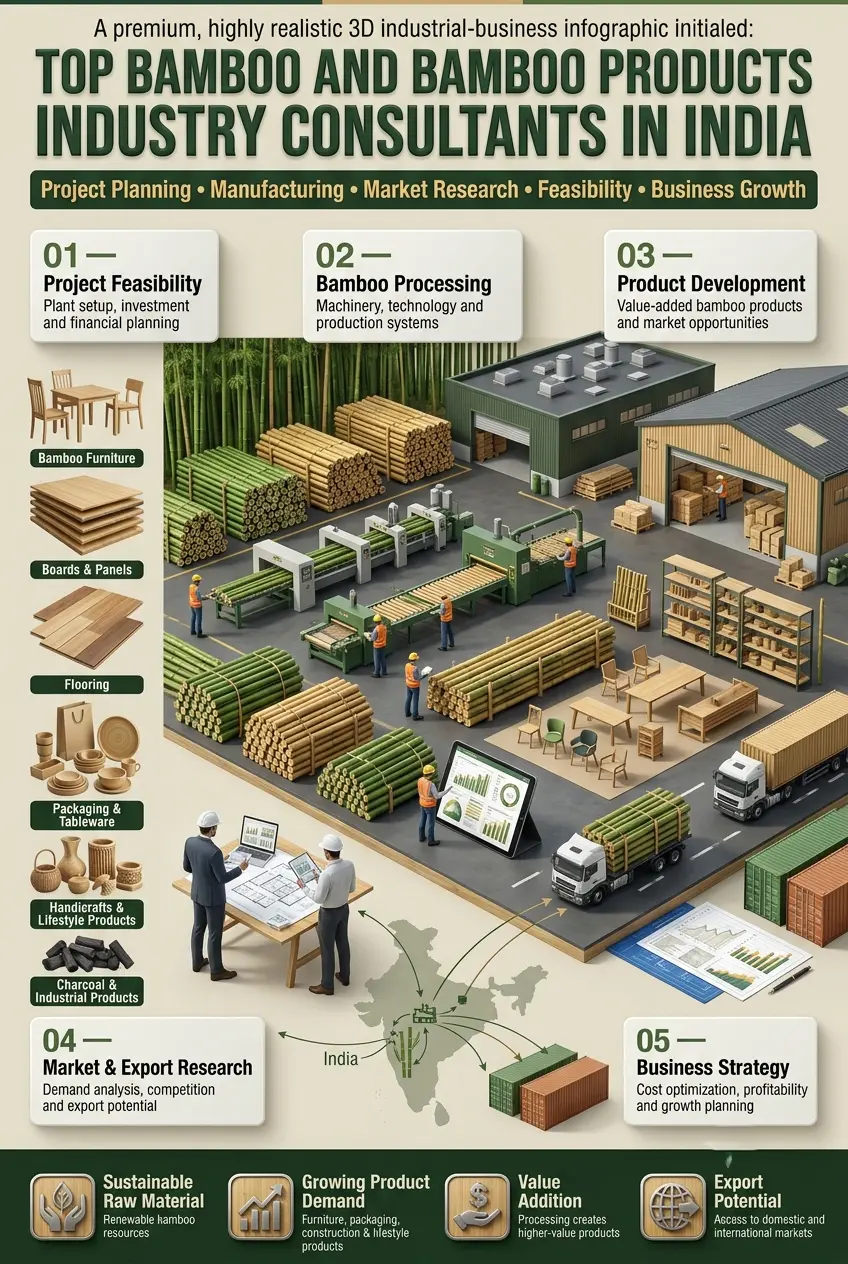
How to Evaluate the Best Bamboo Industry Consultants in India
The selection of a bamboo consulting partner is a key decision that will determine all the downstream consequences of the project. The difference between a good, true consultant and one who has only dipped a toe into the water is in many respects clear.
The first and most basic requirement is experience in the bamboo and bamboo products industry. The bamboo industry is not a single entity, but includes agriculture, forestry, chemicals, textiles, bamboo composites, packaging and food. A consultant who has insight into the bamboo growing and production cycle, post-harvest treatment (heat treatment, chemical preservation, carbonisation), applications of bamboo products downstream and markets is much more useful than a genericist. Specifically ask about the number of engagement projects they have delivered in the sub-sector that matches the project you are looking for (bamboo charcoal, bamboo fibre, bamboo- activated carbon, bamboo construction materials or bamboo food products).
The second critical indicator of DP and feasibility report quality is the. A bankable DPR has to meet the technical evaluation team of commercial banks, SIDBI, NBFCs, and impact investors. It should contain detailed descriptions of the manufacturing process, details of any equipment required and three quotes from vendors, estimates of market demand based on primary survey data, realistic financial projections for three scenarios: conservative, base and optimistic, and mapping of areas covered by regulatory compliance. Product standards are issued by the Bureau of Indian Standards (BIS) for a number of bamboo products and a well-prepared DPR takes into account the standards and tests from early stages.
Engineering and EPC capability is the third dimension of evaluation. A large number of consulting firms provide DPR preparation services. However, they may not have the process engineering expertise to guide the design of proposed equipment, estimation of utilities or treatment of effluents from bamboo processing. Good process engineering consultants can verify the manufacturer’s efficiency of the equipment. They can guide clients not to fall into over-specification pitfalls. They can also find cost-effective technology alternatives — especially bamboo carbonisation kilns, bamboo pulping lines or bamboo composite extrusion equipment.
The fourth evaluation pillar is regulatory knowledge and track record. Seek out consultants who have proven experience in DPR’s that banks have funded and plants that have commissioned. Genuine operational depth reflects in client testimonials, reference projects and the ability to navigate state-specific regulations. These include permissions from the State Bamboo Missions, environment clearances under the Environmental Protection Act, compliance with the Factories Act, etc., and GST framework.
Lastly, check out the scope of the customer base. Geography-wise experienced consultants with multiple Indian states, NRI clients and international assignments are associated with market intelligence. This is unknown to a firm with limited experience. Cross-sector exposure in the bamboo value chain is also useful. A person who generated reports for bamboo charcoal, bamboo paper, bamboo fibre, and bamboo construction will know the competitive landscape. They will also know the investment trends of the different industry sectors that contribute to more savvy project investments.
Role of NPCS in Bamboo and Bamboo Products Project Consultancy
Founded in 1994, Niir Project Consultancy Services (NPCS) is one of India’s leading top bamboo industry consultants, with a broad spectrum of technical coverage, a wide client base and proven experience in over 85 countries. Moreover, Having delivered more than 1.5 lakh project assignments through its 30 years of consulting activities; NPCS has unparalleled institutional knowledge in the bamboo and bamboo products space.
NPCS does Detailed Project Reports and techno-economic feasibility studies for bamboo and bamboo products manufacturing projects. Every report includes the entire project intelligence package, which comprises: manufacturing process assessment and project technology, machinery and equipment sourcing, raw material availability and procurement planning, process flow diagrams, plant layout design, capacity planning and product mix optimisation, market research and demand analysis, and complete financials for the project including capital cost estimation, working capital modelling, projected P&L statements, cash flow analysis, balance sheet projections, break-even analysis, NPV/IRR calculations. A document is presented to the client that is ready to be submitted to banks, financial institutions and government scheme evaluation committees for investment.
The project profile catalog of NPCS allows access to a variety of bamboo and value added bamboo products project profiles ranging from primary processing to specialized manufacturing of bamboo.
NPCS has completed a variety of feasibility and DPRs for a diverse range of promoters. These assignments covered bamboo product categories and states across India.
M/s. The activated carbon from bamboo bankable techno-economic feasibility report was undertaken by Wasera Farms OPC Private Limited (Chandrapur, Maharashtra). The report focused on producing activated carbon from the renewable feedstock bamboo. Bamboo has a huge industrial demand in India for the production of high-purity activated carbon from renewable feedstock.
M/s. Faber Technological Group (Mumbai, Maharashtra) invited NPCS to develop a feasibility report. The report covered the manufacture of high value products from the raw material – bamboo fibre and fibre yarn.
M/s. Trishul Motors (Surat, Gujarat) approached NPCS for expertise on techno-economic viability study of bamboo charcoal production. The product has good demand in metallurgy, food processing and environmental remediation industries.
The company was able to provide support to integrated bamboo industrial clusters. Vandana Global Ltd., Raipur, Chhattisgarh, conducted two separate projects on the production of bamboo charcoal and manufacture of bamboo sticks.
Mrs. Sangeeta Daimari (Ghaziabad, Uttar Pradesh) was involved in conducting a feasibility report on manufacturing of bamboo toothbrushes, a rapidly expanding eco-personal care product category, especially due to the global apprehensions against plastic. M/s. The bamboo paper-based products namely tissue paper, paper bag and paper plates are an important eco-packaging opportunity supported by Precision Impex Pvt. Ltd. (Kolkata, West Bengal). M/s. Shree Ganesh Fabricators (Pune, Maharashtra) had asked for a feasibility report on the bamboo toothbrush. Cross Country Tourism and Infrastructure Pvt. Ltd. (Agartala, Tripura) investigated the bamboo fabric manufacturing, which has a remarkable advantage in the supply chain from Northeast India.
M/s. Borooah Enterprises Pvt. Ltd. Guwahati, Assam engaged NPCS for a bamboo toothbrush market research report. It also commissioned a detailed project study on natural bamboo fibre manufacturing. This combination reflects the firm’s ability to cover consumer, industrial, and natural fibre dimensions of the bamboo sector.
M/s. R and R Industry (Aizawl, Mizoram) and Mr. Rinawma Ralte (also Aizawl, Mizoram) both commissioned NPCS for activated charcoal from bamboo. This demonstrates the firm’s deep penetration into Northeast India’s bamboo-rich states.
M/s. Pawan Casting Meghalaya Pvt. Ltd. (Byrnihat, Meghalaya) also pursued the activated charcoal from bamboo opportunity with NPCS’s financial feasibility support.
M/s. Parity Infotech Solutions Pvt. Ltd. (Delhi) engaged NPCS for a market research report on biodegradable plates from areca nut tree leaves, bark, and bamboo — a hybrid sustainable packaging study that illustrates NPCS’s cross-material advisory capabilities. M/s. Jaini Chemicals and Pharmaceuticals Pvt. Ltd. (Mumbai, Maharashtra) received a detailed information study on paper, pulp, and paperboard from bamboo — a high-capacity industrial application with direct relevance to India’s import substitution agenda in the paper sector. Mr. G Sriram (Chennai, Tamil Nadu) also received a market research report on activated carbon from bamboo. M/s. Vandana Global. Ltd. additionally received an economic viability study on bamboo charcoal from NPCS — rounding out a strong multi-assignment relationship focused on the charcoal and activated carbon value chain.</p>
Best Bamboo Industry Consultants in Delhi and Across India
Delhi functions as India’s primary hub for industrial consultancy. Therefore, the best bamboo industry consultants in Delhi are well positioned to serve promoters from across the country. This is mainly because of the capital’s concentration of financial institutions, government ministries (including the Ministry of Agriculture & Farmers Welfare, which governs the National Bamboo Mission), and national-level industry bodies. For example, Delhi-based firms like NPCS serve clients from Gujarat, Maharashtra, Rajasthan, Uttar Pradesh, West Bengal, and the Northeast with equal effectiveness. Moreover, they combine the advantage of national market reach with on-the-ground knowledge of state-specific bamboo policies and incentive structures.
Meanwhile, The Invest India platform and the National Bamboo Mission portal remain the primary government reference points for bamboo investment facilitation. In addition, Industry bodies such as the Indian Plywood Industries Research and Training Institute (IPIRTI) and the Bamboo Society of India play a complementary role in providing technical standards, testing support, and sector networking for bamboo-based manufacturing ventures.
Beyond Delhi, significant consultancy activity in the bamboo sector exists in Mumbai, Pune, Hyderabad, Bangalore, and Ahmedabad. Furthermore, these cities have strong engineering consulting ecosystems. As a result, they support bamboo project design, equipment procurement, and plant commissioning.
However, boutique management consulting firms in India specialise specifically in agro-industrial and bio-based sectors — like NPCS. In particular, they consistently outperform generalist firms when it comes to bamboo feasibility studies. This is because of the depth of domain knowledge required across agriculture, forestry, and manufacturing.
Bamboo Industry Consulting Services: A Comparison
| Consulting Service Type | Key Deliverables | Best-Fit Client Type | Typical Engagement Duration |
| Detailed Project Report (DPR) | Manufacturing process, plant layout, machinery specs, market analysis, full financials, cost of project | First-generation entrepreneurs seeking bank finance, MSME loan, or government scheme support | 4–8 weeks |
| Techno-Economic Feasibility Study (TEFR) | Market demand analysis, production economics, technology assessment, financial rationale | NRI investors, industrial groups evaluating new product lines, private equity due diligence | 3–6 weeks |
| Market Research Report | Demand-supply analysis, pricing trends, competitor mapping, end-use industry structure, export market scan | Existing bamboo processors seeking diversification or product expansion | 2–4 weeks |
| Process Engineering Consultancy | Process flow diagrams, equipment selection, utility design, material balance, effluent treatment | Promoters with confirmed financing who need execution-stage technical support | 6–12 weeks |
| EPC Project Advisory | Engineering design, equipment procurement support, construction coordination, commissioning assistance | Large-scale bamboo processing units — charcoal, activated carbon, composite boards, textiles | 4–18 months |
| Regulatory Compliance Advisory | Environment clearance, Factories Act registration, BIS certification roadmap, GST classification, MSME scheme eligibility | All project types — typically bundled with DPR or feasibility study engagement | Ongoing, typically 2–4 weeks for initial mapping |

Conclusion: Next Steps for Entrepreneurs Seeking Bamboo Project Consultancy
India’s bamboo sector stands at a genuinely exciting inflection point. Moreover, National policy support, rising global demand for sustainable materials, a rich raw material base, and a rapidly maturing manufacturing ecosystem have all converged. Together, they make this one of the most promising green manufacturing opportunities of this generation.
However, like any capital-intensive manufacturing venture, the difference between a profitable project and a stalled investment almost always comes down to the quality of the foundation. This includes, in particular, the feasibility study, the DPR, the process design, and the regulatory roadmap.
For entrepreneurs and investors entering the bamboo and bamboo products space, therefore, the practical next steps are clear. First, Start by engaging a credentialed bamboo industry consultant early — ideally before committing to a specific product, site, or scale of operation. Next, Commission a techno-economic feasibility study to validate market demand and process economics. Furthermore, Use the DPR as the basis for bank financing, government scheme applications, and investor negotiations. Finally, And ensure that your consultant’s scope covers regulatory compliance mapping, not just financial projections.
Firms like NPCS (Niir Project Consultancy Services) — with 30 years of consulting experience, a proven multi-state client portfolio in the bamboo sector, and deep expertise across bamboo activated carbon, bamboo fibre, bamboo charcoal, bamboo paper products, and bamboo personal care manufacturing — offer the integrated support that ambitious bamboo entrepreneurs need to move from concept to commercial reality. In addition, Explore their bamboo project profiles at niir.org to identify the right starting point for your investment. Ultimately, The green gold opportunity is real. Therefore, The right consultancy partner will help you claim it.
Your Investment Deserves the Right Opportunity
Every serious investment begins with choosing the right sector and the right business model. With hundreds of industrial opportunities available across India’s manufacturing and clean-energy landscape, making the most informed choice is critical. NPCS Startup Selector tool helps entrepreneurs, MSMEs, and investors identify the most suitable business opportunities based on their investment capacity, location, and interests — so your capital is directed toward a venture with the strongest fit and potential.