


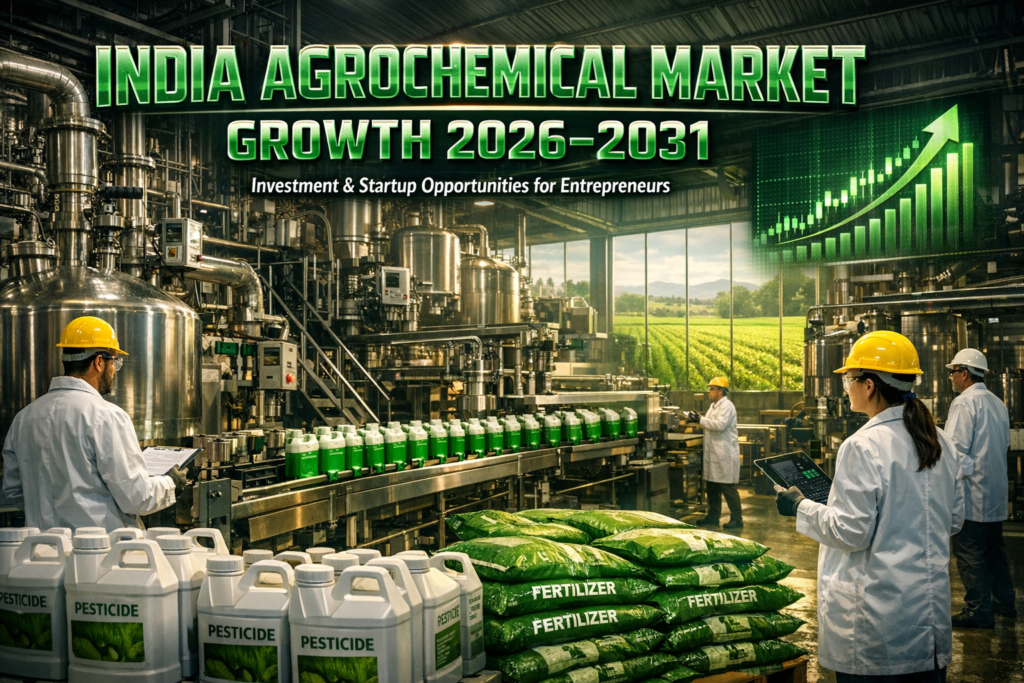
Agrochemical Market in India
The Indian agrochemical sector is emerging as one of the most promising investment in agriculture sector. Valued at around USD 9 – 9.6 billion in 2025 – 26, it is expected to reach USD 13 – 13.25 billion in 2031, at a steady CAGR of 5.5 – 6.6%. India is already the fourth largest producer and the second largest exporter of agrochemicals in the world and exports crop protection products worth over USD 3.3 billions in FY 25 to over 150 countries. However, domestic consumption is still low (0.38-0.6 kg/ha) whereas the world average is 2-2.6 kg/ha. This gap between capacity to produce and domestic application is the basis for a profitable industrial opportunity for both MSMEs and first generation entrepreneurs.
The Indian agrochemical scenario has been undergoing structural change. The total domestic market was estimated at roughly Rs 69,000 crores in fiscal year 24 with exports having a 51% share in terms of value, while domestic formulations have the remaining 49% share. Over the past decade, India’s agrochemical exports have almost tripled, securing India as the third-largest agrochemical exporter globally, right behind China and the United States. While insecticides remain the leading segment with 41% share, herbicides are the fastest growing segment with 10% CAGR between FY21 and FY24. This growth has been propelled by increasing labour shortages in rural areas – the weeding process takes 8 – 10 hours per acre. Eight crops, such as rice, cotton, wheat, soybean, and other important horticulture crops (grapes, chillies) make up close to 65% of the domestic agrochemical consumption. The top States for sales are Maharashtra, Goa, Andhra Pradesh, Telangana, Madhya Pradesh, Karnataka, Uttar Pradesh and Uttarakhand, which constitute around three-fourths of the domestic market.
Read More: The Complete Technology Book on Pesticides, Insecticides, Fungicides and Herbicides (Agrochemicals) with Formulae, Manufacturing Process, Machinery & Equipment Details 4th Revised Edition
Market Segmentation and Crops Dynamics
India is a diverse market for the crop protection product industry, with different demand for the chemical product categories. While the sector is dominated by insecticides, herbicides are rapidly growing as a result of the shortage of labour and need for mechanized weed control. Fungicides, bio stimulants, plant growth regulators and seed treatments are also important, especially on high value horticulture crops.
Market share highlights:
- Insecticides – 41%
- Herbicides – 22% (fastest-growing)
- Fungicides – 21%
- Bio stimulants – 8%
- Plant growth regulators – 6%
- Seed treatment chemicals – 2%
Eight major crops share about 65% of the total consumption which are rice, cotton, wheat, soybean, grapes, chillies, sugarcane and gram. The increased focus on horticulture, particularly export grade fruits and vegetables, puts more demand on fungicides and herbicides, which necessitate precise application under trellis systems and controlled environments.(Agrochemical Market in India)
The Demand-Supply Gap: The Biggest Opportunity for India
India imports almost 50% of the technical-grade active ingredients, primarily from China. Imports have jumped to Rs 14,315 crore from Rs 9,267 crore in FY19. This dependency exposes the supply chain to vulnerability and price volatility.
A number of factors cause the gap, which is structural, not cyclical:
- Reliance on Chinese raw materials and intermediates
- Low Domestic per hectare agro-chemical use
- Increasing demand for high value horticulture crops
- Global patent expirations providing opportunities for generic molecule production
Entrepreneurs who are in a position to produce these imported raw materials locally can supply immediate demand from both the domestic formulators and export-oriented manufacturers.
Read More: 15 Profitable Chemical Business Ideas in India (Low Investment Manufacturing Guide)
Leading Players Operating in India Agrochemical Industry
A mix of domestic and multinational companies characterises the Indian agrochemical market. Key players include:
- UPL Limited – Global generic leader with 140+ countries of presence and excellent backward integration facility.
- PI Industries – Contract manufacturing and R&D driven molecule development.
- Rallis India (Tata Group) – Crop protection and seeds with good domestic network.
- Dhanuka Agritech – Large scale distribution in rural areas and new product registrations.
- Coromandel International – Fertilizer and crop protection integration and scaling bio-pesticide production.
- Identified program and activities include the following: –Bayer CropScience India – Patented molecule pipeline and digital farming initiatives.
- Syngenta India – Sustainable Agriculture solutions and farmer training.
While these large-scale manufacturers dominate the market, there is room for lesser manufacturers, mid-tier CRAMS manufacturers, and startups in niche segments such as biopesticides, herbicide blends, and drone-compatible formulations.(Agrochemical Market in India)
Read More: Business Plans / Project Profiles


Startup Business Opportunities in Agrochemicals
The Indian agrochemical market presents various opportunities for new entrants especially in segments where domestic manufacturing can replace imports or address rising demand in the domestic market.
Key opportunities include:
- Technical-grade manufacturing: Manufacturing intermediates that are currently imported from China, such as molecules such as Chlorantraniliprole.
- Herbicide formulation units: Fast-growing segment because shortage of labour; concentrated on: rice, cotton, wheat, soybean.
- Biopesticides and biologicals: Production lower capital; market expected to gain from USD 242 million in 2025 to USD 381 million by 2030.
- Nano-fertilizers and specialty nutrients: Enhancing nutrient efficiency and safety; Biofertilizer market is estimated at Rs 10,000 Crore by 2030.
- Van Wingerden is a Deputy Chief of Intelligence at the U.S. Central Command. From: Export-oriented contract manufacturing (CRAMS). Meeting global supply chain diversification. Serving global markets in Latin America, Africa, Southeast Asia.
- Drone compatible formulations: New segment for precision application and ultra low volume chemical delivery.
Investment requirements differ depending on the segment selected. Small-scale formulation units can be set up with investments oblations on the order of rupees 2-5 crores, whereas mid-scale technical grade manufacturing units can be set up with investments of 50-200 crores. Biologicals manufacturing is generally cheaper and hence perfect for first-generation entrepreneurs.(Agrochemical Market in India)
Read More: Project Reports & Profiles
Government Support and Policy Incentives
The Indian government has been actively promoting the domestic manufacture of agrochemicals through various initiatives such as Make in India, Atmanirbhar Bharat, PM-PRANAM and biofertilizer promotion schemes, etc. Regulatory frameworks such as BioRRAP allow for quicker approval of biological products, and regulations regarding the use of drones to apply pesticides open new avenues for commerce. These initiatives lower financial and regulatory risk on entrepreneurs entering the sector.
Read More: Agrochemical Intermediates Market in India: Demand, Growth and Startup Opportunities

Future Outlook
With the increase in domestic food demand, labor shortage, pest pressure due to climate, and changes in supply chains across the globe, The agrochemical industry in India will experience long-term growth. Entrepreneurs and MSMEs coming into the market today are able to take advantage of the domestic demand, export potential, and government incentives to build profitable and scalable businesses in crop protection, biologicals, and specialty nutrients.
Frequently Asked Questions (FAQ)
What is the current size of India’s agrochemical market?
USD 9–9.6 billion in 2025–26, expected to reach USD 13 billion by 2031.
Why does India import agrochemicals?
Around 50% of technical-grade active ingredients are still imported from China due to limited domestic production.
Which segments are growing fastest?
Herbicides at 10% CAGR, agricultural biologicals at 14% CAGR, and the fruits and vegetables crop segment at 8.78% CAGR.
What are the startup opportunities?
Technical-grade manufacturing, herbicide formulations, biopesticides, nano-fertilizers, CRAMS, and drone-compatible formulations.
How much investment is needed?
Small-scale formulation units: ₹2–5 crore; technical-grade facilities: ₹50–200 crore; biologicals: relatively low capital.
Is the industry profitable in India?
Yes. Strong domestic and export demand, favorable policies, and China+1 supply chain trends make it highly lucrative.