
 Godrej & Boyce
 Bajaj Steel Industries
 Shyam Steel Industries
 Tata Steel
 JSW Steel
 ITC (Agri Business Division)
 Aditya Birla Management Corporation
 Grasim Industries (Century Rayon)
Industrial developers, warehousing firms and EPC contractors now buy steel buildings that are designed, fabricated and erected by one supplier. A pre-engineered building manufacturing consultant helps you plan the plant that makes these buildings: built-up columns and rafters, purlins and roof sheeting. Demand comes from factories, logistics parks and cold chain projects. NPCS supports you with feasibility, machinery selection, approvals and a project report your lender can read.
Pre-Engineered Building Manufacturing at a Glance
| Typical capacity | ~10,000–1,00,000 MT per year |
|---|---|
| Land | ~10–30 acres |
| Power load | ~1–4 MW |
| Water | Low |
| Manpower | ~150–600 |
| Indicative investment | ~₹40–250 crore |
Investment basis: excludes land.
Figures are indicative ranges. Your project report works them out for your capacity and location.
Market Demand for Pre-Engineered Buildings in India
Demand for pre-engineered buildings is driven mainly by the warehousing boom and factory capex. Buyers value fast delivery, because a steel shed goes up much sooner than a conventional structure. Manufacturing is concentrated in a few regions, and export potential is Medium, with the Middle East and Africa as the main markets.
- Industrial developers building plants and parks
- Warehousing and logistics firms
- EPC contractors bidding for turnkey work
- Cold chain operators needing insulated shells
- Buyers in Gujarat, Maharashtra, Delhi-NCR, Tamil Nadu and Telangana
Pre-Engineered Building Products You Can Make
Most new units start with warehouses and factory sheds, since that is where steady orders sit. Multi-storey steel buildings, aircraft hangars and cold-storage shells need stronger design capability, so many manufacturers add them once their engineering team is established.
- Warehouses and factory sheds, multi-storey steel buildings, aircraft hangars, cold-storage shells
Pre-Engineered Building Manufacturing Process
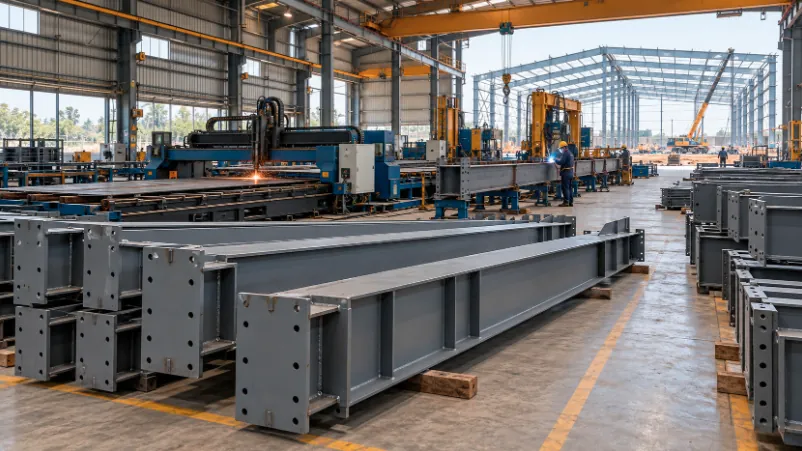
The pre-engineered building manufacturing process starts on the drawing board, not the shop floor. Design and detailing fix the size of every member before plates are cut. The core of the plant is the automatic welding line that joins plates into built-up sections, while purlins are roll formed in-house.
Quality is controlled at three points: weld quality, dimensional accuracy and paint dry film thickness (DFT). Design follows IS 800 and MBMA-type practice. Automatic welding lines and CNC cutting give consistent output, and finished members are dispatched for erection at site.
- Design and detailing
- Plate cutting
- Automatic welding of built-up sections (PEB line)
- Secondary member roll forming
- Shot blasting and painting
- Dispatch
- Site erection
Raw Materials and Machinery for a PEB Plant
Your main inputs are HR plates and coils, cold-formed purlin strips, roof and wall sheeting, bolts and paint. Steel is usually bought from integrated producers and service centres. On the machinery side, the PEB welding line, CNC cutting and the purlin roll former matter most, since they set your output and accuracy.
- CNC plasma or oxy-fuel cutting
- PEB welding line
- Straightening machine
- Purlin roll former
- Shot blasting
- Painting line
- Cranes
Licences and Approvals for a PEB Manufacturing Unit
Start with unit registration and a factory licence, then obtain consent to establish from the State Pollution Control Board before construction. Fabrication with painting is Green, but adding galvanising or pickling would move the unit to Red. Structural steel must meet IS 2062 under the steel QCO. Site erection also needs safety compliance under the building and construction workers' rules.
| Pollution category | Fabrication with painting: Green (CPCB S.No. 125); galvanising or pickling would be Red |
|---|---|
| HSN code | 9406 or 7308 (prefabricated buildings and structures) |
| GST | 18% |
| BIS / quality control order | Structural steel must meet IS 2062 under the steel QCO |
| Other licences | Factory licence; site safety under the building and construction workers' rules |
Choosing the Right PEB Plant Size
Plant size changes the project more than any other decision. Capacity typically runs from about 10,000 to 1,00,000 MT per year, and investment, land and manpower rise with it. A smaller unit suits a manufacturer serving regional sheds and warehouses. A larger plant needs more land, power and a steady order book, so it fits a developer with committed projects.
Our team tests each size against your market, steel buying ability and funds before you fix machinery.
Managing Seasonality and Working Capital
The monsoon slows site erection, so billing can bunch up in the drier months. Steel is the largest cost, and payment delays from customers lock up cash. Plan working capital for steel stock and for the gap between dispatch and payment. A project report that models this cycle helps you size the bank limit sensibly.
Government Schemes and Project Finance for PEB Manufacturing
PEB makers benefit from demand created by logistics parks, PM Gati Shakti and industrial corridors. For finance, lenders look for a clear project report. NPCS reports are used for bank loans and government programmes such as PMEGP, MSME schemes, Mudra and NABARD-linked projects, subject to each lender's requirements.
What Decides Success in a PEB Manufacturing Business
Good operators win on design capability, delivery time and smart steel buying. The risks are just as clear, and you should plan for them early.
- Steel price swings that squeeze fixed-price contracts
- Payment delays from developers and contractors
- Monsoon slowdowns in erection
- Steel scrap, which can be sold to recover value
How NPCS Helps You Set Up a PEB Manufacturing Plant
We tie our services to the decisions you face: capacity, welding and cutting technology, machinery and vendors, plant layout and approvals. Our team also supports installation and commissioning assistance. We prepare detailed and bankable project reports and techno-economic feasibility studies, customised to your capacity, budget and location.
NPCS's published client list records 17 assignments across engineering and industrial equipment projects between 2012 and 2025, for clients in 11 states.
What Your Pre-Engineered Building Manufacturing Project Report Covers
- Project introduction and BIS specifications
- Manufacturing process with flow sheet
- Market survey (demand, imports/exports, existing units)
- Personnel
- Plant and machinery with suppliers
- Land and building with layout
- Raw materials with sources and rates
- Financials (project cost, working capital, cost of production, profitability, break-even, 5–10 year cash flow, projected balance sheet, IRR/NPV/payback)
Pre-Engineered Building Manufacturing: Frequently Asked Questions
How much investment is needed to start pre-engineered building manufacturing?
Investment typically ranges from about ₹40–250 crore, depending on capacity. This is an indicative figure and excludes land. Your project report works out the exact cost for your capacity, machinery and location.
Which licences and pollution category apply to a PEB plant?
You need a factory licence and consent from the State Pollution Control Board. Fabrication with painting is Green, while galvanising or pickling would be Red. Structural steel must meet IS 2062 under the steel QCO.
How much land and power does a PEB unit need?
A PEB unit typically needs about 10–30 acres of land and a power load of about 1–4 MW. Water need is low. Actual figures depend on your capacity and layout.
How to start pre-engineered building manufacturing?
Begin with a feasibility study to fix capacity, products and location. Then secure registration, factory licence and consent to establish, order machinery and arrange steel supply. A bankable project report helps you raise finance along the way.
How can a pre-engineered building manufacturing consultant help me?
A consultant helps you choose capacity, technology and machinery, plan approvals and prepare a project report for lenders. NPCS has worked since 1994 and also supports vendor selection, plant layout and commissioning assistance.