


The Wax and Polish Industry: Bigger Than Most People Realise
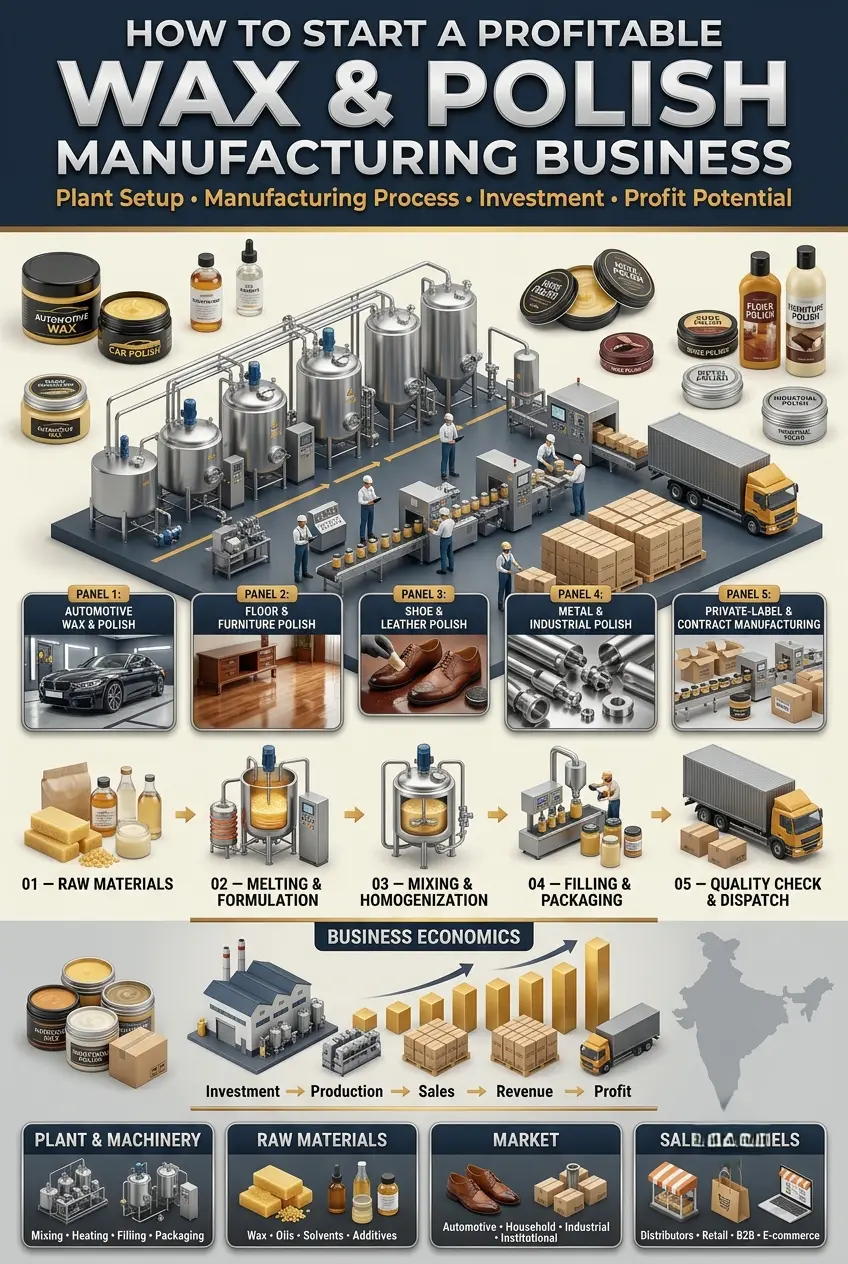
Walk through any Indian hardware store, supermarket, or automobile accessories shop and you will find them on the shelves – shoe polishes, floor waxes, furniture care products, metal cleaners, auto polishes. Consumers buy these products daily, but behind each tube, tin or spray bottle, a chemical formulation industry quietly grows into one of India’s promising small scale manufacturing opportunities.
Globally, the wax market was valued at USD 9.69 billion 2022 and expected to reach USD 14.16 billion by 2031, growing at a CAGR of 4.3%. India’s domestic wax market is growing faster (approx. 4.5% annually up to 2032) driven by rising consumption in packaging, cosmetics, candle manufacturing, automobile care, and industrial applications. The furniture polish market (USD 10.96 billion globally in 2024) is growing at 7.2% annually whereas shoe polish – a segment many consider mature – will grow from USD 14.72 billion to USD 31.03 billion by 2032 (CAGR of 8.64%) as rising formal footwear adoption and urbanization drive growth in developing markets including India…
These are not niche numbers. They represent real, recurring, and scalable demand for products that Indian manufacturers can produce at small and medium scale with relatively modest capital investment — which is precisely why this sector deserves serious attention from Indian entrepreneurs and MSME promoters.
Why Wax and Polish Manufacturing Makes Sense for Indian MSMEs
India has a structural advantage in the area. It is one of the world’s largest producers of beeswax and has access to key raw materials (paraffin wax, carnauba wax, silicone compounds, abrasive minerals, natural solvents). Moreover, India can tap into domestic and import supply chains to manufacture products at small scale with relatively compact machinery footprints. This allows manufacturers to serve both B2C retail markets and B2B industrial buyers.
The Ministry of Micro, Small and Medium Enterprises has support programmes for chemical manufacturing units including credit-linked capital subsidy schemes, technology upgradation, and priority sector lending. Under the PM Vishwakarma scheme and various state-level ODOP (One District One Product) initiatives, artisan-scale formulation and finishing businesses are being encouraged. The wax and polish sector (both traditional craft and industrial chemistry) fits squarely in the target priorities of these initiatives.
India’s Agricultural and Processed Food Products Export Development Authority and the Chemicals and Petrochemicals Manufacturing Association have both highlighted specialty chemical formulations as an export opportunity. Floor waxes, automotive polishes, and industrial abrasive compounds from Indian manufacturers are finding buyers in Africa, the Middle East, and Southeast Asia. Indian pricing is competitive, and quality standards are generally accepted.
What are the biggest barriers to entry for would-be manufacturers?
The biggest barriers are usually the availability of detailed technical knowledge. How exactly is a stable wax emulsion prepared? What abrasive ratio will produce the best result in a metal polish without scratching the surface? How is carnauba wax processed and blended to achieve the right melting point and gloss level? How is a shoe polish formulated for different leather types and climate conditions? These are questions that require access to tested formulations and documentation that most publicly available sources do not typically cover.
India’s Growing Polish Market: Segment by Segment
Automobile polish is one of the fastest-moving segments. India now has over 300 million registered vehicles, and car ownership continues to grow. The detailing and automotive care market is professionalising rapidly — from roadside garages to organised car spa chains. Demand for quality auto wax, compound, and paint protection products is rising in direct proportion to vehicle ownership and consumer spending on vehicle aesthetics.
Furniture polish demand closely links to the housing and real estate sector, which has grown steadily post-pandemic, while consumers increasingly use silicone-based furniture polishes, oil polishes and spray polishes as organised retail furniture brands expand across Tier 2 and Tier 3 cities. India’s furniture industry is growing at over 12% annually according to the Ministry of Commerce and Industry creating a consistent pull for finishing and care products.
Shoe polish remains a high-volume everyday category for India, particularly in industrial, defense and formal workplace settings. Leather goods (bags, belts, saddles, upholstery) all require periodic treatment products and the addressable market extends beyond footwear.
Metal polish and abrasive compounds serve the engineering, fabrication and jewellery manufacturing industries. India’s jewellery sector (supported by the Gem and Jewellery Export Promotion Council) employs millions of artisans who regularly use polishing compounds and abrasive media.
Floor wax and floor care products represent a more institutionalised segment in terms of demand with hospitals, hotels, airports, office buildings, and commercial complexes all contributing to the pull. As India’s service sector infrastructure grows the institutional market for high grade floor treatment chemicals is growing.

Introducing the Book: The Most Comprehensive Wax and Polishes Technology Reference Available
The Complete Technology Book on Wax and Polishes (Formulae, Manufacturing Processes with Machinery & Equipment Details) – 2nd Revised Edition, is authored by P. K. Chattopadhyay and published by Asia Pacific Business Press Inc. It is a definitive technical and commercial reference for professionals and entrepreneurs entering this industry.
At 536 pages this is not a general overview but a working manual. The book compiles over 500 tested formulations and production processes. It also covers raw material specifications, equipment selection, plant layout principles, and process flow charts. Manufacturers can reference and adapt these resources directly.
The scope of coverage is truly comprehensive. On the wax science side, the book covers vegetable waxes. These include carnauba, candelilla, Japan wax, rice-oil wax, sugar cane wax, and ouricury. It also covers their adulterations, grades, and properties. Mineral waxes include paraffin, microcrystalline, montan, ozocerite, peat, and Fischer-Tropsch waxes. The book covers these waxes in technical depth. It also explains their compatibility with other substances and industrial applications. Chemically modified and synthetic waxes – including Duroxon series and polymer wax compounds – document their specific performance characteristics.
On the formulation side the book is exceptional. Readers will find detailed, step-by-step recipes for:
- Shoe polishes – paste, cream, liquid – black, brown, white, and coloured – including specialties for patent leather, suede, and rubber footwear
- Furniture polishes – oil-based, silicone, aerosol, paste, and spray-type – including perfume formulations for furniture polish
- Automobile polishes – paste compounds, rubbing compounds, hand-rubbing polishes, haze removers, and silicone auto polishes
- Metal polishes – for brass, nickel, chrome, silver, aluminium, steel, and mixed metals – including specialised barrel tumbling and buffing compositions
- Floor polishes and waxes – emulsion types, solvent types, bright-drying, rubless, water-resistant, and insecticidal variants
- Leather polishes and dressings – including belt polishes, leather finish coatings, and specialty edge polishes
- Abrasive compounds – grinding pastes, lapping compounds, diamond dust formulations, and optical glass polishes
- Specialty products – ski wax, stove polishes, dance floor waxes, glass wax polish, gold polish, and many more
The second revised edition also features updated photographs of machinery and equipment. It includes supplier contact details, making it a valuable resource for anyone setting up a manufacturing unit. Process flow charts and plant layout guidance are also provided. These help ensure that the production setup can be planned efficiently from the outset.
Who Will Benefit Most From This Book
The book is written for practitioners and not theorists. Moreover, First-time entrepreneurs planning a speciality chemical manufacturing project will find the technical formulations and business context they need in one place. Additionally, Small manufacturers can also diversify their product range. For example, a candle maker can add floor wax. Similarly, A cosmetics formulator can add metal polish. Furthermore, They will find ready-made recipes and practical guidance. In addition, Chemical engineers and R&D professionals working in related industries will find the breadth of formulation data useful for product development. Likewise, Students of chemistry, chemical engineering, and industrial management will find this a reliable reference for project work and industry orientation. Moreover, Bank loan officers and consultants assessing project reports for wax and polish manufacturing units will find the technical content and production data directly usable in techno-economic analysis.
In contrast, What sets this book apart from chemistry textbooks or online formula databases is that it has a focus on manufacturing. Furthermore, Every formulation comes with context. For instance, It covers the materials, mixing procedure, quality outcome, and sometimes the specific application or trade scenario it addresses. Overall, It reads like it was written by someone who has spent time on the factory floor, not just in a laboratory.
5 Authentic Government Reference Links
- Ministry of MSME — Schemes and Incentives for Small Manufacturers, Government of India
- Ministry of Commerce and Industry — Chemicals and Petrochemicals Policy, Government of India
- APEDA — Export Promotion for Processed Chemical and Specialty Products, Government of India
- Gem and Jewellery Export Promotion Council (GJEPC) — Polishing and Finishing Industry
- Invest India — Manufacturing Opportunities in Specialty Chemicals Sector
Purchase This Book
The Complete Technology Book on Wax and Polishes (Formulae, Manufacturing Processes with Machinery & Equipment Details) – 2nd Revised Edition is now available from Asia Pacific Business Press Inc. / Niir Project Consultancy Services. Whether you are setting up a manufacturing unit, diversifying an existing chemical business, or need a comprehensive technical reference for formulation and production work, this is the one book that covers the entire wax and polish industry from raw material to finished product.
Buy directly from the publisher:
→ NIIR.org — Official Book Page: https://www.niir.org/books/book/complete-technology-book-on-wax-polishes-formulae-manufacturing-processes-with-machinery-equipment-details-2nd-revised-edition/isbn-9788195370115/zb,,10d,a,0,0,a/index.html
→ Amazon India: https://www.amazon.in/dp/8178330121
Published by Asia Pacific Business Press Inc. (APBP), New Delhi — a sister organisation of NIIR Project Consultancy Services (NPCS). NPCS is an ISO 9001:2015 certified industrial consultancy with 30+ years of experience, 150,000+ project reports delivered across 85 countries. For project consultancy, techno-economic feasibility reports, or bulk book orders, visit niir.org.

Your Investment Deserves the Right Opportunity
Every serious investment begins with choosing the right sector and the right business model. With hundreds of industrial opportunities available across India’s manufacturing and clean-energy landscape, making the most informed choice is critical. NPCS Startup Selector tool helps entrepreneurs, MSMEs, and investors identify the most suitable business opportunities based on their investment capacity, location, and inter