


Virudhunagar textile business opportunities
The man-made fibre (MMF) industry in India is one of the fastest-growing and competitive textile markets in the world, and a ₹1,000-crore prospectus announcement has thrown a curve ball at all concerned. Indian Textile Magazine reports that Pallavaa Group, one of the country’s biggest producers of MMF yarns and fabrics, is constructing its second-of-its-kind integrated manufacturing plant at PM-MITRA Textile Park in Virudhunagar, Tamil Nadu.
This is NOT a capacity increment. A full vertically integrated complex with the ability to spin, weave, knit and process all of this in one place, under the roof of green energy, with world-class plug-and-play facilities and targeting the global market.
This one-time investment marks one seismic shift in the market: The demand for man-made fibres, sustainable fabrics and ancillary manufacturing services will skyrocket in Tamil Nadu and elsewhere for entrepreneurs, MSME manufacturers, investors and startup founders. A project this size requires a supply chain, which includes packaging, industrial chemicals, machine components and more — and it’s not something that one company can create alone. That gap is your opportunity to build a business.
Access Complete Business Plan: Technical Textiles Manufacturing Projects
What Recent Reporting Means for Entrepreneurs
The news article posted by Indian Textile Magazine offers a glimpse into the entry of the Pallavaa Group, which has five decades of MMF experience and eight manufacturing units in Pallapalayam, into the PM-MITRA Textile Park in Virudhunagar.
The project is not a greenfield project. It currently has a daily yarn production capacity of 330 tonnes and 600,000 metres of fabric and is amongst the biggest vortex yarn manufacturers in the world except China, exporting to more than 40 countries. An operator at this scale doesn’t arrive on its own when he or she starts a new integrated complex. It comes in with a procurement budget, a short-list of suppliers and a strong requirement for dozens of ancillary services.
Why This Matters for Stakeholders
- Entrepreneurs: A ₹1,000 crore anchor project generates at least a five- to eightfold of the demand in its upstream and downstream suppliers.
- MSMEs: The accessories used in spinning mills, finishing chemicals, dye auxiliaries and textile machinery spares are all hot commodities in and around the park.
- Manufacturers: Virudhunagar PM-MITRA Park with infrastructure in place 1,000+ acres. Ancillary suppliers can be accommodated on adjoining plots and industrial sheds.
- Investors: MMF segment (Viscose, Modal, Lyocell and vortex spun blends) is under penetrated globally. Ancillary manufacturing wins long-term contracts for the first movers.
- Exporters: Pallavaa is already exporting to 40+ countries. Sellers of ancillary products that satisfy their quality requirements benefit from an indirect export route, without having to establish their own export structure.
- These are service plays in the high margin, low cap-ex side of services for Startup Founders, with technologies applying in the textile park ecosystem, such as quality testing technologies, chemical traceability platforms, and logistics aggregation.
The message sent by Indian Textile Magazine is evident: this investment is a quantum leap for Pallavaa, and a catalyst for dozens of neighboring businesses that will make it run.
Why India’s Man-Made Fibre Industry Is Growing Rapidly
The textiles industry accounts for about 2.3% of India’s GDP, has a direct employment of more than 45 million people and generates foreign exchange of billions of dollars every year. In this, the biggest is the man-made fibre sub-sector, for obvious reasons.
There is a growing demand on global brands for a supply of sustainable, traceable and uniform quality fabrics. Cotton supply is sensitive to weather fluctuations and MMF products (such as viscose, modal, lyocell, bamboo blends) have superior moisture management properties, eco-friendliness and uniformity of fibre. However, the fast-changing fashion brands in Europe and North America are aggressively moving towards sourcing in blended and MMF fabrics.
India has a large pool of skilled labour and has developed the clusters of spinning (Coimbatore, Pallipalayam, Erode, Surat, Bhilwara), and has excellent potential to benefit from this trend due to better infrastructure. The plant at Virudhunagar by Pallavaa Group, which aims to achieve carbon neutral status by 2035, and relies on almost 90% green energy further strengthens India’s sustainability credentials with global buyers.
For MSMEs in the textile value chain, the growth journey is a long one. PM-MITRA parks program has been formulated with a very clear intent to create “ecosystems” by aggregating textiles and establish “ecosystem density” — or ecosystem of units becoming a powerhouse for a supply chain.
Related Article: Top 3 Textile Manufacturing Business Opportunities Backed by PLI Scheme
Government Policies & Incentives Supporting Textile Manufacturing
The integrated textile manufacturing is now being supported by multiple policy levers both at the central government and state government level of Tamil Nadu. The following information is important for the attention of the entrepreneurs and MSME investors:
PM-MITRA (Production Linked Incentive for Textiles — MITRA Parks)
Ministry of Textiles is creating 7 PM-MITRA Mega Integrated Textiles Region and Apparels Parks in India. The Virudhunagar park, which Pallavaa is investing in, provides plug-and-play sheds, uninterrupted power, a zero-liquid-discharge water treatment plant and housing for workers. Applicants of MSME can apply for sheds at a subsidized rate.
PLI Scheme for Textiles
The Production Linked Incentive Scheme is launched by the Ministry of Textiles under the PLI Portal in the country that offers 3–15% incentive on incremental sales of MMF fabrics, garments, and technical textiles. The incentives are available for 5 years for eligible manufacturers who make man-made fibre-based products.
MSME Credit Guarantee Scheme
The Ministry of MSME – CGTMSE offers collateral-free credit guarantees to MSME manufacturing units with a limit of ₹5 crore under the Credit Guarantee Fund Trust for Micro and Small Enterprises. This is important for ancillary suppliers establishing themselves in the vicinity of the park.
PMEGP — Prime Minister’s Employment Generation Programme
The scheme, available at KVIC – PMEGP Portal offers 15-35% margin money subsidy for manufacturing units in rural and semi-urban sector, directly applicable for new textile ancillary units in Virudhunagar district.
Tamil Nadu Textile Policy
The Government of Tamil Nadu provides more incentives to the textile manufacturers for setting up their units in the state under the Guidance Tamil Nadu — Invest Tamil Nadu (GTI-TN) which include waiver of stamp duty, capital subsidy and power tariff concession to textile manufacturers. Virudhunagar is a priority zone under the policy — PM-MITRA park.
Make in India — Textiles
Make in India — Textiles Sector portal is a single window to understand licensing, infrastructure and investment facilitation services for the textile manufacturing sector.
SIDBI — Credit for MSMEs
Small Industries Development Bank of India (SIDBI) offers targeted credit lines to MSME manufacturers in textiles industry, such as working capital for import of raw materials like yarn, machinery financing, export credit facilities etc.
Invest India — Textile Sector
The Invest India — Textile Sector enables FDI and domestic investment in the textile sector, provides advisory on incentive stacking and also supports with navigation in the regulatory processes for new manufacturing units.
EEPC India — Export Support for Machinery and Components
The EEPC India export facilitation services can be utilized by ancillary manufacturers engaged in production of precision components for textile machinery and get access to various export trade fairs and buyer-seller meets organized around the world.

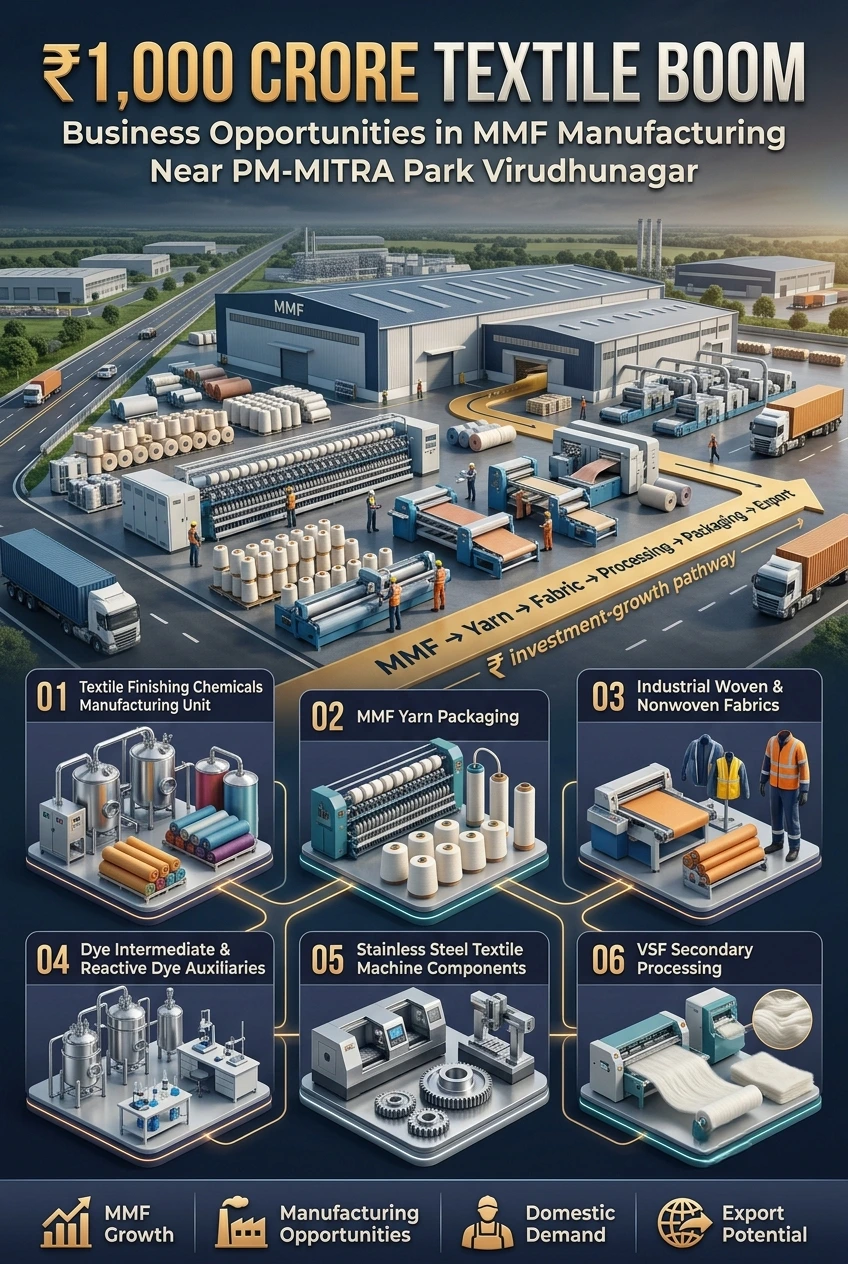
Manufacturing Business Opportunities Directly Linked to the Pallavaa Investment
1. Textile Finishing Chemicals Manufacturing Unit
A lot of finishing chemicals are needed for every integrated textile unit where there are processing activities – such as Pallavaa’s new unit in Virudhunagar – including softeners, optical brighteners, anti-wicking agents, handle modifiers and flame retardants. General specialty chemicals manufacturing unit of small and mid-scale, situated within 50 km of PM-MITRA Park, can enter into long-term contracts. The investment amount in a basic formulation and blending unit is on the higher side of ₹80 to 200 lakhs and the margin is 18 to 28%. Unlike cotton, the MMF processing segment requires special low-alkali, enzyme compatible finishes, a specialty which is not well served by the big chemical companies in smaller textile clusters.
Explore This Book: The Complete Technology Book on Textile Spinning, Weaving, Finishing and Printing
2. Man-Made Fibre Yarn Packaging (Cone, Bobbin, Tube Manufacturing)
A giant appetite for paper cones, plastic bobbins, yarn tubes and corrugated yarn packaging boxes exists at a 330-tonne-per-day yarn operation. At present, majority of the Yarn manufacturers in Pallipalayam, Erode cluster get these from the remote sources which involves the added logistical cost and lead time. The establishment of a paper cone and bobbin manufacturing unit close to the PM MITRA park in Virudhunagar has assured market from anchor tenants such as Pallavaa and others who are going to occupy the park. Access to investment is made easier — a 1-tonne per day paper cone unit can be built for around ₹40-75 lakh, while demand from a single big yarn producer would easily be sufficient to use up the capacity.
3. Industrial Woven and Nonwoven Fabric Manufacturing for Protective Workwear
A textile complex with thousands of employees creates steady demand for protective clothing, aprons, glove liners, caps, and industrial workwear. This niche is often overlooked in mainstream fabric manufacturing. A small technical textile manufacturer can supply polypropylene spunbond nonwoven fabric to institutional buyers. Woven polycotton workwear fabric can also be supplied to industrial parks in Tamil Nadu. The Ministry of Textiles’ PLI scheme for technical textiles lists eligible nonwoven manufacturers. This can help reduce the effective investment cost.
4. Dye Intermediate and Reactive Dye Auxiliaries Unit
Reactive dyes, levelling agents and fixatives are used in large quantities in MMF spinning and processing, especially viscose and modal. In the national market, larger dye manufacturers control the market while the smaller auxiliary chemical formulation units can cater to the regional clusters with quicker response, lesser MOQs and formulation support. The estimated cost of setting up a textile dye auxiliary formulation unit ranges from ₹60–150 lakh, while the operating margin typically ranges from 22–32%. Entrepreneurs can achieve the break-even point within 24–30 months by securing supply contracts with one or two anchor producers. This geography offers an ideal location for the growing MMF processing industry in Virudhunagar.
Get Detailed Insights from This Book: Modern Technology of Textile Dyes & Pigments
5. Stainless Steel Textile Machine Components and Spares Fabrication
Stainless steel and engineering-grade polymer parts are widely used in spinning machines. These include rotor blades, nozzles, guide rings, needle beds, and selvedge devices. Vortex spinning machines, rapier looms, and circular knitting machines require frequent replacement of these parts.
Pallavaa alone has more than 200 vortex machines. This creates a strong demand for reliable replacement parts. A precision fabrication facility can serve this growing need. It can manufacture certified replacement parts for textile machinery. A reconditioning and refurbishing service can also be a profitable business opportunity.
The cost of a CNC machining and precision fabrication cell starts at Rs 1.5 to 3 crore. The gross margin in the spare parts supply business can range from 25 percent to 40 percent. This business also offers export opportunities. Vortex machine spares are in demand across Southeast Asia.
6. Viscose Staple Fibre (VSF) Secondary Processing and Pre-Opening Unit
Viscose staple fibre (VSF) is supplied to spinning mills in compressed bales. These bales must be opened, blended, and pre-processed before spinning. A fibre pre-opening and blending unit can serve MSME entrepreneurs as a mid-level service business. It can operate between VSF producers, such as Grasim (Birla Cellulose), and downstream spinners. This makes it a relatively low-complexity fibre business with high volume and rapid asset turnover. The investment cost is also relatively low, at around ₹50–90 lakh for basic infrastructure. The product is standardised, which simplifies operations and quality management. Demand is expected to remain regular as new spinning units enter PM-MITRA parks. It is a mundane, basic supply-chain service, which is what makes textile clusters profitable.
Import–Export Opportunity Analysis
Export Markets for MMF-Based Products
Pallavaa already exports to 40+ countries and is currently exporting viscose, modal, lyocell, bamboo and blended yarns and fabrics. Furthermore, This will be enhanced by the new Virudhunagar facility. Ancillary manufacturers providing to Pallavaa or other PM-MITRA park tenants get an indirect export pathway: the quality standards that the global customers demand of Pallavaa seep up through the chain of manufacturers.
In addition, There are also direct export possibilities for yarn packaging, specialty finishing chemicals, and textile machine components (especially to the ASEAN countries, Bangladesh, Vietnam, and Sri Lanka, where the textile clusters are dependent on Indian suppliers for many intermediate goods). APEDA & EEPC India organise buyer-seller meets in these geographies.
Import Substitution
Heavy shipments of special textile chemicals, high-tech vortex machine parts, and precision knitting needles are currently being imported into India. The growth of the PM-MITRA ecosystem is creating strong domestic demand at scale. This demand can support import-substitution manufacturing units that previously lacked sufficient scale.
For instance, India imports more than 60% of its optical brightening agents (OBAs). It also imports several specialty softeners. This creates a clear opportunity for domestic manufacturing.
A domestic formulation unit (DFT) could help replace imports at a meaningful scale within 18–24 months. Such a unit can be established by leveraging the growing textile manufacturing cluster in Tamil Nadu.
International Demand and Trade Opportunities
Global demand for sustainable MMF textiles — particularly viscose and modal, which are biodegradable alternatives to synthetic polyester — is accelerating. The EU’s Strategy for Sustainable and Circular Textiles, implemented through 2025–2026, is pushing European brands to phase out virgin polyester in favour of certified viscose, modal, and recycled blends. India, as a major viscose spinner and processor, stands to benefit enormously. Businesses that can certify their production to OEKO-TEX STANDARD 100, Bluesign, or Global Recycled Standard (GRS) and supply into this ecosystem will command premium pricing.
Indian MSME Success Stories in the MMF Textile Ecosystem
Loyal Textile Mills — Virudhunagar
Loyal Textile Mills, headquartered in Virudhunagar, is a publicly listed integrated textile manufacturer. It started with cotton spinning and expanded into MMF blended fabrics over two decades. Its growth shows that Virudhunagar already has a strong textile ecosystem. The region has skilled workers, reliable suppliers, and good logistics. This ecosystem can support integrated textile manufacturing at scale. This foundation was established well before the PM-MITRA park opened.
Pratibha Syntex — Pithampur, Madhya Pradesh
Pratibha Syntex is an MSME-origin company that built a vertically integrated knitting and dyeing operation serving global activewear brands. Starting with a small knitting unit, it climbed the value chain into sustainable fibres and today supplies to major international sportswear labels. Its trajectory — from MSME to global supplier — shows the path that ancillary manufacturers in the Virudhunagar ecosystem can aspire to.
Sutlej Textiles — Rajasthan and Beyond
Sutlej Textiles and Industries began as a state-government entity and was privatised into a dynamic MMF yarn producer. Today it operates 600,000 spindles and produces cotton, polyester, and viscose blended yarns, exporting to over 55 countries. Sutlej’s story illustrates how MMF-focused spinning companies can build durable global export books when paired with vertical integration and consistent quality investment.
Choose the right startup backed by real market demand
About NPCS — Niir Project Consultancy Services
Niir Project Consultancy Services (NPCS) is one of India’s leading industrial consultancy and project facilitation organisations, with over three decades of expertise in manufacturing project development across textiles, chemicals, food processing, and engineering industries.
NPCS supports entrepreneurs, MSMEs, and investors through the following services:
- Detailed Project Reports (DPRs) for bank finance and government scheme applications
- Market Research Reports covering sector sizing, demand forecasting, and competitor mapping
- Feasibility Studies for manufacturing investments, including techno-economic analysis and IRR calculations
- Technology Consultancy for process selection, plant layout, and equipment procurement
- MSME and Startup Advisory for licensing, registration, and scheme eligibility navigation
Entrepreneurs exploring the Virudhunagar PM-MITRA ecosystem can access sector-specific project reports and feasibility services at entrepreneurindia.co — the flagship publication and knowledge portal of the NPCS group.
Business Opportunity Data Snapshot
| Parameter | Details |
| Industry | Man-Made Fibre (MMF) Textiles — Spinning, Weaving, Knitting, Processing |
| Trigger Investment | ₹1,000 crore by Pallavaa Group at PM-MITRA Park, Virudhunagar, Tamil Nadu |
| Market Driver | Global shift from cotton to sustainable MMF (viscose, modal, lyocell); EU Sustainable Textile Strategy |
| Anchor Production Scale | 330 TPD yarn, 6,00,000 m/day fabric, ~200 vortex machines (Pallavaa current base) |
| MSME Opportunity | Finishing chemicals, yarn packaging, machine spares, VSF pre-processing, workwear fabrics, dye auxiliaries |
| Investment Range (MSMEs) | ₹40 lakh (small packaging unit) to ₹3 crore (precision fabrication cell) |
| Export Potential | Indirect export via Pallavaa supply chain (40+ countries); direct exports of chemicals and components to ASEAN/South Asia |
| Government Support | PM-MITRA Park, PLI for textiles, CGTMSE, PMEGP, Tamil Nadu Textile Policy, SIDBI credit lines |
| Sustainability Angle | Pallavaa carbon-neutral target by 2035; 90% green energy — creates quality bar for entire supplier ecosystem |
| Risk Level | Medium — dependent on park infrastructure timeline and Pallavaa ramp-up schedule |
| Growth Outlook | High — MMF global demand growing; PM-MITRA parks to attract multiple anchor investors in 2026–2028 |

Conclusion: Act Now — The Supply Chain Window Is Open
Pallavaa Group’s ₹1,000-crore investment at the PM-MITRA Textile Park in Virudhunagar is one of the most significant announcements in India’s man-made fibre sector in recent years. Moreover, Indian Textile Magazine highlights the group’s five decades of MMF expertise. In addition, The company also has an export presence across 40 countries. Its integrated manufacturing model further strengthens its position. The new investment will expand operations within a purpose-built infrastructure park. The park is designed to support a strong and connected supplier ecosystem.
For MSMEs and entrepreneurs, the opportunity window is not in the distant future. Currently, The Pallavaa facility will be under construction, and its procurement team will be building its supplier list, within months. Ancillary manufacturers who establish their operations — and their supplier relationships — during the construction and commissioning phase will be first in line for long-term supply contracts.
Overall, India’s global textile ambitions are being written one investment at a time. Pallavaa has written its ₹1,000-crore chapter at Virudhunagar. The next chapter belongs to the MSME ecosystem that supplies, supports, and scales alongside it.