


In Uttar Pradesh, a major policy-driven shift in the economics of freshwater pearls farming is taking place. The state government has announced that eligible farmers taking up pearl farming would receive a 60 per cent grant, thereby drastically reducing the entry barriers for a crop once thought of as niche, technical and capital intensive. Prayagraj district, known for its rich cultural heritage and agricultural capabilities, actively promotes this initiative as one of the key districts working to diversify the livelihoods of the agrarian community in Uttar Pradesh.
It is an event that needs careful observation for agri-business observers like entrepreneurs, manufacturers, processors and investors in India. Freshwater pearl farming is not just a farming activity; it is a gateway to a global market of pearl jewellery worth ₹34,000 crore+ of which India is moving towards to become a part in cultivation, processing, designing and export. Government support at this level can stimulate a realistic supply-side growth in an industry where domestic production has consistently been less than domestic and foreign demand.
Despite the challenges, pearl business is a lucrative proposition because of low capital intensity for production at per unit, short freshwater crop cycle, high market price realisation, and great potential for value addition. This article explores the implications of this policy thrust, the manufacturing and processing possibilities and how India’s entrepreneurs can systematically assess this industry.
What This Development Means for Indian Businesses
The offer of 60 per cent grant to farmers for pearl farming is not just a farm subsidy, it is a sign of one of the largest states in India making a structural shift to positioning freshwater aquaculture and pearl farming as a high-value enterprise. There are a number of downstream implications of interest to business planners and investors.
Second, this amount of a grant can impact the feasibility of a project. For a farmer or an “agri-entrepreneur,” who would have required ₹5 lakh just to establish a pearl farm, he now needs just ₹2 lakh be brought from his own resources. For MSMEs and self-help groups, this difference between participating and not participating in the opportunity.
Second, the expansion of freshwater pearl production in UP generates demand for industrial services, such as pearl processing units, grading and sorting factories, polishing equipment, cold-chain logistic companies, jewellery design studios, and trading companies for pearls. These each represent a business opportunity that is independent, but grows in proportion to the main farm business.
Third, those who have experience in aquaculture, fisheries, jewellery retail, handicrafts, agri-processing are well prepared to venture into related ventures. Sector naïve fishers can acquire sector skills through the ICAR training programmes and reachers of state fisheries departments. This is because both the farm and the supporting industry value chains are supported by the government’s subsidy and investment in education, which helps mitigate risk.
Related Article: Best Low-Stress Manufacturing Business Ideas for Retired Individuals That Generate Steady Monthly Income
Last but not least, India’s expanding pearl jewellery industry is growing at more than 11 per cent CAGR, and relies on a steady supply of quality cultured pearl products from within the country. This supply gap can be directly addressed by increasing UP production and reducing pearl imports from China and Japan, adding an additional commercial dimension to this project.
Why This Industry Could See Stronger Growth
India’s fresh water pearl farming industry is coming together to settle into a structurally positive phase, influenced by both domestic and global factors.
The demand side remains strong with Indian culture deeply ingrained in the popular traditions of weddings, festivals, and religious events, which drive the growth of the Indian pearl jewellery market. In Indian culture, pearls have a great symbolic meaning and they’ve been in demand both in urban and semi-urban area. As the availability of low-cost jewellery stores, both online and offline, has grown, their customer base has also increased substantially from the premium end. Custom shapes and religious iconography, created using the technique of nucleus implantation, are premium-priced.
On the demand side, India produces hardly any freshwater pearls, which is far less than the capacity. Progress is visible in a few states, such as Odisha, Bihar and Uttar Pradesh, but the organised sector remains at an early stage overall. This creates actual market space for new producers, unlike other agriculture sectors that have already developed further and now face squeezed margins because of overcapacity.
India shipped out $10.1 million in pearls in 2024, a huge leap from its rank of 19th position two years ago. The path followed, along with increased buyer interest in Hong Kong, the United States, Japan, Brazil, and Bahrain, is indicative of increased global awareness of the quality of Indian pearls. Government policies which encourage domestic production will help to stimulate this export path.
Infrastructure development, access to training through various institutions in the country such as ICAR-CIFA (Central Institute of Freshwater Aquaculture, Bhubaneswar), and the formalisation of pearl supply chain in the cooperative model are all contributing towards the creation of an attractive investment landscape.
Government Policies and Incentives
The state-level grant of 60 per cent in UP for pearl farming is based on the strong central government support to fisheries and aquaculture industry. It is important for entrepreneurs looking into this area to be familiar with the following policy frameworks:
As per the Blue Revolution scheme, the flagship central scheme Pradhan Mantri Matsya Sampada Yojana has been launched, which is the central scheme for aquaculture in the country, including pearl culture. The general category beneficiaries are eligible for up to 40 per cent central subsidy while those belonging to SC/ST and women beneficiaries are eligible for up to 60 per cent subsidy on approved unit cost. The Department of Fisheries, Ministry of Fisheries, Animal Husbandry and Dairying, is responsible for implementing PMMSY, which includes all the approvals and guidelines for aquaculture.
The UP Department of Fisheries runs state programmes and liaison with the central programmes for the purpose of subsidy disbursement in Uttar Pradesh particularly. Entrepreneurs wishing to avail the benefits of the state should register and apply on the department’s portal.
The Ministry of MSME provides different capital subsidies such as Credit Linked Capital Subsidy Scheme (CLCSS) and Prime Minister Employment Generation Programme (PMEGP) to MSME entrepreneurs who are interested in setting up processing or manufacturing units in relation with pearl farming. The Startup India portal also offers a one-stop solution for Startups in Agri-tech & Aquaculture on recognition, tax benefits and funding access.
Read the Complete Book Here: Our Books
The Uttar Pradesh Invest UP authority facilitates larger investments in the state, including agri-business clusters and aquaculture parks. Investors looking to set up sizeable processing and export-oriented units can explore single-window clearances through this body.
On the trade side, the Marine Products Export Development Authority (MPEDA) under the Ministry of Commerce provides market development support, quality certification assistance, and buyer-seller meets for aquaculture exporters. Pearl exporters can leverage MPEDA’s international linkages to identify overseas buyers. For broader export promotion, the Agricultural and Processed Food Products Export Development Authority (APEDA) covers processed and value-added agri products including pearl jewellery and pearl-based handicrafts.
Technical training, which is critical for successful pearl cultivation, is available through the ICAR-Central Institute of Freshwater Aquaculture (CIFA) in Bhubaneswar. CIFA conducts structured programmes on freshwater pearl culture, covering mussel selection, nucleus implantation, post-operative care, and harvesting — skills that are essential for both farmers and agri-entrepreneurs.

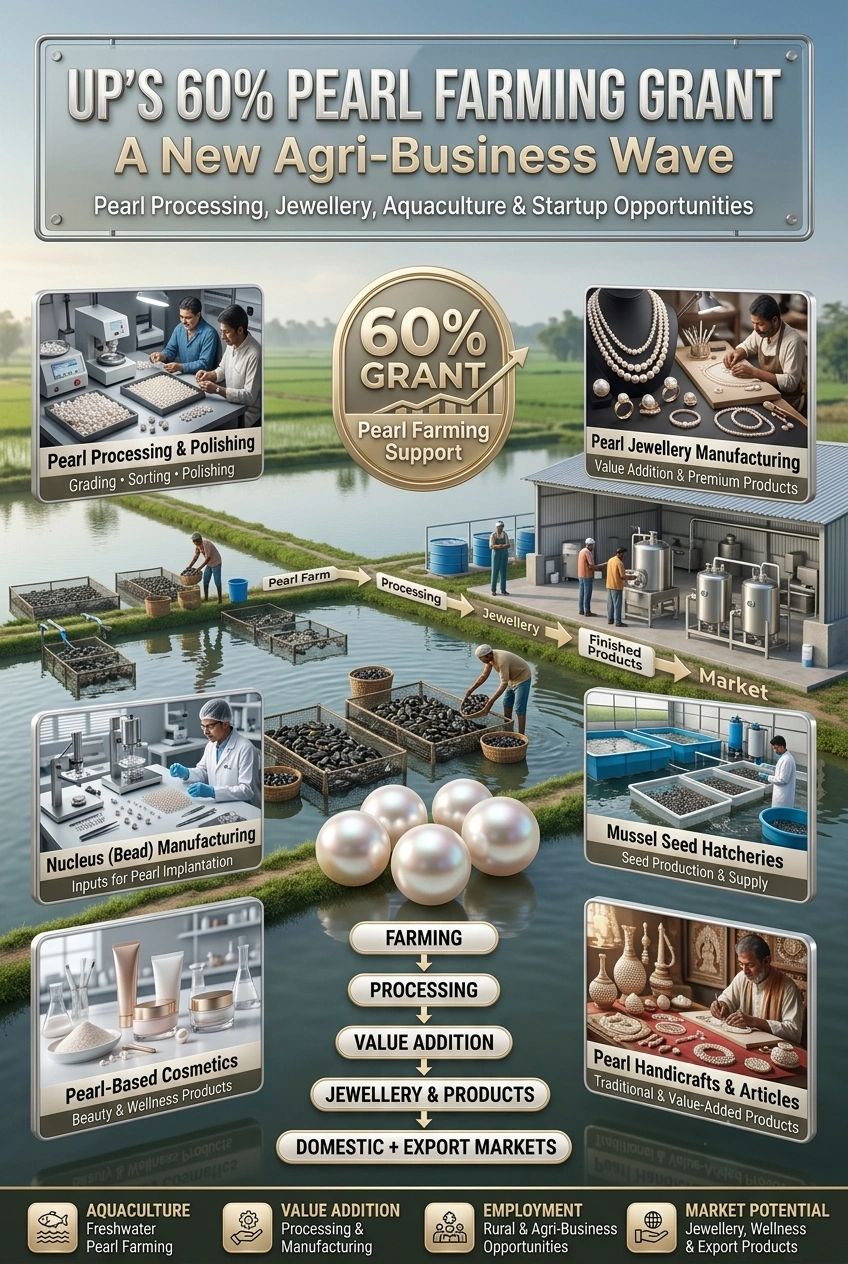
Manufacturing Business Opportunities Emerging From This Development
1. Pearl Processing and Polishing Units
Freshwater pearl farmers clean the harvest, sort the pearls according to size and lustre, treat their surfaces and polish them before sending them to the jewellery supply chain. The pearl processing unit connects the farmer and the jeweller. The demand for such units will also grow in UP as the production is on the up rise. These units are a lot more complex and demand-controlled environments, chemical processing, and trained personnel. The required investment for a small- to mid-scale facility is low, making these units suitable for MSME manufacturing. Businesses can also avail of additional incentives under PMMSY and state export promotion policies for export-oriented processing units.
2. Pearl Jewellery Manufacturing
India already exports substantial quantities of pearl jewellery and finished jewellery exports about 25 per cent of all pearls exported. The setting up of Pearl jewellery manufacturing units (Necklace, Earring, Pendant, Ring and Bracelets) close to the pearl farming cluster in UP can bring down the cost of supply chain. The demand for low-cost pearl jewellery, especially for marriages and religious ceremonies, is huge and increasing. Anyone with a design eye and access to retail distribution can create a growing enterprise that appeals to both home and foreign customers via platforms and trade shows. UP’s craftsmanship expertise in jewellery and handicrafts further mitigates the challenge of skilling of the labour force.
3. Nucleus (Bead) Manufacturing for Pearl Implantation
One of the most important ingredients in the pearl industry is the nucleus or the seed bead that is inserted into a mussel to cause it to form a pearl. As of now, India has imports from Japan and the USA for a considerable amount of nuclei. A home-based manufacturing unit that uses good quality shell materials such as the freshwater mussel shell or any other appropriate material, is an opportunity for import substitution with clear demand visibility. With more and more people becoming involved in domestic pearl farming, there will be an increasing demand for locally available good and consistent nuclei. This is a technical specialism position, with good margins and captive demand, in a growing market.
4. Mussel Seed Hatcheries and Oyster Supply Units
Healthy, young freshwater mussels are needed for pearl oysters to be raised. Currently, mussel farming is based on the collection of mussels from natural water bodies, which is not reliable and is ecologically unsustainable. Mussel hatchery and controlled broodstock are the major missing links in the freshwater pearl supply chain in India. The number of pearl farmers assisted by government grants is increasing and will be a market for the entrepreneurs who are able to produce certified healthy mussel seed in large quantities. This business would be appropriate for people with aquaculture experience and who have adequate water resources.
5. Pearl-Based Cosmetics and Health Product Manufacturing
6. Pearl Handicraft and Religious Pearl Article Manufacturing
ICAR-CIFA pioneered the technology for producing designer-shaped pearls resembling religious figures such as Lord Ganesha, Lord Shiva, and Buddha. These command high price in the domestic market particularly in the religious and spiritual gift market and are slowly starting to attract interest from outside India as unique Indian craft products. Establishment of small units producing and selling such specialised pearl articles is a business opportunity with high margin of profit and little competition, which is appropriate for the small manufacturers and entrepreneurial class of the artisan of culturally important districts such as Prayagraj.
Import-Export and International Market Opportunity
Export Opportunity
India’s pearl export has increased significantly, with export worth of $10.1 million in 2024 with countries like Hong Kong, the United States, Japan, Brazil, and Bahrain among the major destinations. India is gradually competing in the freshwater pearl segment that makes up about 60 per cent of the total pearl exports from the country. Freshwater pearls are a superior choice in fashion jewellery due to their wide range of shapes, colours and their price when compared to saltwater varieties of pearls.
With the expanding domestic supply, Indian exporters can take a boost in the value chain, that is, to export not only loose pearls but finished jewellery and designer pieces as well. Value added products to exports bring higher prices for exports and mitigate dependence on commodity-type exports. There are some channels that are available such as trade facilitation agencies such as MPEDA and APEDA, and buyer-seller interaction at international gem and jewellery fairs.
Get Detailed Project Report (DPR): Project Reports & Profiles
Import Substitution
India still imports many pearls from China and Japan, especially high-quality Akoya and South Sea pearls, along with nucleus beads that pearl farmers use in pearl farming. The development of domestic nucleus manufacturing capacity and incremental improvement of the quality of Indian freshwater pearls for the higher market segments meet both the supply security and trade balance goals. The objective of support specifically provided by the government and PMMSY is to bring about a decrease in this import dependency by building a stronger base of production.
Indian MSMEs and Startups in Related Industries
The value chain of the freshwater pearl industry already has a number of active MSMEs in India and their experience provides useful lessons for MSMEs entering the chain.
Bijnor, Uttar Pradesh: Bijender, a farmer from Dhampur village in UP’s Bijnor district, who moved his farming from dry land to freshwater pearl farming and achieved a significant income through pond farming of mussels. This experience has shown that pearl farming is indeed possible for smallholder farmers who have access to a water body and that return in the relatively small investments is possible. This experience can be used as a reference point to help entrepreneurs plan their projects.
Established Indian jewellery brand Bluestone and Melorra (Pearl Jewellery Retail Segment): They actively promote fresh water pearl jewellery to the mainstream market that comprises of middle class consumers, making the jewellery an affordable luxury. They did well, thus proving the domestic demand thesis and indicating that the volume-based freshwater jewellery, a product of the domestic farms, has a receptive and scalable consumer market in India. Anyone who can provide these and other retail outlets will be well-placed.
Hyderabad Pearl Trade Cluster: Hyderabad has a long-established pearl trading community centred around markets like Laad Bazaar near Charminar. This cluster represents the commercial infrastructure that processes, grades, and retails pearls at scale. New entrepreneurs in UP can evaluate how to develop similar supply-chain relationships with established Hyderabad traders, especially as fresh, certified UP-origin pearls become available in growing volumes.
What Entrepreneurs Should Evaluate Before Investing
Any entrepreneur or investor evaluating the pearl farming and related value-chain opportunities should conduct a structured feasibility assessment across the following parameters:
Market Demand: Assess both domestic jewellery demand in your target geography and potential export channels before committing capital. Pearl jewellery’s strong wedding and festival demand creates seasonal peaks — understand how your production cycle aligns with these market windows.
Raw Material (Mussel Seed) Access: Reliable access to healthy freshwater mussel seed is the foundational input. Evaluate proximity to natural water bodies, access to hatcheries, or feasibility of establishing your own mussel seed supply.
Technology and Training: Nucleus implantation is a skilled procedure. Arrange formal training from ICAR-CIFA or recognised state training centres before setting up operations. Technology competence directly determines pearl quality and yield.
Water Quality and Land: Pearl mussels require clean, oxygen-rich freshwater with stable pH levels. Conduct water quality testing of your proposed pond site before investing. Contaminated or chemically affected water bodies are a major risk factor.
Machinery and Equipment: Core requirements include surgical implantation tools, nylon cage systems, aeration equipment, water quality monitoring instruments, and harvesting and processing tools. Source these from verified aquaculture equipment suppliers.
Regulatory Requirements: Obtain clearances from the state fisheries department. If processing or exporting, ensure compliance with MPEDA or APEDA quality certification requirements.
Build a profitable business with the right idea
Working Capital: Pearl farming has a crop cycle of 12–18 months for freshwater varieties. Plan working capital for mussel feeding, water management, and operational costs during this period before revenue is realised.
Market Linkages: Establish buyer relationships before harvest — with local jewellers, aggregators, pearl traders, or direct export buyers. Unplanned inventory accumulation after harvest can erode margins.
Risk Management: Key risks include disease or mortality of mussel stock, water quality deterioration, and market price fluctuations. Diversification across multiple ponds and crop cycles mitigates concentration risk.
Scalability and Exit: Begin with a pilot-scale unit to validate operations before committing to large-scale investment. Pearl farming businesses with established supply chains and buyer relationships have viable exit or partnership opportunities with larger jewellery businesses.
How NPCS Can Help Entrepreneurs Evaluate the Opportunity
NPCS – Niir Project Consultancy Services has supported entrepreneurs and investors in evaluating agri-business, aquaculture, and manufacturing opportunities for over two decades. For entrepreneurs exploring the pearl farming and pearl value-chain space, NPCS offers a structured suite of advisory services.
Through Detailed Project Reports (DPRs) tailored to pearl farming, pearl processing, pearl jewellery manufacturing, and nucleus bead production, NPCS helps clients understand the full project economics — from capital expenditure and raw material requirements to revenue projections, profitability analysis, and government incentive mapping. Feasibility Studies conducted by NPCS provide an independent, data-driven assessment of whether a specific project in a given location makes commercial sense before any capital commitment.
NPCS also assists with Plant and Machinery Assessment, identifying appropriate suppliers and evaluating equipment costs for aquaculture and jewellery processing setups. Market Research reports on the freshwater pearl and pearl jewellery segment help entrepreneurs understand competitive dynamics, pricing benchmarks, and demand patterns before entering the market. For those seeking bank finance, NPCS supports the preparation of bankable project reports that meet institutional lending requirements.
Business Opportunity Snapshot
| Industry | Freshwater Pearl Farming, Pearl Processing, Pearl Jewellery Manufacturing |
| Market Driver | State government 60% grant, PMMSY support, rising domestic & export demand for pearls |
| Key Development | Uttar Pradesh (Prayagraj district focus) activating 60% grant for pearl farming to diversify farmer income |
| MSME Opportunity | Pearl processing units, jewellery manufacturing, nucleus bead production, mussel hatcheries, pearl cosmetics |
| Manufacturing Potential | High — multiple processing and value-addition stages from raw pearl to finished jewellery and cosmetics |
| Export Potential | Strong — India 13th largest pearl exporter (2024); key markets: Hong Kong, USA, Japan, Brazil, Bahrain |
| Import Substitution | Nucleus beads (currently imported), higher-grade cultured pearls; scope for domestic manufacturing |
| Government Support | PMMSY (40–60% central subsidy), UP state 60% grant, MPEDA, APEDA, MSME schemes |
| Investment Consideration | Low-to-moderate; freshwater pearl farm setup from ₹50,000–₹2 lakh per unit (net of subsidy); processing units higher |
| Risk Level | Moderate (biological risks, market price variability, water quality dependency) |
| Growth Outlook | Strong; India pearl exports grew from 19th to 13th position in two years; domestic pearl jewellery market growing at 11%+ CAGR |

Conclusion
Uttar Pradesh’s decision to extend a 60 percent grant for freshwater pearl farming marks a genuine inflection point for the sector. For a crop that has historically faced awareness gaps, capital barriers, and inadequate support infrastructure, this strong government commitment, supported by central-level schemes like PMMSY, creates the enabling conditions for meaningful scale.
The commercial opportunity is multidimensional: pearl farming itself becomes accessible to a broader population of farmers and entrepreneurs; adjacent businesses from processing to jewellery manufacturing gain a more reliable domestic supply base; export growth accelerates as Indian pearl quality and volumes improve; and import dependence on nucleus beads and high-grade pearls provides an additional domestic manufacturing opportunity.
For entrepreneurs, the opportunity window is now — early movers who develop technical competence, build supply-chain relationships, and position themselves for the export market will gain a stronger advantage as the sector matures. For investors, freshwater pearl businesses with integrated value chains represent a rare convergence of government support, rising export income, and an expanding domestic jewellery market.
The prudent path to participation is through rigorous evaluation: Market Research to understand demand and pricing, a Feasibility Study to assess specific project economics, a Detailed Project Report for structured planning and bank finance, and methodical Investment Planning before deployment. Those who take the time to plan well will be better prepared to benefit from the sustained expansion shaping India’s freshwater pearl sector.