


Uttar Pradesh just gave a strong message to all the MSMEs, manufacturers, and industrial investors in India. The Uttar Pradesh State Industrial Development Authority (UPSIDA) has cleared a ₹2,250 crore ambitious project to establish new industrial zones in the state and also to improve the infrastructure in the existing industrial estates, reported Swarajya Magazine on August 5, 2026.
The decision, which was made at UPSIDA’s annual board meeting presided by Additional Chief Secretary Alok Kumar II, is part of the authority’s massive budget of ₹8,000 crore for FY 2026-27. The plans for the layout of the industrial estate have been approved at sites Katayi mill, Fatehpur and Sandhi Nawa and Tris hundi in Ayodhya.
This is not only a policy declaration for the entrepreneurs and MSMEs, but a land and infrastructure opportunity that will only come once in a decade. If the State Government invests ₹2250 crore to create purpose built industrial zones, the early movers who have secured plots, established manufacturing units or secured anchor positions in the supply chain, secure long-term competitive edge over the late movers.
To fast track the development of new industrial areas and the expansion of existing ones, ‘strengthening of roads, power supply, water supply and drainage system’ will be given priority, said Additional Chief Secretary of Uttar Pradesh Alok Kumar II.
Get Detailed Project Report (DPR): Complete Guide to Business Opportunities in Uttar Pradesh
What Recent Reporting Means for Entrepreneurs
What Happened
UPSIDA’s board have approved a two-fold plan; first is to allocate ₹2,250 crore from its FY 2026-27 budget to find and develop new industrial estates, based on demand surveys and land price analysis; second was to fast-track the layout approvals for three specific estates, namely, Katayi Mill at Fatehpur, Sandhinawa at Ayodhya and Trishundi at Ayodhya. The authority also approved a new resumption policy for closed or sick industrial units, which involves the re-use of idle industrial land.
Why It Matters
Uttar Pradesh is now second largest economy of Uttar Pradesh by the way of Gross Domestic Product in India. This infrastructure investment directly attacks the one big constraint which has been preventing UP’s industrialisation for decades: the poor roads, unreliable power and lack of structured industrial areas. UPSIDA is already indicating that UP is ready to chip in with the existing industrial corridors in Gujarat, Maharashtra and Tamil Nadu, by spending a large chunk of its annual budget of more than 28% in the development of these new industrial areas.
Organised industrial estates for the MSMEs mean reduction in cost of operation. An in-house plot ensures a guaranteed power supply, a road access to the factory and a close proximity to other manufacturers in your value chain which are not available with comparable factory location cost.
Who Should Pay Attention
- Farmers seeking additional land on a cost-effective basis
- Entrepreneurs intending to start first generation manufacturing businesses
- Landowners and users of sheds and barns
- Logistics/warehousing companies looking for distribution centres based on UP.
- The exporters from North India for the markets of the Gulf, South Asia and Africa.
- Founders of hardware, precision engineering, & B2B manufacturing startups
The Swarajya Magazine report also states that UPSIDA has set a final deadline of November 7 for residential scheme allottees to finalise delayed lease deeds. This creates short-term urgency. Early investors can benefit from the newly approved layouts before demand-driven price inflation begins.
Why Industrial Infrastructure Investment in UP Is Growing
Structural shift in economic activities has taken place in Uttar Pradesh during the last 5 years. The state has hosted two investment summits. Both events attracted investment pledges worth several lakh crore rupees. MSME activity has also increased significantly in districts such as Agra (footwear and leather), Varanasi (textiles and handicrafts), Moradabad (brass goods), Meerut (sporting goods), and Kanpur (chemicals and leather). UPSIDA has also established new industrial estates in Fatehpur and Ayodhya. These estates provide access to organised industrial infrastructure in previously underserved areas.
Ayodhya’s strategic value is priceless. After the Ram Temple was inaugurated and the state is promoting it as a pilgrimage-tourism centre, Ayodhya has now become the subject of considerable investment in real estate and infrastructure. Manufacturing companies can take advantage of the growing connectivity and consumer economy of the district with the help of new industrial estates at Sandhinawa and Trishundi, which will enable them to pay premium land costs in city-centre areas.
The production linked incentive (PLI) schemes of the Centre, PM Vishwakarma scheme for traditional artisans, One District One Product (ODOP) programme provide a structured demand for manufacturing capacity which is the very kind of zone that UPSIDA is now coming up with. Time is purposeful and well-planned.
Government Policies & Incentives You Must Know
Capital subsidy of up to 25% for general category, 35% for women & SC/ST entrepreneurs, interest subsidy and GST reimbursement for MSME units set up in the state are available under the UP MSME Policy 2022.
To ensure that entrepreneurs are not defrauded by the speculative price during initial land-allotment, UPSIDA’s plot allotment system is managed by the official portal of UPSIDA.To keep entrepreneurs from the speculative price during the first round of allotment of plots, UPSIDA’s plot allotment system is managed through the UPSIDA official portal.
There are other layers of policy support:
- Subsidised loans of ₹50 lakh for manufacturing under PMEGP (Prime Minister Employment Generation Programme)
- PM Vishwakarma Scheme – Skill development and credit assistance for artisans engaged in traditional fields in Ayodhya and Varanasi belts of the city
- These are related to the marketing and cluster-development support for district-specific products (ODOP)
- The credit facilitation of the MSMEs for purchasing raw materials by NSIC.
- Export promotion programmes of EPCH, APEDA and CLE for handicrafts, agri-products and leather respectively
Entrepreneurs seeking project financing can also access the SIDBI MSME Loan portal for collateral-free credit under the Credit Guarantee Fund Trust for Micro and Small Enterprises (CGTMSE).
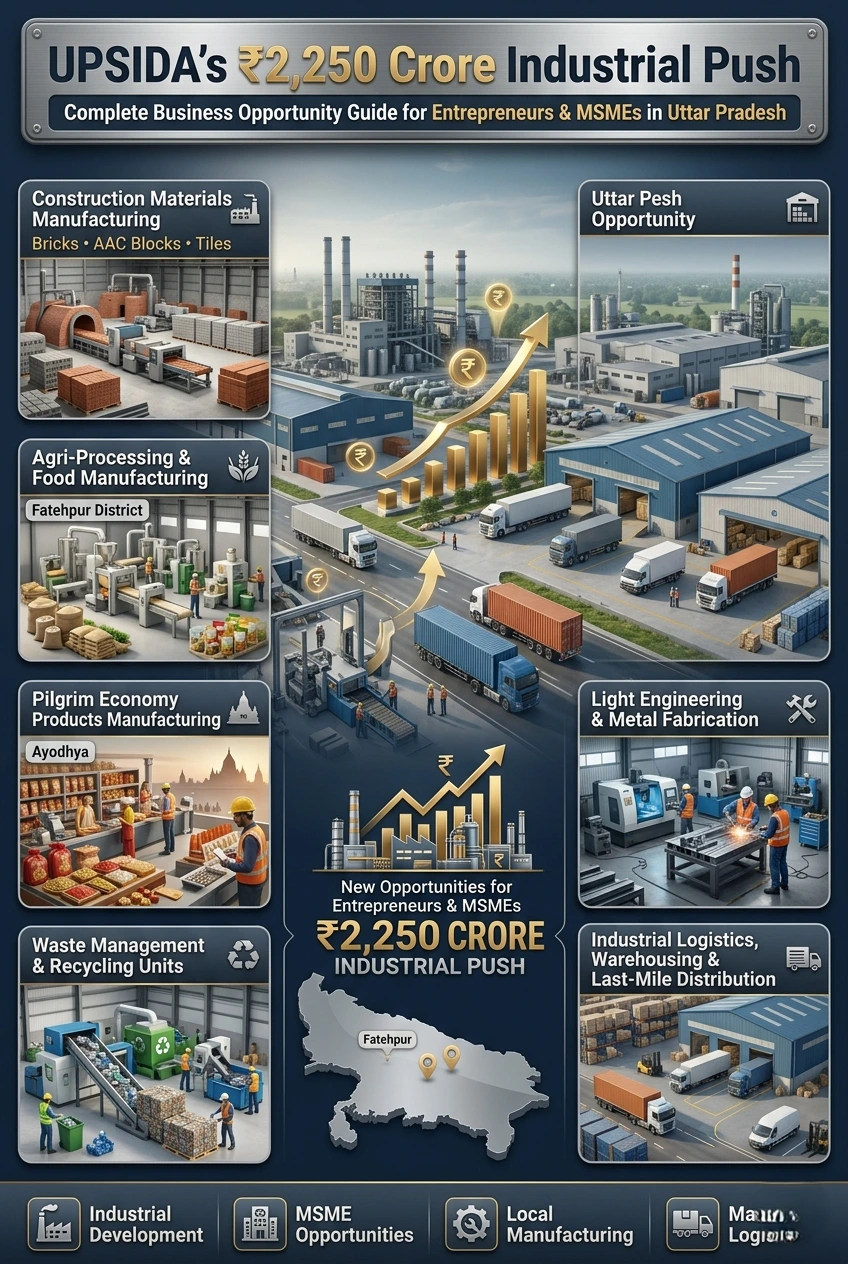
6 Manufacturing Business Opportunities Directly Linked to This Development
Specifically, the following opportunities are based on the features that the UPSIDA approved plan has created, such as organised industrial plots, reliable infrastructure, and government-backed industrial zones in the districts of Fatehpur and Ayodhya.
1. Construction Materials Manufacturing (Bricks, AAC Blocks, Tiles)
Why This Emerges from This News
The construction of three industrial estates will require large quantities of materials, including blocks, tiles, paving materials, drainage pipes and prefabricated products. Units within or near UPSIDA estates can supply these materials directly. They can later expand into the wider construction market as residential and commercial development grows.
Get Detailed Insights from This Book: The Complete Book on Construction Materials
2. Agri-Processing & Food Product Manufacturing — Fatehpur District
Why This Emerges From This News
Fatehpur is a district with considerable agricultural produce such as wheat, pulses and mustard in the Bundelkhand-Prayagraj belt. The new Katayi Mill estate establishes a formal industrial address for agri-processing entrepreneurs that currently operate in an informal and with no guarantees of grid power, road or water supply.
The viable units are: wheat flour milling, mustard oil cold pressing, dal (pulses) cleaning and grading, packaged spice blending. The businesses need only small-scale investment (₹15 – ₹80 lakh), have strong domestic market and are supported by ODOP/APEDA for exporting the products.
Explore This Book: Food Processing, Canning & Preservation Handbook
3. Pilgrim Economy Products Manufacturing — Ayodhya
Why This Emerges from This News
Now millions of people come to Ayodhya every year as pilgrims. The new Sandhinawa and Trishundi estates are well placed to act as the pillars of the pilgrim economy industry. These encompass: Incense sticks and dhoop, coconut shell-based offerings bowls, Natural dyes and sindoor manufacturing, devotional lamp (diya) casting in Brass and Clay, and religious textile printing (dupattas, turbans, temple cloth).
These are the real manufacturing ventures of MSMEs. For instance, the incense industry requires an initial investment of Rs 5-25 lakh, relies on simple machinery and has high local and export demand in the South-East Asian countries, among the Gulf countries.

4. Light Engineering & Metal Fabrication
Why This Emerges From This News
The investment of industrial infrastructure of such dimensions results in a persistent demand for fabricated metal products. During the construction and operation of the estate, sheet metal panels for electrical panels, GI pipe fittings, construction components for shed and industrial gratings are all in urgent demand.
A light engineering unit in a UPSIDA estate can be served by lower or free logistics costs from other units within the estate, and can be located near the contractor networks. Initial investment: ₹30 lakh to ₹2 crore based on machinery. With the government construction pipeline, the turnover potential in the first three years can be significant.
5. Waste Management & Recycling Units
Why This Emerges From This News
Industrial scrap and waste streams will be recovered as a result of UPSIDA’s restarted policy of closed and sick industrial units. At the same time, new active units will generate packaging waste, off cuts of metal and chemical waste, all of which needs to be disposed of in a compliant manner. This is a clear business model: establish a waste collection, segregation and recycling cycle within the industrial estate.
There are commodity markets for recyclable materials such as plastic pellets, ferrous scrap, paper and cardboard. The investment cost of such a unit ranges between Rs 20 and 60 lakh, can be operated as an SME and can get Pollution Control Board registration as a business to pursue government and corporate recycling contracts.
Related Article: Start a Plastic Waste Recycling Unit and Build a Sustainable, Eco-Friendly Future
6. Industrial Logistics, Warehousing & Last-Mile Distribution
Why This Emerges From This News
Predictable and dense cargo flows are generated in organised industrial estates. A logistics start-up can be the basis of an UPSIDA estate that can provide dozens of co-located manufacturers with inbound raw material receipt, outbound dispatch and e-commerce fulfilment from a single base.
The economic appeal of the logistics is immense, given the investments that UPSIDA is making through its own road and drainage initiatives, and the Expressway Authority’s corridors, which are also investing in their road network. There is a possibility to build a 5,000 to 10,000 sq ft warehouse in the Fatehpur or Ayodhya estates, which could be a distribution hub in the North. The investment amount is around ₹20 lakh to ₹80 lakh, which involves the racking, forklift, and WMS software.
Import–Export Opportunity Analysis
Export Markets
The manufacturers of these estates, which are located in UP, can tap several high growth corridors of export markets. Fatehpur agricultural products (processed pulses, flour, spices) can be supplied to the market of Gulf countries, South-East Asia and UK diaspora. The devotional items of Ayodhya have natural export markets in Nepal, Sri Lanka, Mauritius, South Africa and the Indian diaspora. Light engineering components developed by UP estates can reach the export wings of larger industrial houses in Noida, Greater Noida, and the DMIC corridor.
Import Substitution
There are a number of product categories which are now being imported on a scale, which could be produced locally in the new UP estates. Even in AAC blocks there are certain areas where there is a dependency on specialised equipment. As the world economy continues to diversify the supply chain, industrial ceramics, HDPE pipe fittings, precision stamped sheet metal parts are examples of categories where domestic manufacturing, in UP’s cost competitive environment is able to compete on price with imports, especially from China.
Trade Facilitation
The support services available for export licensing, advance authorisation and benefits under EPCG scheme for exporters in UP are through UP export promotion bureau and district offices of Directorate General of Foreign Trade (DGFT) at Lucknow and Kanpur.
Indian MSME Success Stories From Similar Industrial Estate Ecosystems
Dharampal Satyapal Group (DS Group), Noida
The DS Group started as a small confectionery unit in a NOIDA industrial estate. It later expanded into a multi-category FMCG and hospitality group. The founders stated that organised industrial infrastructure was critical to early growth. This included reliable power, plot ownership, and estate-level logistics.
Kanpur Plastipack Limited
This BSE-listed, Kanpur-based manufacturer of FIBC (Flexible Intermediate Bulk Containers) has operated in UP’s industrial ecosystem since its early days. It now exports to more than 50 countries. The company is a model for organised industrial infrastructure and shows how UP can support export-scale manufacturing.
Craft Cluster MSMEs, Moradabad
The organised industrial zones of Moradabad support brass manufacturing, which generates more than ₹5,000 crore in handicraft exports every year. Collaborative efforts in MSME cluster infrastructure, including shared effluent treatment, common facility centres, and plot-based ownership, have strengthened access to collateral-backed credit and contributed directly to the cluster’s success. The two estates of Ayodhya and Fatehpur can create more such groups in their product areas.
Identify high-growth industries before others do
About NPCS – Niir Project Consultancy Services
NPCS (Niir Project Consultancy Services) is one of India’s leading industrial project consultancy firms, providing end-to-end support for entrepreneurs, MSMEs, and investors who want to set up or expand manufacturing businesses.
Their service portfolio covers:
- Detailed Project Reports (DPRs) – Bankable feasibility and techno-economic reports for bank finance and government subsidy applications
- Market Research – Industry demand analysis, competitor benchmarking, and pricing studies
- Technology Consultancy – Machinery selection, process flow design, and vendor identification
- Feasibility Studies – Site-specific cost modelling, raw material mapping, and break-even analysis
- Investment Facilitation – Guidance on government schemes, MSME subsidies, and industrial estate plot applications
For entrepreneurs planning to set up units in the new UPSIDA estates at Fatehpur or Ayodhya, NPCS project reports can serve as the primary document for bank loans, PMEGP applications, and UPSIDA plot allotments.
Industry Data Snapshot
| Parameter | Details |
| Industry | Industrial Infrastructure / MSME Manufacturing |
| Market Driver | UPSIDA’s Rs 2,250 Cr new industrial area development plan (FY 2026-27) |
| Investment Range | Rs 10 Lakh – Rs 5 Crore (MSME unit setup in UP industrial estates) |
| MSME Opportunity | Plot allotments in Fatehpur & Ayodhya estates; plug-and-play shed leasing |
| Export Potential | Agri-processing, light engineering, leather goods, construction materials |
| Government Support | UP MSME Policy 2022, ODOP, PM Vishwakarma, PMEGP, Invest UP incentives |
| Risk Level | Low to Medium (backed by state government infrastructure commitment) |
| Growth Outlook | Strong – UP targets to become India’s No.1 state for ease of doing business |

Conclusion: Why Founders Should Act Now
The UPSIDA board approved a ₹2,250 crore industrial expansion plan, as reported by Swarajya Magazine on August 5, 2026. It is one of the most significant state-level industrial infrastructure commitments in India this fiscal year. Uttar Pradesh aims to become India’s manufacturing powerhouse. This goal is backed by a concrete budget allocation and specific estate layouts in Fatehpur and Ayodhya. The state also has policy support for MSMEs, covering stages from land acquisition to exports.
For entrepreneurs, the opportunity is clear. Industrial plots are available at government-regulated rates. The state government is investing in roads, power, and water. Policies such as MSME Policy 2022, ODOP, PMEGP, and PM Vishwakarma can reduce early-stage manufacturing risks. Entrepreneurs can enter these new industrial estates now, before demand rises and plot prices increase.
Construction materials, agri-processing, pilgrim economy manufacturing, light engineering, recycling, and industrial logistics are six concretes, verified, capital-efficient paths to building an MSME in these new estates. Each has direct roots in what the UPSIDA expansion enables. Each can be initiated with detailed project planning today.
Entrepreneurs who align their manufacturing plans with India’s state-led infrastructure investment waves consistently outperform those who wait for conditions to be ‘perfect.’ The infrastructure is arriving in Fatehpur and Ayodhya. The question is whether your business will be ready to move with it.
To take the next step, obtain a detailed project report (DPR) for your chosen manufacturing category. Register on the UPSIDA portal for allotment notifications. Also, contact your district’s DIC office and SIDBI representative to explore financing options. The new Uttar Pradesh is being built — and MSME founders who show up early will help define what it produces.