


Trademark Registration Cost in India
All founders ask the same question: How will you prevent another person from using your name? The solution is trademark registration and that’s at the heart of most serious businesses these days. A brand name is the most important asset that a young company can have, but there are thousands of Indian entrepreneurs who create a product without securing the name. This divide poses genuine danger. A trademark is a set of property rights that are assigned to a name, and it should be at the top of every founder’s list, next to obtaining a GST registration and opening a bank account. In this article, the cost, process, timeline and support from the government are discussed as well as some practical business ideas that rely on robust brand protection.
Why Trademark Registration Deserves Priority in Every New Venture
India’s start-up landscape has expanded rapidly and so has the competition to grab the attention of customers. A unique name or logo is no longer a luxury but a valuable working asset of the business with goodwill, trust and resale value. If it is not registered, that asset remains legally tenuous. Anybody can copy a popular unregistered name and the originator has few quick legal options.
This changes all that with registration. After the Trade Marks Registry issues a certificate, the owner will be granted exclusive rights to use that mark for the registered goods/services throughout the country. Competitors may not legally be able to ride on the brand’s coat tails and the owner may choose to take the action for infringement rather than waiting for slower and weaker passing off claims under common law. This protection also adds to the business value as investors and franchise partners always value the registered brand higher than the unregistered brand.
Trademark filing has been steadily rising with the growing number of digital commerce, D2C brands, and export-oriented MSMEs in the country. This means that for the first time, new entrants have to battle for space in overcrowded classes, especially the food and apparel classes and cosmetics and technology services classes. Even a couple of months can result in the loss of a favourite name to a quicker competitor. The one fact makes early filing one of the more underrated, but lucrative business ideas that a new entrepreneur can consider.
Get Detailed Insights from This Book: Our Books
Government Policies and Incentives Supporting Trademark Registration
The Indian government has put in place a tiered or multi-layered support mechanism for IP and trademark filing. Founders can benefit from this support. It’s important for a founder to know these schemes. This helps them understand the true cost of protecting a brand. Not everyone is charged the same corporate fee.
Concessional Fees Under the Trade Marks Rules
The Trade Marks Rules, 2017 has two slabs of fees in its First Schedule. A government fee per class is reduced for individuals, sole proprietors, Udyam registered MSMEs and DPIIT registered start-ups. It is twice that for companies, LLPs and other larger entities. This 50% concession alone makes registration truly cost friendly to a first-time founder and is claimed by attaching the appropriate Udyam or DPIIT certificate to Form TM-A.
Startup India and DPIIT Recognition
Additionally, a start-up registered under Startup India gets the benefit of automatic unlocking of the lower fee slab and an increased range of benefits, such as a tax holiday window of 3 years and patent examination acceleration for founders with technology IP. The recognition is free and done online by DPIIT so it is advisable to be done prior to filing any trademark application.
The SIPP Facilitator Scheme: Current Status
The Scheme for Facilitating Start-ups’ Intellectual Property Protection (SIPP) took it one step further for a few years. As per this scheme, the professional facilitator fee was paid directly by the Controller General of Patents, Designs and Trade Marks and hence, the eligible start-up had to pay only the statutory government charge. It is not known whether a new Notification of SIPP has been issued, and if so, when, as the latest Notification of SIPP ended on 31 March 2026. Founders should check the official IP India portal for the current status as the statutory fee concession is not being withdrawn, it will continue irrespective of the status of SIPP.
MSME and State-Level Support
The units registered under the Udyam Scheme also benefit from trademark and patent support under the MSME Innovative Scheme offered by the Ministry of MSME, based on ongoing guidelines and with a limit of Rs. 5,00,000 per applicant. While sound judgment of the business is essential, it is also important to check out the MSME facilitation cells that are established by several state industries departments, which assist first-time exporters in registering their IP rights and also assist them in the Udyam and GST formalities; such as the MSME facilitation cell of Delhi industries department or MSME facilitation cell of Maharashtra industries department.
View Full Project Details: Project Reports & Profiles

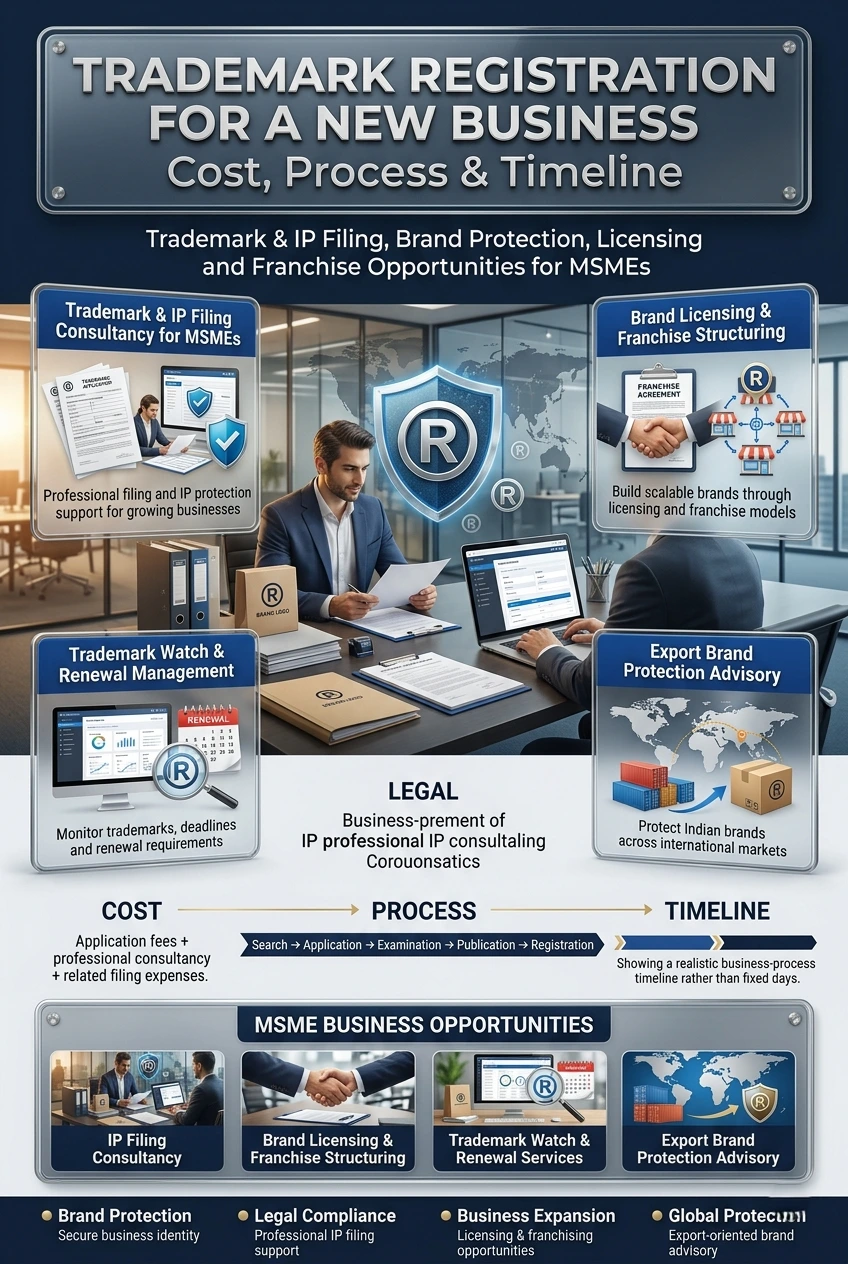
Multiple Business Ideas Built Around Strong Trademark Protection
The registration of a trademark is not solely a defensive action. It also creates real business opportunities as protection of brands has become a service category in India and a number of allied businesses have sprouted in its wake.
Trademark and IP Filing Consultancy for MSMEs
There are still thousands of small manufacturers and traders in India not even registered with a brand. This is a large and underserved market which is addressed by a consultancy that specialises in trademark search, TM-A filing and a class selection service. This work includes managing existing clients’ renewal calendars, drafting responses to examination objections, performing phonetic and visual similarity analysis, and advising clients of appropriate Nice Classification class. The business model is built on professional service quality and quantity, with the government statutory fee being fixed and transparent, and a consultancy firm that develops an effective system for tracking renewals and has a solid reputation will generate recurring revenue for at least 10 years after each client’s initial filing.
Brand Licensing and Franchise Structuring Services
For a business to license its trademark to franchisees or regional partners is commercially safe once the trademark is registered. The service of an advisory that can transform an established brand into a formal franchise agreement for regional food brands, coaching institutes or retail companies is a service that really helps. This concept falls in the middle ground of legal drafting and business strategies, and is an excellent concept for consultants who already are familiar with DPR preparation and unit economics, as franchise partners always request a viability assessment before committing.
Trademark Watch and Renewal Management Platforms
One of the most common and expensive errors committed by Indian brand owners is failing to renew before the scheduled renewal date. Otherwise, someone else can apply for it. A recurring pain point can be solved with a subscription-based monitoring service. It can track renewal deadlines for multiple SME clients, journal publications, opposition risks, and portfolio health. Once the tracking system is developed, the service becomes mostly software-based. As the client base grows, margins can gradually rise without a proportional increase in manpower.
Export Brand Protection Advisory
Eventually, manufacturers who wish to export under their own brand name require protection beyond India as well. This is usually in the form of Madrid Protocol protection, provided by WIPO. Advising Indian MSMEs on international filing sequencing, WIPO basic fees, and country-specific fees addresses a real planning issue. It also helps them prioritise target markets based on export volumes. Most domestic trademark agents limit their services to filing in India. This creates a comparatively untapped segment for a consultancy that can develop the skills needed to file trademarks internationally.
Import–Export Opportunity Analysis for Trademark-Backed Brands
India’s outward looking MSMEs increasingly consider trademark registration as an export pre-condition, rather than a post-condition. Indian suppliers are also frequently asked for proof of brand ownership by buyers in the European Union, the Gulf and Southeast Asia countries before entering into long-term contracts, as the importer is equally faced with legal uncertainty in such an instance. An extended Indian trademark (under the Madrid Protocol) is also of some collateral value as franchise and distribution contracts are more valuable for a protected brand than an unprotected one. When setting up an export-oriented manufacturing facility, budgeting for international trademark filing is now a standard procedure, and there are trademark and international trademark firms that offer the package of trademark filing and product certification/packaging compliance for a one-stop service that saves the client from additional rework and a lot of time.
This is also the backward flow that is important. Similar sounding local names have been a source of conflict as global brands venture into India, leading to Indian founders having to register their proposed name with both local and global registers and avoiding packaging, signage and marketing investments till they are certain it’s available. It is thus, that a pre-launch international trademark clearance check has become its own little yet precious advisory specialty.
Indian MSME Success Stories Built on Strong Trademarks
Early and proper trademark protection has been responsible for the growth of some of the best-known consumer brands in India.
Haldiram’s
The Agarwal family had to protect the ‘Haldiram’s’ name early on. They took legal action against local imitators selling under the same brand. This helped the company grow into one of India’s biggest snacks and namkeen makers. This legal protection enabled the brand to expand into other states and eventually enter export markets. It also helped prevent copycat brands from taking over its identity.
Related Article: FSSAI License Registration: Basic vs State vs Central — Which One Do You Need?
Patanjali Ayurved
A locked-down trademark portfolio across dozens of product categories was part of the strategy from the beginning. It remains one of the main reasons Patanjali grew into a full-scale FMCG house in just a decade. Acharya Balkrishna and Baba Ramdev built the company on this foundation. Early registration across multiple classes allowed the group to introduce new product lines under the same well-known brand. This approach also eliminated the need to renegotiate rights to the name for each new line.
Imagine Marketing (boAt)
The common theme in all three stories is that the founders who established the brand early invested in building distribution. They did not spend excessive time fighting imitators. New business owners reviewing new concepts should follow the same sequence. They should not treat brand registration as a formality after the business has grown.
How NPCS Supports New Businesses Beyond Trademark Registration
We at Niir Project Consultancy Services (NPCS) are experts in the preparation of Market Survey cum Detailed Techno-Economic Feasibility Reports (DPR’s), which are required by entrepreneurs when starting a new industry or business. Our reports contain manufacturing processes, market research, demand analysis, process flow diagram, product mix/capacity, machinery details, raw material details, and full financials of the project with profitability analysis. Businesses are protected by trademark rights, their financial base can be safeguarded by a good DPR and we want to make sure that an entrepreneur assesses the feasibility, profitability and long-term scalability of their business before investing in a brand or a product.
Start with clarity—choose the best business idea
Trademark Registration: Cost, Process and Timeline at a Glance
The table below summarises the statutory government charges across the trademark lifecycle, drawn from the First Schedule of the Trade Marks Rules, 2017.
| Applicant Category | Government Fee (Per Class, e-Filing) | Renewal Fee (Every 10 Years) |
| Individual / Sole Proprietor | ₹4,500 | ₹9,000 |
| DPIIT-Recognised Startup | ₹4,500 | ₹9,000 |
| Udyam-Registered MSME | ₹4,500 | ₹9,000 |
| Private Limited Company / LLP / Partnership | ₹9,000 | ₹9,000 |
| Opposition / Counter-Statement (any applicant) | ₹2,700 | Not applicable |
| Restoration After Removal | ₹9,000 + renewal fee | ₹18,000 total, typically |
On the process side, filing follows a fairly predictable sequence: a preliminary name search, filing Form TM-A online, formality checking, examination by the Registry, publication in the Trademark Journal, a four-month opposition window, and finally registration and certificate issuance if no opposition is filed. End-to-end timelines commonly range from eight to eighteen months. The timeline mainly depends on whether the examiner raises an objection or a third party files an opposition after publication.

Conclusion
When it comes to early business decisions, trademark registration is one of the most important. It can benefit a company for a decade or longer once renewed. Besides the existing tax regime, the government has also made provisions for recognition under DPIIT and MSME schemes. These provisions can make things easier for founders who plan ahead. If the objective is to protect a single product name or build an export-driven brand, getting a “trademark on day one” is better than waiting until the end. It can help businesses grow without facing years of disputes over a name they do not actually own.
References
Office of the Controller General of Patents, Designs and Trade Marks (CGPDTM) — ipindia.gov.in
Startup India, DPIIT, Ministry of Commerce and Industry — startupindia.gov.in
World Intellectual Property Organization, Madrid System — wipo.int/madrid
Trade Marks Rules, 2017, IndiaCode — indiacode.nic.in
Federation of Indian Chambers of Commerce and Industry (FICCI) — ficci.in