


₹2 Crore Manufacturing Business Ideas in India
The manufacturing sector is one of the most dynamic, and transforming, in India over the past few decades. Entrepreneurs seeking high-potential business ideas can view a ₹2 crore investment in plant and machinery as a strong middle ground—large enough to support a serious production operation, yet still affordable for determined first-generation promoters and MSME investors.
Furthermore, the government has been aggressively promoting the manufacturing sector, by providing production linked incentives, easier credit facility and investment in infrastructure, which has made the investment risk-benefit profile for manufacturing companies extremely favourable. So, when making the decision of where to invest ₹2 crore in plant and machinery, there has been no better time or policy environment.
In this article, we will be looking at the most actionable manufacturing business ideas in the investment range of ₹2 crore and evaluating them based on the demand, profit, and scalability in the market. It is based on actual feasibility information, intelligence from the MSME sector and field consulting experience with industrial projects in India.
Why Manufacturing Businesses at This Investment Scale Make Sense
Firstly, The plant and machinery category of ₹2 crore is an important category for the obvious reason. Furthermore, It enables the manufacture of finished products in commercially viable quantities without making a promoter heavily into debt during the early years. Moreover, Besides, at this level, entrepreneurs can avail institutional finance from SIDBI, nationalised banks and NBFCs, which range from 65-75% of the project cost.
Firstly, The domestic consumption market in India is still good. Increasing incomes, urbanization and a growing middle class are driving up demand for packaged foods, construction materials, specialty chemicals, personal care products, and industrial components. In addition, Indian exports, especially to areas where production costs are competitive, are still going strong in Southeast Asia, Africa and the Middle East.
The ministry of MSME claims that MSME industry accounts for close to 30% of the GDP of the country and exports more than 48% of the product. In this, all manufacturing MSMEs are in a better position to show profitability than trading businesses. So, a good ₹2 crore manufacturing project has intrinsic better long-term economics.
Find high-return business ideas based on your budget & ROI
Government Policies and Incentives Supporting New Manufacturing Units
The Indians have extensively developed a foundation, to support the MSME manufacturers. Before any entrepreneur puts money into these schemes, it is crucial for them to understand these schemes, as they can drastically lower the effective investment and operating expenses.
The Prime Minister’s Employment Generation Programme (PMEGP) provides subsidy to the manufacturing projects in rural areas up to 35% and in urban areas up to 25%. This is equivalent to a direct grant of ₹40–70 lakh for a ₹2 crore investment to boost the return on equity.
First generation entrepreneurs can avail of collateral free loan up to ₹2 crore under Credit Guarantee Fund Trust for Micro and Small Enterprises (CGTMSE) with ease, which would have been difficult to finance plants and machinery without collateral.
The Startup India initiative of DPIIT offers tax relief, ease of regulations and procurement by the government for recognised startups in manufacturing. In the meantime, state level industrial policies in Gujarat, Maharashtra, Tamil Nadu and Telangana provide an extra capital subsidy, exemption from stamp duty and power tariff concessions for new industrial units.
Also, the Make in India programme has identified 27 sectors for investment facilitation, that includes a number of sectors that are very relevant to ₹2 crore scale manufacturing projects.
Profitable Manufacturing Business Ideas with ₹2 Crore Plant & Machinery Investment
1. Packaged Spices and Masala Manufacturing Unit
Moreover, India has made its branded spices and blended masala business a high-margin FMCG business, instead of a commodity trade. Consumers have shifted their preference toward branded spice products that companies pack hygienically and standardize for quality, even in semi-urban and rural markets. A mid-size spice processing plant can be set up with an investment of ₹2 crore. As a result, It processes and cleans various spices and then dries, grinds, and blends them in the same facility. The important equipment are pulverisers, dryers, blending machines and automatic pouch filling lines. The value-added blended masalas have a relatively short working capital cycle and margins are in the range of 20-30%. Moreover, there are numerous regional brands that have successfully become a national brand beginning from just this investment.(₹2 Crore Manufacturing Business Ideas in India)
Get Detailed Project Report (DPR): Spices and condiments, Indian Kitchen Spices, Masala Powder

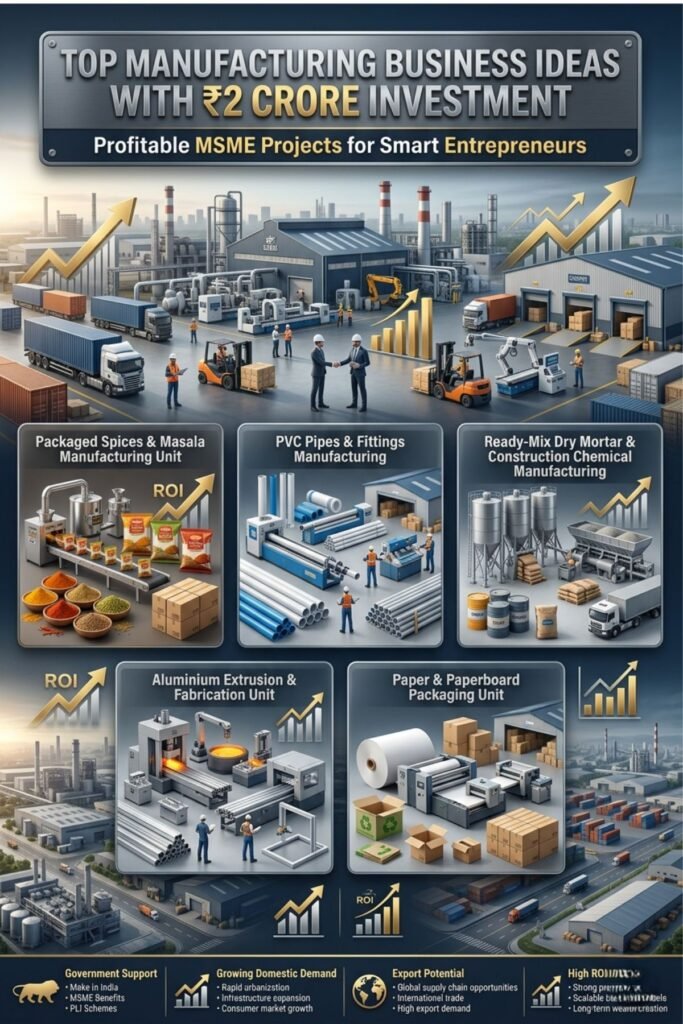
2. PVC Pipes and Fittings Manufacturing
Firstly, The infrastructure development in India (housing, irrigation works, sewerage and industrial pipe) has generated a continuous demand for PVC pipes and fittings. Moreover, Investment in the range of ₹ 2 crore may benefit the production capacity of 500–1,000 MT per year based on the product mix. Furthermore, The basic equipment includes extruders, moulds, and testing equipment. In addition, The demand of construction contractors, municipal corporations and agriculture buyers is continuous in this business. In addition, PVC raw material (the PVC resin) is readily available from domestic petrochemical producers. The margins are generally 12-18%, but the business is cash generating because of high turnover ratios. Those who are prepared to distribute their product in their region can break even in 24–36 months.
3. Ready-Mix Dry Mortar and Construction Chemical Manufacturing
Dry mix mortar—such as tile adhesives, wall putty, and plaster compounds—is one of the most rapidly growing categories in construction materials. India’s real estate and infrastructure growth has driven a shift in demand from site-mixed materials to factory-made, quality-controlled dry mixes. The capacity of the plant made with a cost of ₹2 crore is 10,000 to 15,000 MT of dry mortar products annually. It consists of a mixing stage of dry materials (cement, sand, polymers and additives) in a computer-controlled proportion and an automatic packaging stage. They are sold through construction material dealers, tiling contractors, and directly to the builders. Brands have typically 25-35% gross margin, while the product category has high repeat sales associated with construction cycles.
4. Aluminium Extrusion and Fabrication Unit
Aluminium extrusions are essential components in the manufacturing of windows, doors, curtain walls, solar panel frames, automotive parts and industrial machinery. Demand growth has been strong in the construction and energy industries in India. With an investment of only ₹2 crore in an extrusion press, along with the required die sets, ageing ovens, and cutting machines, we can produce a wide range of standard and customised profiles. Demand is solid from fabricators, OEMs and infrastructure projects for the business. As a material, aluminium is infinitely recyclable, which makes it more environmentally friendly, and one of the qualities purchasers are looking for. The value-added finishing (anodising, powder coating, precision cutting) is a factor that affects margins while the realisation per kg is substantially better than commodity metal trading.
Related Article: Aluminium Value-Added Manufacturing in India: A High-Growth Startup Opportunity
5. Paper and Paperboard Packaging Unit
Collectively, e-commerce, FMCG, pharmaceuticals and food processing have generated a thirst for corrugated boxes, mono-cartons and specialty paperboard packaging. A machine investing of Rs.2 crore can help regional businesses to run a corrugation and printing machine, which can produce customised packaging for them. The main machines involve corrugation plants, die cutting machines and offset or flexographic printers. This approach has advantages for businesses because it gets recurring orders from manufacturing customers who require a predictable and reliable packaging provider. Moreover, as the plastic packaging ban gains momentum, paper-based packaging is becoming more popular in various end-user industries. Any entrepreneur who has basic printing knowledge and selling skills can scale this into a lucrative regional business.
Get Detailed Insights from This Book: Modern Technology of Pulp, Paper and Paper Conversion Industries
Import–Export Opportunities for ₹2 Crore Manufacturing Businesses
One of the most important factors that first generation entrepreneurs miss while choosing a manufacturing project is their potential of exporting. In several cases, however, the export markets offer additional revenue streams for the business ideas mentioned in this case, resulting in better capacity utilization and project economics.
Indian exports of spices to the United States and Europe, as well as the Gulf countries, are regularly over ₹25,000 crore with demand for both raw and value-added spices.Likewise, developers and contractors are increasingly using construction chemicals and dry-mix products in markets across Africa and Southeast Asia, where rapid urbanisation is driving building activity. Agricultural and Processed Food Products Export Development Authority (APEDA) and Federation of Indian Export Organisations (FIEO) offer export facilitation, market intelligence and buyer match-making assistance to MSME manufacturers.
For packaging companies, the location is a significant driver of continuous OEM supply networks that can develop in a steady and predictable manner with the anchor firm’s business. Hence, the choice of site to export hubs is a wise strategic decision from the promoters of new manufacturing units.(₹2 Crore Manufacturing Business Ideas in India)
Indian MSME Success Stories: What the Leaders Did Differently
Everest Industries Limited – Construction Materials
Everest Industries became a much-admired company in Kolkata, established by the Bangur family and specializing in fibre cement boards, roofing products and prefabricated steel structures. The lesson from this story is that the company has steadily invested in products and technical marketing, focusing not only on price but also on architects and contractors. Everest began as a small manufacturing venture and expanded by targeting small markets with high replacement rates. So, the take away message for MSME entrepreneurs is to choose a product that has a recurring demand and to establish a connection with the specifier community, not end buyer.
Bikaji Foods International – Packaged Snacks and Namkeen
Bikaji started with a small-scale production of Bhujia in Bikaner, Rajasthan. Founder Shivratan Agarwal created and nurtured the brand by standardising recipes, investing in modern packaging machinery and unwaveringly moving methodologically into new geographies and retail outlets. The growth story of the company clearly shows that a good investment in a food processing unit, ensuring consistent product quality and establishing a good market reputation, can develop from being an MSME business in a particular region to a company listed in the NSE Nifty 50. Investing in the plant and machinery in the early days was an advantage. Manufacturers should be aware that the greatest enduring competitive advantage in the food industry is the ability to produce quality that is consistent.
Astral Poly Technik – PVC Pipes
Sandeep Engineer identified an early opportunity with a product that was completely unpopular in the market then – CPVC plumbing pipes – which was a product that was 100% imported. He has invested in modern extrusion technology, established a culture of quality manufacturing and developed a distribution network across India aggressively. Astral’s transition from a business with a ₹2 crore turnover to a market cap company of multi-thousands crore has one of the most fascinating journeys of any MSME to a large company in the Indian manufacturing sector. The advice for newbies: invest in good equipment, pay attention to the performance of the products, and develop distribution networks before production.
How NPCS Helps Entrepreneurs Evaluate Manufacturing Projects
Niir Project Consultancy Services (NPCS) will prepare detailed Market Survey cum Techno-Economic Feasibility Reports (DPRs) for the entrepreneurs who are intending to establish new manufacturing business projects. Our reports encompass the entire scope of project assessment, including information on the manufacturing process, capacity planning, machinery requirements, raw material needs, market research, market demand analysis and detailed financial analysis of projects with profitability projections.
The questions which the entrepreneurs must answer before investing any amount in plant and machinery are: Is the product market expanding? Will the business model create positive cash flow over a specified period of time? What else is in this target geography? Our feasibility reports will take the guesswork out of these questions by providing the data, not the assumption, and put the promoter in a position to make informed investment choices and present banks and investors with project documentation.
Investment and Return Estimates: ₹2 Crore Manufacturing Projects
| Business Idea | P&M Investment | Projected Revenue/Year | Gross Margin (%) | Approx. Breakeven |
| Packaged Spices & Masala | ₹1.8–2.0 Cr | ₹6–9 Cr | 22–30% | 24–30 months |
| PVC Pipes & Fittings | ₹1.8–2.0 Cr | ₹5–8 Cr | 12–18% | 30–36 months |
| Dry Mix Mortar / Wall Putty | ₹1.5–2.0 Cr | ₹4–7 Cr | 25–35% | 24–32 months |
| Aluminium Extrusions | ₹1.8–2.0 Cr | ₹5–9 Cr | 15–22% | 28–36 months |
| Paper Packaging (Corrugated) | ₹1.5–2.0 Cr | ₹4–6 Cr | 18–25% | 24–30 months |
Note: Estimates are indicative and vary by location, product mix, and market conditions. A detailed feasibility report is recommended before finalising any project.

Frequently Asked Questions (FAQ)
Q1. Are 2 crores in plant and machinery sufficient for a serious manufacturing unit?
Yes, 2 crore is enough machinery investment for a profitable manufacturing unit for a large number of businesses – spanning across food processing, building materials, packaging and chemical industry sectors. With such level of machinery investment, capacities are achievable, which can ensure revenues of 4-9 crore in most sectors on a year-on-year basis. The trick is to choose the correct product category and provision working capital separately.
Q2. What government schemes can I leverage for 2 crore manufacturing projects?
Central government schemes such as PMEGP can be used for subsidies ranging from 25-35% of project costs. CGTMSE provides collateral-free loans up to 2 crore. Under the MSME Technology Upgradation Scheme (CLCSS), capital subsidy on machinery is available. States also offer incentives depending on the location of the project. A bank loan is significantly likely to get approved after preparing a robust DPR of your proposed project, or if one avails the services of a project consultant.
Q3. When can I expect my business to reach the break-even point?
For well-chosen business projects in this investment bracket, a break-even can be achieved within 24-36 months. Business with higher gross margins (e.g., spice processing, wall putty’s/construction chemicals) reach break-even faster than projects with relatively lower margins (e.g., PVC pipe and aluminium extruded products, where sales are generally high and compensating for low margins). The exact timeframe would be covered in the DPR.
Q4. Should I be looking at both the domestic market and exports from the onset?
It is always recommended that first generation entrepreneurs should concentrate on developing the domestic distribution system from the very start. Exports are more complicated from the perspective of required documentation (such as certifications) and handling foreign exchange as well as logistics. Certain product categories like spices, food ingredients, packaging industry are already a part of global demand; however, their markets can be exploited from the start if a good planning is done.
Q5. What is the role of a Detailed Project Report (DPR)?
A DPR is more than just a prerequisite for getting bank loans; it is a scientific document, which serves as the roadmap for the entrepreneur to analyse and understand the feasibility, technical viability and economic prospects of the proposed project prior to investing in it. Banks and investors need a DPR, and intelligent entrepreneurs know how to use it to study business idea feasibility.
Q6. Which sectors are likely to have the highest margins at 2 crore investment?
Spice processing, wall putty’s, dry mix mortars, specialty packaging and food ingredients provide highest gross margins in this range – usually between 20% to 35%. Businesses such as PVC pipes and aluminium products offer lower margins but can reach higher sales volumes faster. The correct sector choice is ultimately based upon raw material availability, established supplier base and local market demand.
Conclusion: Choosing Your Manufacturing Business with Clarity
Many entrepreneurs are not aware of the opportunity in the investment bracket of ₹2 crores in Plant & Machinery. The industrial momentum, government support ecosystem and India’s market demand has come to a perfect alignment and now is an ideal time to start a manufacturing unit in the right category.
But the key to success is not a bit of enthusiasm, it’s informed selection. The quality of the planning that occurs prior to the purchase of the first machine is the difference between a successful project and one that fails to achieve strong returns. So invest in a sound feasibility study, learn about your market, and develop conservative cost estimates before putting your money at risk.(₹2 Crore Manufacturing Business Ideas in India)
Business ideas that I have discussed in this article are the ideas which are proven, they are scalable, they have market demand and government also supports them. The road from planning to execution is straightforward for any entrepreneur looking to take the plunge: thoroughly test the opportunity, efficiently organize your finances, and invest in the production of quality that will ensure long-term expansion.