


Research suggests that demand is still increasing and the market still allows for growth. As a result of these factors, you seem well poised to capture a market niche.
In this guide, we have prepared 5 ideas for you to consider, focused on industrial product development. Each of these ideas is described in terms of the product, industry, and competition as well as the investments required.
Read Our Book: Click Here
1) Aluminium Shots And Notched Bars
Aluminum Shots consist of small rounded pellets; Notched Bars are grooved cast bars easily broken by weight into measured pieces and can be fit into any other segment of processes.
What industries do with them (main uses):
- Deoxidation during steel making: Aluminium is added to molten steel by steelmakers to bind oxygen and ward off defect formation.
- Shot blasting and peening: Nonferrous material or lower-impact surface cleaning and strengthening are done when plants require surface cleaning and strengthening.
- Alloy additions: Very controlled portions of alloy aluminium are added by foundries during the alloying or casting step.
Market Outlook
Analysts prognosticate that the market for aluminium cut-wire shot which absorbs aluminium shots would amount to a healthy ~USD 1.8 B by 2033 at ~5% CAGR. Growth reflects the robust steel output projections for construction and automotive machinery.
Moreover, with lightweight metals being used increasingly in cars and aircrafts, there is a growing demand for surface treatments and refinements.
How to make it:
First, melt scrap or primary ingots and then:
Shots: Atomization or drip casting of globules.
Notched bars: Cast bars and then notch for easy dosing.
You will require a furnace, casting/shot-making equipment, and cutting/notching tools for this. Moreover, you must uphold very tight purity and size specifications to ensure attrition against results.
Why is it good? You moderately invest in addition to saving scrap instead of procuring with using these sold to mills, foundries, and processors in steel. Hence you create a good, sticky B2B relationship and have steady demand of good quality.
2) Biofertilizers and Biopesticides (Powder Form)

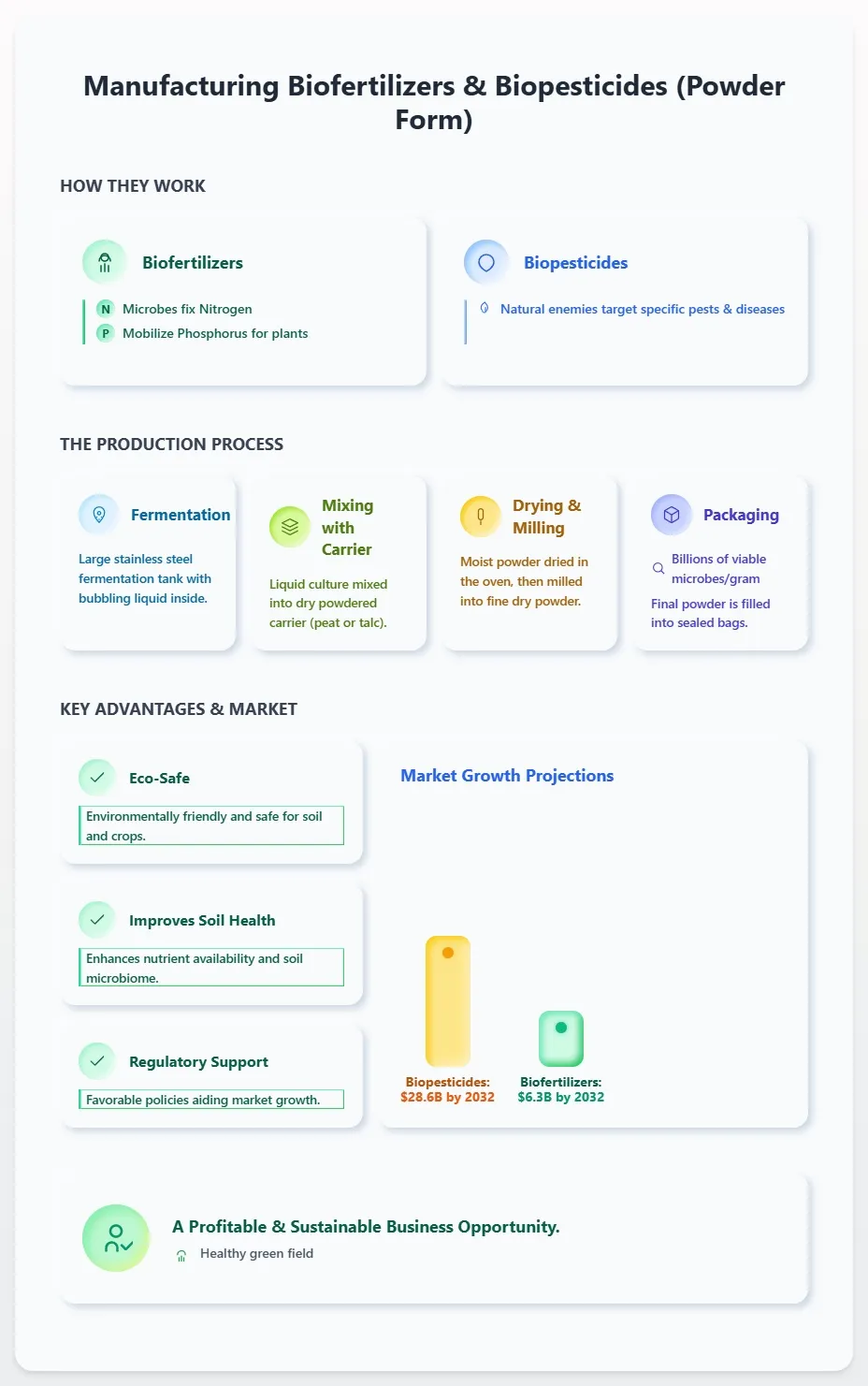
How biofertilizers work:
living microorganisms Rhizobium, Azotobacter, Azospirillum, PSB and Mycorrhizae are used to fix nitrogen, mobilization of phosphorus and increasing root absorption. Manufacturers mix these cultures with peat or talc as carriers and crushed them into powder for application in osiva, soil or root.
How biopesticides work:
attack pests and disease through biological substances: BT bacteria, sponge Trichoderma and their botany from Neem. It is free to maximize pest specificity and minimize the toxicity of the environment by focusing on disputes or active plant compounds.
Advantages for farmers:
- Ecological and safe: Inputs biodegrad and leave low residues.
- Soil health: Over time, products gradually create fertility and structure.
- Regulatory support: Many regions subsidize or gives rapid monitoring of biological inputs.
- Resistance management: New ways of effect slow development of resistance.
The market outlook:
- Biopesticides: ~ 28.6B USD by 2032, growing 10-15%.
- Biofertilizers: ~ 6.3B USD by 2032, usually grow to> 10-12%.
Acceptance in Asia, Europe and North America is increasingly growing because farmers are looking for products without remnants, soil durability and strict adherence to regulations.
How to produce:
You ferment to the tension of the trunks and mix them with the carriers to dry, mill and packaging. If it is from BT or similar products, add a few steps to process (drying/grip).
In addition, you have to maintain sterility and ensure that they have viable counts per gram. Farmers’ training on their manipulation and use must be carried out and an effective distribution network established to ensure durability and ensure that acceptance is increased.
Why is it attractive: using strong sustainability trends, earn a political tail and distinguish your offer from the solution specific to crops or region. In this way, you build your brand on scientific knowledge with the growth route that remains a responsible value.
Read More: Bamboo-Based Activated Carbon Manufacturing Business
3) Zeolite from Coal Fly Ash
Huge volumes of dawn fly ash and silica and alimin -generated coal plants can be used instead by converting it into an economically valuable zeolite. The disposal will therefore decrease and the waste turns into wealth.
What do zeolites allow (main applications):
- Catalysts: refining and chemical plants use zeolites to burst heavy oils and perform selective reactions.
- Adsorbents: Plants clean air/water, capture VOC and perform gas separation (eg medical oxygen concentrators).
- Ion exchange: Zeolite of the cleaning degree degrees and softens water and replaces phosphates.
- Agriculture and the environment: soils retain nutrients and water; Systems remove ammonium, heavy metals or even radioactive ions.
How to make from fly ash:
The method is an alkaline hydrothermal treatment (eg NaOH), with temperature/time/concentrations plus crystal vaccination as needed. Zeolite and more likely to achieve your goals; In general, more advanced types are more complex.
Meanwhile, you are processing variable ash chemistry through preliminary treatment or mixing.
The market outlook:
The Global Zeolite market (natural+synthesized) shows a slow but stable Cagr 3% to 5% and is estimated that in 2023 there are about $ 4.3 billion, specifically for special views.
In wider definitions such as other end use material, estimates increase around $ 8-11 billion+ to ~ 2030. Increase in demand in different areas, from wastewater treatment and detergents without phosphates to R&D capture CO2 and green catalysis.
In India, coal power plants themselves generate more than 200 million tonnes of fly ash per year, which maintains a lot and mostly very cheap.
Read More: Top 10 High-Growth Manufacturing Businesses for Startups in 2025
Why is it attractive: you are in line with your circular economy objectives by finding yourself as close as possible to the power plant, which reduces raw material and logistics.
You focus on markets that extend from detergents to remediation, so expanding from local cases of use (eg, waste water) to catalysts with the highest specification, as your QA matures.
4) Biomass Briquettes from Biological Waste
Compacted fuel blocks made from agricultural residues and wood waste such as rice peels, bagasse, sawdust, hazelnuts, coconut peels, corn stems, cotton stems, bark, coffee skin and shell shells.
The briquettes burn at higher temperatures, cleaner and longer due to their high density and low moisture content.
Where users burn them:
- Industrial boilers and furnaces
- Participation and small power plants
- Home heating/cooking and hospitality
- Coal alternative (after carbonization)
Why are they important: basically briquettes release as much CO₂ as they were absorbed by the plant during growth; Therefore, net carbon emissions of users against coal. Meanwhile, you turn the waste to the combustion fields to valuable fuel, improving the air quality and creating revenue in rural areas.
The market outlook:
The market was measured at ~ 0.9 B in 2023 and probably at ~ 1.8 B to 2033 (~ 7-8% Cagr). Political incentives, rural energy needs, burning regulations and better presses maintain adoption of high-cost throughout Asia, with increasing interests in Europe, Africa and Latin America.
How to produce:
You go about the piston/RAM press (solid cylinders) or screw extruder (often with a central opening). You can also prepare the raw material by drying (<15% humidity) and decrease in size.
Lignin is generally bound naturally under heat and pressure, and therefore chemical binders are usually not used; However, you have to take good care of seasonality, storage and transport, because biomass is bulky.
Attractive business model: Start small, get cheap waste, supply local industry, creates jobs and sells a clean story. Building a durable and impact business with repeated orders, provided that the humidity is low, the strength is high and consistent caloric value.
Read Our Project Report: Click Here
5) Chemical Purification of N-Propanol
What it is: You buy crude or mixed propanol streams—by-products from oxo/hydroformylation routes, hydrogenation of propionaldehyde, or fermentation—and you refine to >99% n-propanol.
Where customers use it:
- Coatings & inks: Printers and painters value quick-evaporating solvency for cellulose esters, vinyl resins, and oils.
- Intermediates: Producers make n-propyl acetate, glycol ethers, and other esters.
- Cosmetics & pharma: Formulators use it as a solvent; regulators permit it as a food flavor in the U.S.
- Cleaning & disinfection: Some markets prefer n-propanol for efficacy against certain bacteria.
- Lab & fuel blends: Users tap it for niche blends and standards.
Market outlook: The n-propanol niche totals ~USD 1.6–1.7B in 2024 and likely ~USD 2.3–2.4B by 2032 (~4–5% CAGR). Growth tracks coatings, packaging inks, pharma/personal care, and diversified sanitization demand, with Asia-Pacific leading.
How to purify:
You design a multi-column fractional distillation train, remove water via molecular sieves or azeotrope strategies, and polish streams to meet USP/pharmacopeia specs. You add tanks, nitrogen blanketing, fire/explosion protection, emission controls, and an in-house QC lab (GC, Karl Fischer, etc.).
Because large players don’t always focus on regional by-product streams, you can source feed cheaply and sell high-purity grades at a premium—especially if you add bio-based (fermentation) narratives.
Why it’s attractive: You apply proven unit operations, capture value from purification, and target supply gaps. Therefore, you can build a reliable, regionally focused solvent hub—with safety, QA, and partnerships as your moat.
Read More: 15 Best MSME Manufacturing Business Under ₹70 Lakhs (2025 Edition)
How Niir Project Consultancy Services (NPCS) Can Help You
You want to have the knowledge beforehand of your investment.
Thus, NPCS compiles Market help with Detailed Techno Economic feasibility reports on various topics, among which include the manufacturing process, raw materials, the layout of the plant, the list of machinery, capitalization & regulatory requirements, operating costs, and comprehensive financial models, among others.
Find the Best Idea for Yourself With our Startup Selector Tool
Conclusion
You have the opportunity to create one of the best manufacturing businesses in 2025 if you pick the right niche and do proper execution. The market and the policy both have to support the Biofertilizers and biopesticides the market. The zeolites from flyash open a circular value at scale.
Local wastes can be converted into a reliable source of energy using biomass briquettes. Aluminium shots and notched bars have a constant demand in B2B due to the quality of steel used. The purification skill premium price is highly covetable n-propanol.
Thus you must align opportunity, expertise, feedstock available to you, location, the market, the regulatory environment, and available support from customers then scale n quality, safety and customer support.

FAQS
Q1: Which opportunity gives the biggest market?
A: The biopesticides market leads at $28.6B by 2032. This is, however, subject to your competition, the local market, and your investment know-how.
Q2: What raw materials can be used for briquettes?
A: Dry agri or woody residues such as rice husk, bagasse, sawdust, shells, and husks and stalks and husks can be used to create briquettes moisture must be kept below 15%.
Q3: Do I need approvals for bio inputs?
A: Yes. Registration and product safety and efficacy must be met, labeled, recorded, and safe, along with meeting microbial counts and expiry rules.
Q4: How capital heavy is n-propanol purification?
A: Expect mid to high for safety, and utilities for distillation trains, and other facilities, along with a QC lab.
Q5: How do I start my feasibility study fast?
A: Validate the NPCS report on processes, relevant market data, projected finances and airplanes. Purchase the report to save time needed for local market validation.