

The food ingredient segment within the global economy is multifaceted and one of the most profitable worldwide. This includes food colors and flavors, gums and stabilizers, hydrocolloids, and other modifiers that enhance the taste, appearance, texture, and longevity of food products.
The demand of packaged foods and convenience foods has translated to a sharp increase in the demand for high-grade ingredients. India’s food processing market has the potential to cross USD 535 billion by the year 2030. This expecation sets a fantastic ground for the entrepreneurs.
Startups are more than welcome to take advantage of the innovative, clean-label, export-based, and other such sustainable solutions in the evergrowing market for ever-lasting profitable solutions.
Natural Food Colours (Curcumin, Annatto, Carotenoids)
Natural food colors are as colors from plants, fruits and spices, such as turmeric (curcumin), the seeds of annatto, and the carotenoids.These colors are necessary in bakery and confectionery products and even in dairy and some beverages.
With the increase of demand for ‘natural foods’ and the removal of additives from foods, the demand for plant-based colors continues to increase. There is a lucrative market for entrepreneurs in the domestic and export sector. This is especially true for regions that are clean-label and sustainable focused.
Dyes Allowed in Food Products
Permitted synthetic food dyes continue to be an integral part of the food industry owing to its low cost and stability as well as eye-catching vivid hues of synthetic dyes in food and beverages.
As technology advances, the dyes are increasingly being used in the confectionery, snacks, soft drinks, and processed food industries. Despite the competition increasing for natural colour substitutes, synthetic food dyes continue to be the industry standard for most mass-marketed items.
There is considerable market demand, and thus, reliable profits to be made for new companies that focus on high-quality, safe synthetic food dyes to be supplied in bulk to food manufacturers.
Colours Extracted from Fruits and Vegetables
Fruit and vegetable colour extracts provide a more sustainable and potentially healthier option for food colourings. They are necessary to enhance colour in clean-label food segments, particularly in dairy products, confectionery goods, baked items, and beverages. Sources for these colours include beetroot, spinach, red cabbage, and various berries.
The method of extraction employs low quantities of chemicals and is, therefore, considered eco-friendly and suitable for sale to the increasingly health-conscious market. Business ventures that focus on these colour extracts would benefit from the increasing demand by focusing on local suppliers as well as eco-friendly methods to enhance profitability.
Flavours Based on Essential Oils
Flavours based on essential oils come from natural sources like mint, clove, citrus, and vanilla. These flavours enhance taste and smell as well as consumer’s desire for natural components.
These flavours have application in drink, bakery, and confectionery items, thus, having immense market potential. Production of these flavours needs skilled professionals in extraction, blending, and quality control processes. Startups can also focus on developing organic and sustainable oil-based flavours to cater to a broader audience.
Nature Identical Flavours
Though nature-identical flavours have the same taste and smell as natural extracts, they are synthesized and are thus, produced at a considerably lower price.These flavours are necessary on baked products, confectionery, dairy, and drink items.
This sector is quite fast growing within the industry, as there is a higher emphasis on affordability, consistency, and scalability. This is a field that can be entered with a focus on innovation and quality assurance.
Production of Synthetic Flavors
Synthetic flavors ensure uniformity of taste and smell throughout a variety of processed foods. It is more stable than and is more affordable than its natural variants, and is a must-have for mass food production.
There is demand for it for use in artificial flavors in the bakery, snacks, and refreshment industries, making artificial flavor manufacturing a lucrative business. New market entrants can invest in creating safe, reliable, and tailor-made artificial flavor solutions for diverse applications.
Starch-Based Hydrocolloids
These are necessary in the food industry to thicken or stabilize and improve the texture of the food products. These include soups, sauces, dairy desserts, and even confectionery.
It enhances the mouthfeel and the stability of the said products, thus, a necessity for processed food. There is a market for updated starches as food technology advances and meets the demand for starches with better functional characteristics.
Processing of Guar Gum
Guar gum is necessary in bakery products, dairy products, beverages, and gluten-free foods due to its ability to thicken and stabilize.It is a natural hydrocolloid gum obtained from the seeds of guar beans.
India is the largest producer and exporter of guar gum in the world, providing possible sources for startups in the industry. These startups have an advantage from the combination of domestic as well as export demand found in Europe and North America.
Xanthan Gum Production
Xanthan gum is the polysaccharide created by the process of fermentation. While being a polysaccharide, Xanthan gum is also necessary as a stabilizer and thickener in sauces, dressings, beverages, and gluten-free products. The ability of Xanthan gum to provide a maintained constant viscosity is vital in the food processing industry. Thus, entrepreneurs can consider its cost-effective production and export to areas containing functional food and concentrate on convenient foods.
Carrageenan Extraction
Carrageenan is a thickening and gelling agent in meat and dairy products. It is extracted from red seaweed. Carrageenan aids in texture, mouthfeel, and improving the stability of products.
Due to the rising demand for plant-based products, carrageenan has now become a global necessity. Entrepreneurs can develop seaweed farming which can provide a steady supply of carrageenan, and use sustainable methods of seaweed extraction for the quality.
Read More: List of Profitable Value Added Products from Fruits & Vegetables.
Pectin Manufacturing
Pectin is extracted from the peels of citrus and the pomace of apple. It is necessary as a gelling agent in beverages, jellies, and jams. The global demand for pectin is rising as it gaining attention as a natural stabilizer. This leads to pectin’s increasing demand.
It is quite simple to set up a pectin manufacturing plant as it does not require much. It requires an abundant supply of fruit waste, and effective extraction methods. This leads to pectin manufacturing being an environmentally sustainable and highly profitable business.
Production of Gelatin
As a protein based stabilizer, gelatin has found its applications in confectionery, dairy desserts, and dairy based products. With the ever expanding range of gelatin products, and the comparatively stronger demand for gelatin in the international market, the production of gelatin has proven it’s worth to be a sustainable and profitable business opportunity.
Entrepreneurs can further pursue the opportunity of fish based gelatin for the vegetarian and religious market.
Production of Agar-Agar from Seaweeds
Agar-Agar works well in its applications as a natural gelling agent, and as a vegetarian substitute for gelatin. It’s usage is known in the bakery and confectionery, microbiology, and dairy industries.
Given the rise in demand for plant based foods around the globe, the demand for agar-agar is consistent in both domestic and export markets. Establishing a unit for the production of agar from seaweeds has a promising advantage in the coastal regions.
Processing of Gum Arabic
Gum arabic, which is harvested from the acacia tree, is necessary as an emulsifier in the production of soft drinks, pharmaceuticals, and candies. Gum arabic is of great value due to its natural attributes and high solvability in diverse industries.
Entrepreneurs can set up units for the processing of gum arabic to maximize international market opportunities by focusing on purity, certification, and international trade processing.
Soy Protein Isolates as Stabilizers
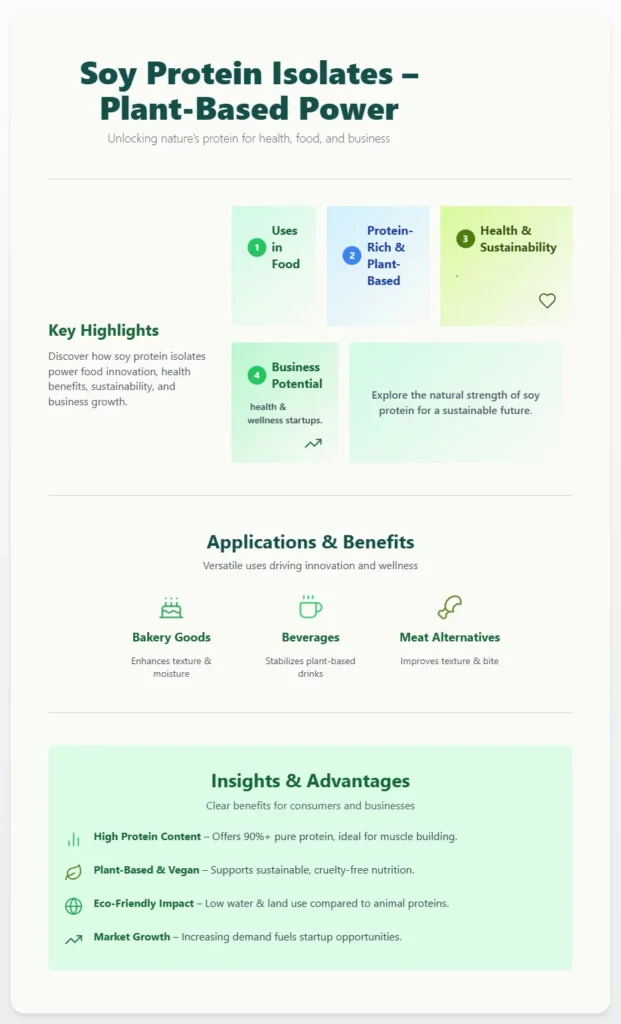
In bakery goods, beverages, and meat alternatives, soy protein isolates serve as stabilizers and texturizers. They fall seamlessly into the growing plant-based food trend as they are rich in proteins. Given the benefits of profitability and sustainability, manufacturing soy protein isolates is strategic for new entrants in the health and wellness industry.
Read More: Cloud Kitchens: The Secret to Running a Successful Food Business with Low Investment
Maltodextrin Production
In processed foods, processed soups, and sports drinks, Maltodextrin is a carbohydrate that serves as an energy source, filler, and thickener. Its simplistic production is one of the many reasons why it is highly sought after by new startups. For example, entrepreneurs can extract Maltodextrin from corn or potato starch and cater to the growing packaged food industry.
Lecithin (Soy & Sunflower)
In the bakery, dairy, and chocolate industries, Lecithin is necessary as an emulsifier. It can be extracted from soy or sunflower. It enhances the product quality by improving texture, preventing separation and maintaining emulsified ingredients. Strategic startups can target the growing global market by focusing on the production of non-GMO and organic lecithin as a natural food additive to cater to rising demand.
Fermentation Citric Acid Production
Citric acid is produced by fermentation of sugars or molasses. It is necessary as a food, preservative, acidity and flavour enhancers. Increasing demand in pharmaceuticals and other sectors makes fermentation of citric acid a worthy economic pursuit with sustained profitability.
Fermentation Lactic Acid Production
Lactic acid is produced by fermentation of agricultural products and is necessary on bioplastics and as preservative and acidulant in dairy products, pickles and other processed foods. The growing demand in biodegradable products makes this a promising venture for entrepreneurs with modern fermentation and agricultural resources.
Read Our Book: Click Here
Additives Based on Enzyme Addition
Enzymes of biological origin are necessary for additives used in foods to enhance texture, flavour and ease of processing. These are necessary for baking, brewing and in other sectors of dairy. The growing demand in minimally processed foods provides a market for bioprocessed enzyme additives and fosters innovation.
Additives – Preservative Sodium Benzoate, and Sorbates Sorbates
Sodium benzoate and sorbates are necessary as food preservatives that extend storage periods and prevent spoilage. These are necessary in the baking, confectionery and beverage sectors. With growing demand in the packaged foods sector, entrepreneurs are keen on preservative additive production complying with stringent global food safety standards.
Antioxidants (Tocopherols, Ascorbates)
Antioxidants keep products fresh and prevent oxidation. Naturally occurring antioxidants such as Tocopherols (Vitamin E) and Ascorbates (Vitamin C) are in great demand in clean-label and health-oriented foods. The production of these antioxidants enables entrepreneurs to address both the nutraceutical and food markets.
Sweeteners (Stevia, Aspartame, Sucralose)
Low-calorie sweeteners such as Stevia, Aspartame and Sucralose are widely utilized in beverages, confectioneries, as well as in health products. With the growing trend of eliminating sugar from the consumer’s diet, the demand for sugar alternatives is rapidly growing. Start-ups can concentrate on natural sweeteners such as Stevia, to fit with the global trend of healthier diets.
Emulsifiers for Bakery and Dairy
The use of emulsifiers improves texture, increases shelf-life, and maintains stability in baked and dairy products. Common emulsifiers are mono and diglycerides and lecithin. The growing consumption of bakery and dairy products ensures sustained demand for high quality emulsifiers.
Export-Oriented Food Additives Units
Establishing entrepreneur driven export focused units helps in servicing overseas markets which depend on India for raw material and its value addition. There is high global demand and thus the potential for high return on investment for export oriented additives like Guar gum, natural colours, carrageenan and others.
Read Our Project Report: Click Here
How NPCs Assists You
NIIR Project Consultancy Services helps clients strategize, commence, and effectively manage profitable ventures in food ingredients.
NPCS meticulously compiles Draft Market Survey Reports, which outlines the technocommercial feasibility of a unit and details the manufacturing processes, procurement of raw materials, process flow charts, machine requirements, market analysis and exhaustive financial projections.
With the help of NPCS’s consultancy services, startups are in a better position to determine project worth, eliminating risks and developing a successful and scalable operation, both in the domestic and export market.
Find the Best Idea for Yourself With our Startup Selector Tool
Conclusion
For entrepreneurs willing to delve into the fauna of the food ingredient and the vast technology of colours, flavours, gums, hydrocolloids, and various food additives, the prospects of carving a niche are enormous.
With the demand rising globally for food ingredients that are clean, safe, and are natural and sustainable, new ventures can be set up to cater to a thriving market both regionally and internationally.
Frequently Asked Questions
What are food additives?
The ingredients in food to enhance taste, color, texture and improve shelf life are food additives. They help to enhance and maintain the quality of a product.
Why the fast growth?
The growth of the food ingredients industry is by increasing urbanization, modernization and the growing need for convenience and packaged food.
What food ingredient projects are suitable for starters?
Initiatives such as the production of guar gum, natural colours and citric acid are better for beginners.
Can we export products from India?
Yes. India exports food ingredients such as guar gum, lecithin, pectin and Stevia to USA, Europe and Asia-Pacific.
What services does NPCS render to new entrepreneurs?
NPCS assists new businesses in setting up profitable businesses. We are providing reports on the project’s feasibility, technical assistance, financial evaluations, and market analyses.