


The industry of tobacco and pan masala in India is at a peculiar juncture. On the other hand, it is one of the oldest agri-processing industries in the country, it is culturally embedded and plays an important role on rural livelihoods. On the other, it faces constant pressure from health officials, tax officials and international trade organizations. If you are a businessman, manufacturer or investor thinking about venturing into this intricate field, then hiring the best tobacco, pan masala industry consultants in India is not just helpful, but crucial. Navigating the regulatory labyrinth, product formulation complexities and compliance requirements of Tobacco Technology are amongst the most challenging industries to navigate without professional assistance.
India produces the second highest amount of tobacco in the world and is one of the major exporters. The Tobacco Board of India says that tobacco farming offers jobs to 45.7 million people, directly and indirectly. There is a vast processed-products segment extending the value chain, including pan masala, gutkha, khaini, zarda, supari, cigarettes, bidis, mouth fresheners and smokeless tobacco variants. Different product categories have different manufacturing parameters, quality standards, and regulatory requirements. As a result, the need for specialist industrial consultants to deal with all aspects of this, ranging from plant layout through to Detailed Project Reports (DPRs) has increased significantly.
In this article, you will learn what tobacco and pan masala plant consultants do, why India is such a hotspot for such advisory services, how to find the best tobacco, pan masala industry consultants in India and how a well-established firm like NPCS (Niir Project Consultancy Services) fits in.
What Tobacco and Pan Masala Industry Consultants Actually Do
A common misconception is that industrial consultants in this field only put pen to paper. In effect, the top tobacco, pan masala industry consultants in India are project architects and work end-to-end. Their experience starts well before the first brick is laid and extends through production ramp up.
The initial step in performing a research project for a consultant is to produce a techno-economic feasibility study, which is a detailed document that examines market demand, reviews the availability of raw materials, assesses production economics and decides on whether the proposed investment is financially viable. For the tobacco and pan masala industry, this study needs to consider the regulatory restrictions imposed by certain states, where the industry faces complete bans, the Goods and Services Tax (GST) under the new taxation regime, and the Central Board of Indirect Taxes and Customs (CBIC) requirement to declare machine capacity through Form GST SRM-I.
The project usually moves from feasibility to a Detailed Project Report (DPR). A DPR for a pan masala or tobacco processing unit will include details of the manufacturing process flows, the specifications of the machinery and the capacity planning, raw material requirements areca nut, slaked lime, catechu, tobacco leaf, flavouring compounds etc., plant layout, effluent treatment provisions, complete project financials including capital cost, working capital, break-even analysis, and projected profitability etc. Whether a project loan is being considered for by banks, NBFCs, or the MSME development agencies, they will always need a DPR.
Read the Complete Book Here: Manufacture of Pan Masala, Tobacco and Tobacco Products
In addition to documentation, process plant consultants and EPC consultants in this area deliver hands-on plant engineering services, including process engineering, detailed design, equipment procurement support and at times, full turnkey (engineer-procure-construct) project delivery services. At larger tobacco processing or cigarette manufacturing processes, EPC consultant co-ordinates civil, mechanical and electrical activities from inception till commissioning. Indian boutique management consulting firms might also provide post-commissioning advisory including capacity optimisation, setup of quality system and preparation for statutory audit.
Why India Is a Hub for Tobacco and Pan Masala Consulting
The Indian market has seen the emergence of dedicated tobacco and pan masala consultancies due to a number of structural reasons. Variety of products is the first and foremost. Bidis, chewing tobacco and cigarettes make up about 38%, 48% and 14% of the tobacco produced in India, respectively, which is a different pattern from other tobacco-producing countries in which cigarettes are the staple product. This division requires very specialized consultancy services, such as khaini processing, zarda manufacturing, gutkha blending and supari roasting, in their respective niche sub-categories.
Second, the MSME nature of industry continues to ensure that demand is maintained in the field of consulting. 93% of the tobacco farmers in India are small farmers and many of the manufacturing companies of pan masala and chewing tobacco are MSMEs. The technical and regulatory skills and knowledge are lacking in these enterprises. They seek service from process engineering consultants and boutique management consulting firms in India to manage everything from factory applications to compliance documents. The sector is now under increased regulatory pressures, such as registration under the Goods and Services Tax (GST) regime and the new Health and National Security Cess on pan masala, in line with the revised excise regime, and MSMEs require the right advice now more than ever.
Thirdly, India is creating new career opportunities in the area of Consultancy. The country exported tobacco and tobacco products worth over Rs. It is one of the world’s top exporters with 12,000 crores in the last fiscal year. Implementing a phytosanitary system, importing-country product regulations and quality certifications by international standards are the extra compliance layers that are necessary in export-oriented units. Alongside project experts at home, export specialists with consulting experience are also sought after.
View Full Project Details: Tobacco & Pan Masala Manufacturing Projects
Last but not least, the rising share of non-tobacco pan masala which are herb-flavored and tobacco-free, sold as mouth fresheners, is attracting a new set of investors who require full greenfield project support. This segment is expanding in a quicker manner than the traditional tobacco inclusive categories, partly due to lesser state level restrictions on non-tobacco pan masala.
How to Evaluate the Best Tobacco, Pan Masala Industry Consultants in India
It is important to have a proper evaluation procedure when it comes to shortlisting the best tobacco masala industry consultants in India. The regulations in this sector are highly complex, and it’s almost certain that a generic manufacturing consultant won’t catch the key compliance requirements. This is what successful business owners are searching for.
1. Domain Expertise in Tobacco Technology
The special engineering and processing technology that applies to this industry is called tobacco technology. It addresses leaf curing, blending, cut tobacco production, pouching and smokeless tobacco processing. The best tobacco plant consultants in India will have a working knowledge of this discipline and not a generic knowledge of food processing parameters. Request samples of feasibility studies or DPRs that are provided by potential consultants for various product categories such as gutkha, khaini, zarda, filtered cigarettes, pan masala.
2. DPR and Feasibility Track Record
A good DPR is a key part of a project being bankable. Sample DPR frameworks or client case studies (anonymised if required) will be readily available from top tobacco, pan masala industry consultants in Delhi and elsewhere. The key indicators of a sound DPR are that it provides granular capacity calculations (in metric tonnes per day), qualified vendors to provide accurate machine quotes, realistic working capital estimates and a sensitivity analysis stress testing the project across raw material and selling price scenarios.

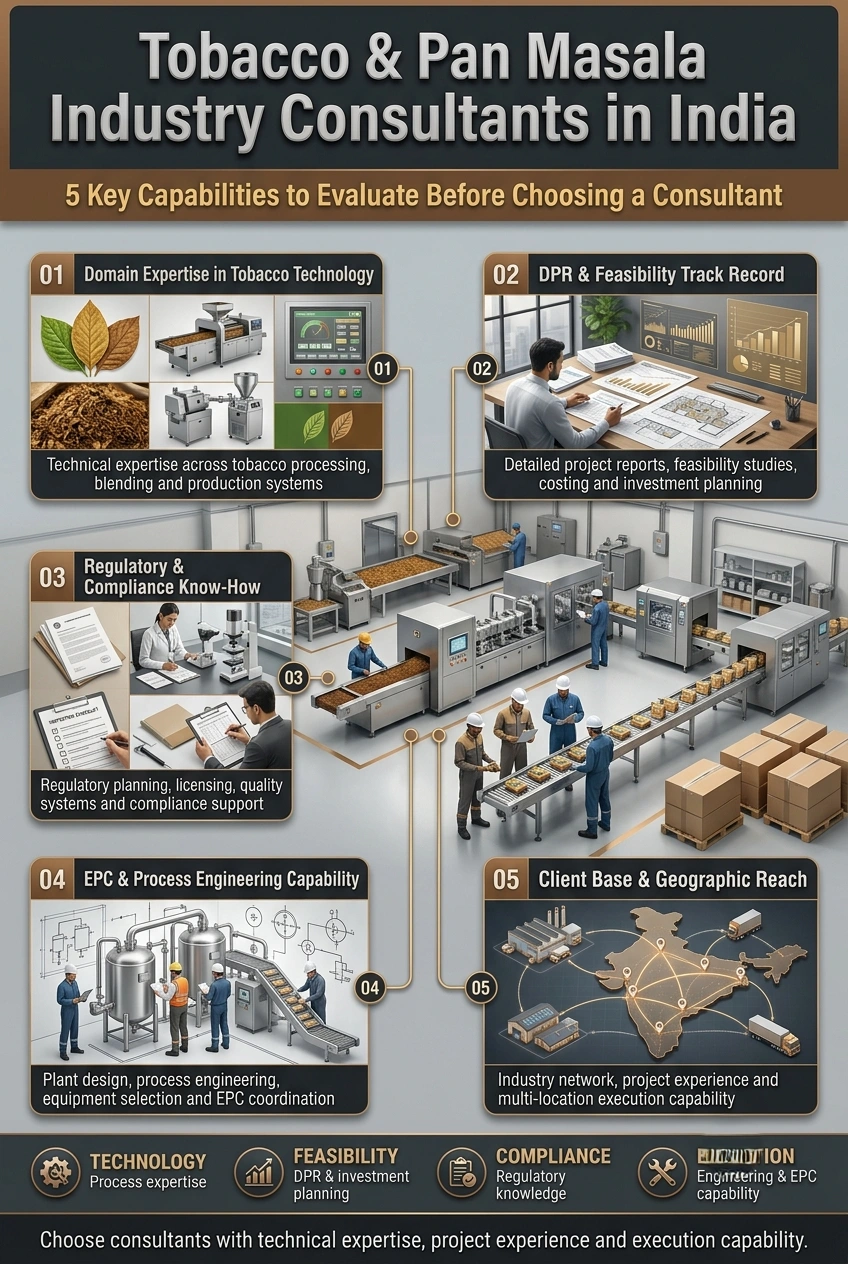
3. Regulatory and Compliance Know-How
The Tobacco Board of India, under the Tobacco Board Act, 1975, Ministry of Commerce and Industry (tobaccoboard.commerce.gov.in), is the main statutory body in charge of the tobacco regulation, especially for the growers, traders and exporters of Flue-Cured Virginia (FCV) tobacco. Central Board of Indirect Taxes and Customs (CBIC) has implemented machine-registration for processed products. The factory effluents are controlled by State Pollution Control Boards. The Factories Act regulates the safety of workers. Food Safety and Standards Act (FSSA) provisions also apply at state level when there is a concurrence with the food standards. A good consultant should be able to cross all these layers and flag any state-specific regulations (such as ban on gutkha in certain states) which can impact the basis of the business model.
4. EPC and Process Engineering Capability
By adding real engineering depth, the real value of EPC consultants and process plant consultants for investors who aren’t satisfied with just a paper is added. They can convert a DPR’s machinery schedule to a real plant layout, outline levels of automation, coordinate deals with vendors and oversee installation. Such a feature is particularly useful in bigger tobacco processing or cigarette manufacturing projects, where the investment is in the crores.
5. Client Base and Geographic Reach
In the tobacco and pan masala industry, Andhra Pradesh and Karnataka are the exclusive states of FCV tobacco cultivation; Uttar Pradesh and Rajasthan are for pan masala manufacturing; and Gujarat is for export-oriented processing. It’s important to know that it’s a consultant with proven experience in these geographies and the local regulatory regime that would be better able to provide practical, contextual advice than one who has only metropolitan exposure.
Role of NPCS in Tobacco and Pan Masala Project Consultancy
Niir Project Consultancy Services (NPCS) www.niir.org is one of the leading industrial consultancies in India with a huge experience in tobacco and pan masala industry. NPCS was established in 1994, and is based in Delhi with offices nationwide and internationally, and has been developing project reports, feasibility studies, and techno-economic analyses for manufacturing entrepreneurs in India and abroad for more than 30 years. It is one of the most referenced project consultancy names in Indian industrial planning with delivery of over 1,50,000 projects and serving clients in 85 countries.
The report of the NPCS projects provides comprehensive coverage of the entire range of products in the tobacco and pan masala sector – pan masala, gutkha, khaini, zarda, supari, mouth freshener, kimam, cigarettes, zafrani patti and different formulations of smokeless and chewing tobacco. Each report is usually accompanied by detailed information about the manufacturing process, specifications and details of the machinery and equipment, raw material sourcing and costs, market research and demand analysis, process flow diagrams, capacity planning, and detailed information about the project’s financial aspects such as the capital cost estimates, profitability projections and break-even analysis.
Entrepreneurs interested in having multiple product ideas in this sector can access the Tobacco, Pan Masala and Chewing Tobacco project profiles catalog which provides a consolidated view of pre-feasibility profiles of the major product categories of the sector. This is especially helpful at the ideation phase where an investor is still determining which product or capacity to move forward with prior to a detailed DPR.
Related Article: The Definitive Handbook on Manufacturing Pan Masala and Tobacco Products
The unique aspect of NPCS in this area is that of breadth and depth of documents. The firm operates as an information-rich consultancy, supporting its reports with primary information from industry sources, market surveys, and equipment vendors. NPCS’s project profiles are an efficient way for first-generation entrepreneurs and NRI investors to identify projects and to check its initial feasibility in the tobacco and pan masala industry. The DPRs prepared by NPCS are familiar to the MSME bankers and project appraisal teams which is an added advantage while applying for the loan.
NPCS is noteworthy because it is a form of industrial consultancy, namely the project advisory and DPR preparation model. For investors looking for the entire package of EPC engineering or custom hands-on plant commissioning services, they may require additional services from a specialist process plant consultancy or engineering service. In general, a well-structured tobacco processing unit consulting engagement will feature a project advisory firm for feasibility studies and DPR and feature a process engineering or EPC consultant for plant design and implementation.
The Tobacco and Pan Masala Consulting Landscape: Delhi and Beyond
As entrepreneurs look for the best tobacco, pan masala industry consultants in Delhi, they tend to be interested in both policy proximity and sectoral depth. Moreover, The immediate location of the administrative interfaces of the Tobacco Board, the Central Government regulatory bodies and the major banking institutes make the consultants ecosystem in Delhi advantageous. In addition, There are a number of renowned industrial consultancy firms as well as boutique management consultancy firms in India with their main offices in NCR with a nationwide clientele.
However, Outside Delhi, the consulting network for this industry has the clusters in Hyderabad and Guntur (Andhra Pradesh’s FCV tobacco base), Mumbai (large export and cigarette companies), Indore and Jaipur (pan masala manufacturing hubs) and Ahmedabad (export-oriented processing). The geography of the India consultancy industry within this sector is, therefore, dispersed, mirroring the geographic distribution of the industry.
Small and medium investors have an added benefit of having easy access to Delhi based consultancies. Many provide remote consultation services and deliver project reports at the convenience of the pan masala entrepreneur, irrespective of whether they are based in Uttar Pradesh or Rajasthan or any other location in India, without having to relocate or travel a long distance. Over the past few years, the market of DPR delivery and project consultation in India has become much more accessible to those who are first generation entrepreneurs.
Discover scalable startups tailored to your goals
Consulting Service Types: Focus, Deliverables, and Best-Fit Clients
| Service Type | Core Focus | Key Deliverables | Best-Fit Client |
| Pre-Feasibility Study | Product selection, market demand, investment sizing | Market overview, capacity recommendation, rough cost estimate | Early-stage entrepreneur, NRI investor exploring options |
| Detailed Project Report (DPR) | Full techno-economic project assessment | Manufacturing process, machinery list, financial model, profitability analysis | MSME investor, bank loan applicant, first-generation entrepreneur |
| Process Engineering Consultancy | Plant design, process flow, equipment specification | Process flow diagrams, PFDs/P&IDs, equipment layout | Mid-size manufacturer scaling capacity or setting up a new plant |
| EPC (Engineer-Procure-Construct) | End-to-end project delivery | Detailed engineering, procurement, construction, and commissioning | Large tobacco or cigarette company, bulk-investor projects |
| Regulatory & Compliance Advisory | Licensing, GST machine registration, state-level compliance | Compliance roadmap, liaison documentation, CBIC filing support | Existing manufacturer facing regulatory requirements |
| Market Research Report | Demand-supply dynamics, competitor mapping, pricing | Sector size, growth forecast, brand benchmarking | Investor evaluating market entry, existing firm planning diversification |
| Export Advisory & Certification Support | International market compliance, phytosanitary standards | Export documentation, buyer-market regulatory mapping | FCV tobacco exporter, processed tobacco product exporter |
Key Reference Resources for Tobacco and Pan Masala Industry in India
Entrepreneurs and investors evaluating this sector should draw on credible, authoritative sources for market intelligence, regulatory guidance, and industry benchmarks. The following resources are particularly useful:
Tobacco Board of India (tobaccoboard.commerce.gov.in) — The primary statutory regulator for tobacco under the Ministry of Commerce and Industry. The Board oversees production regulation, grower registration, export promotion, and trade licensing for FCV tobacco.
Tobacco Institute of India (tiionline.org) — The representative body for cigarette segment manufacturers, farmers, and exporters. A useful source for industry data, taxation analysis, and policy advocacy positions.
India Brand Equity Foundation (IBEF) — Tobacco Industry Page — IBEF provides sector overviews, export data, government scheme information, and investment potential analysis for the Indian tobacco industry.
Invest India (investindia.gov.in) — The Government of India’s official investment facilitation agency. Useful for understanding PLI schemes, ease-of-doing-business reforms, and industry-specific incentives relevant to tobacco processing.
Ministry of Commerce and Industry (commerce.gov.in) — The nodal ministry for tobacco sector policy, export promotion, and Tobacco Board oversight. Key source for policy updates.
Central Board of Indirect Taxes and Customs (cbic.gov.in) — CBIC is the authority governing machine-registration requirements for tobacco and pan masala manufacturers under GST SRM-I and SRM-II, as well as the revised excise and Health and National Security Cess structure for pan masala.
Ministry of MSME (msme.gov.in) — Essential for entrepreneurs seeking MSME registration, credit-linked capital subsidy schemes, and government-backed loan facilitation relevant to small tobacco and pan masala manufacturing units.

Conclusion: Practical Next Steps for Entrepreneurs
The tobacco and pan masala sector in India rewards investors who do their groundwork thoroughly. However, The regulatory environment is genuinely complex, the product landscape is highly diverse, and the compliance burden — from the Tobacco Board to CBIC’s machine-registration requirements — leaves little room for error. Therefore, The right industrial consultant is not a cost; it is a form of project risk insurance.
For entrepreneurs taking their first steps, the practical approach is to begin with a pre-feasibility assessment — either through a published project profile from a consultancy like NPCS or through an initial scoping conversation with a specialist advisor. This helps narrow down product selection, realistic capacity, and the regulatory framework applicable to your chosen state and product type. From there, a customised DPR provides the detailed technical and financial roadmap the project needs.
Meanwhile, Investors already beyond the ideation stage should prioritise consultants with demonstrable DPR track records in this specific sector, strong regulatory knowledge, and a working understanding of the updated GST and excise framework. Additionally, For projects of significant scale, additionally engaging an EPC consultant ensures that the DPR’s blueprint translates into a functioning plant within budget and timeline.
Furthermore, staying connected with official sources — particularly the Tobacco Board of India, the Tobacco Institute of India, the Ministry of Commerce and Industry, and the CBIC — ensures that your project planning reflects the most current regulatory and market reality. Ultimately, India’s tobacco and pan masala industry is evolving rapidly, and the best tobacco, pan masala industry consultants in India will always keep you ahead of that curve.